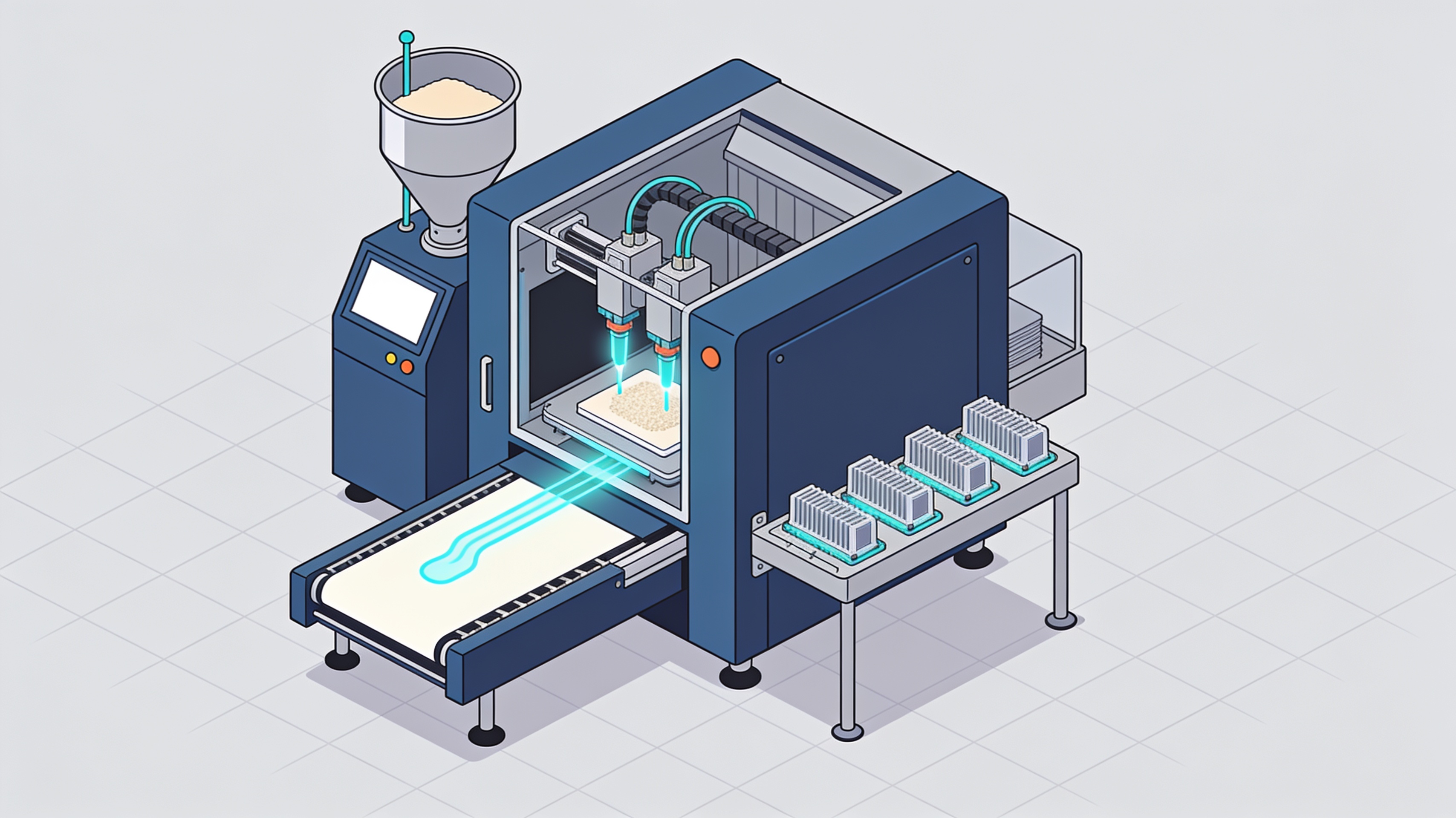
EOS launches HELIOR: the polymer system validated by five industrial customers
The German company presents at Formnext 2024 a new powder-bed 3D printer designed to maximize ROI in real production environments. Five partners tested the machine before the official launch.
EOS has unveiled HELIOR, its new industrial polymer 3D printing system, following the same collaborative approach that made the M4 ONYX metal system a commercial success. The machine was validated by five pilot customers before its official launch at Formnext.
Among the partners that took part in the validation phase are established names in the sector: FKM, Prototal Group, FORMRISE and Materialise. All contributed to optimizing the system for high-intensity production environments.
Designed for continuous production cycles
HELIOR stems from a precise need: to enable service providers to operate in 24-hour cycles with minimal downtime between jobs.
“Our focus has always been: what can a customer print in 24 hours?” explains Rüdiger Herfrid, head of EOS’s polymer portfolio. “Contract manufacturers and service providers want to produce parts in 12- or 24-hour cycles to maximize uptime.”.
The machine was designed to handle six consecutive jobs with extremely short changeover times. The goal is to eliminate time losses related to cleaning operations between one print and the next.
- Build volume: 700 x 380 x 580 mm (compatible with P 770)
- Three 70W lasers for high production speeds
- Optimized job changeover times for continuous cycles
- Compatibility with PA 2200 and PA 2220 HighReuse
Ten years of experience in a new platform
Despite the new name, HELIOR incorporates a decade of know-how accumulated by EOS in powder-bed systems.
“Even though this is a new machine with a new name, it is built on the platform we have had for ten years,” says Herfrid. “Ten years of experience is inside. Some innovations are already part of previous platforms.”.
During the development phase, the system was improved thanks to feedback from pilot customers. EOS integrated advanced software features while maintaining the reliability that characterizes its industrial systems.
Build volume aligned with the P 770
The build volume of HELIOR (700 x 380 x 580 mm) matches that of the P 770, which has the largest envelope among previous EOS polymer systems. This choice facilitates process standardization for those already using the P 770 platform.
The machine is equipped with three 70W lasers, a configuration designed to increase production speed without compromising part quality.
HELIOR is compatible with PA 2200 and PA 2220 HighReuse, polyamides established in industrial production environments for functional applications and advanced prototypes.
EOS’s collaborative approach
The development method based on user feedback has already proven successful with the M4 ONYX metal system.
In 2023, EOS launched M4 ONYX after a development process that actively involved the user base. Months after launch, Beehive Industries announced a $50 million investment in M4 ONYX units.
With HELIOR, the German company has taken this approach to a higher level, having the system validated by five pilot customers before the official presentation. This made it possible to verify performance under real operating conditions and refine features based on concrete market needs.
Focus on industrial ROI
The input from pilot partners focused on the requirements needed to maximize return on investment in real production environments. Priority was given to machine uptime and reducing non-productive times.
“We designed HELIOR so that customers have very short changeover times from one job to another, so as not to lose time on cleaning between prints,” concludes Herfrid.
The machine will be exhibited at Formnext, where EOS will be able to gather further feedback from the market and potential customers interested in large-scale additive manufacturing solutions.
article written with the help of artificial intelligence systems
Q&A
Which customers validated the EOS HELIOR printer before launch?
Five pilot customers participated in the validation phase, including FKM, Prototal Group, FORMRISE and Materialise. All contributed to optimizing the system for high-intensity production environments.
What is the build volume of the EOS HELIOR?
The build volume is 700 x 380 x 580 mm, the same as the P 770 system. This choice facilitates process standardization for those already using the P 770 platform.
How many lasers does the HELIOR have and at what power?
The machine is equipped with three 70W lasers. This configuration is designed to increase production speed without compromising part quality.
Which polymer materials are compatible with the EOS HELIOR?
The HELIOR is compatible with PA 2200 and PA 2220 HighReuse. These materials are designed to support continuous production cycles.
Why is the HELIOR designed for continuous production cycles?
The machine was designed to handle six consecutive jobs with very short changeover times, eliminating downtime related to cleaning operations. The goal is to enable service providers to operate in 12 or 24-hour cycles while maximizing uptime.