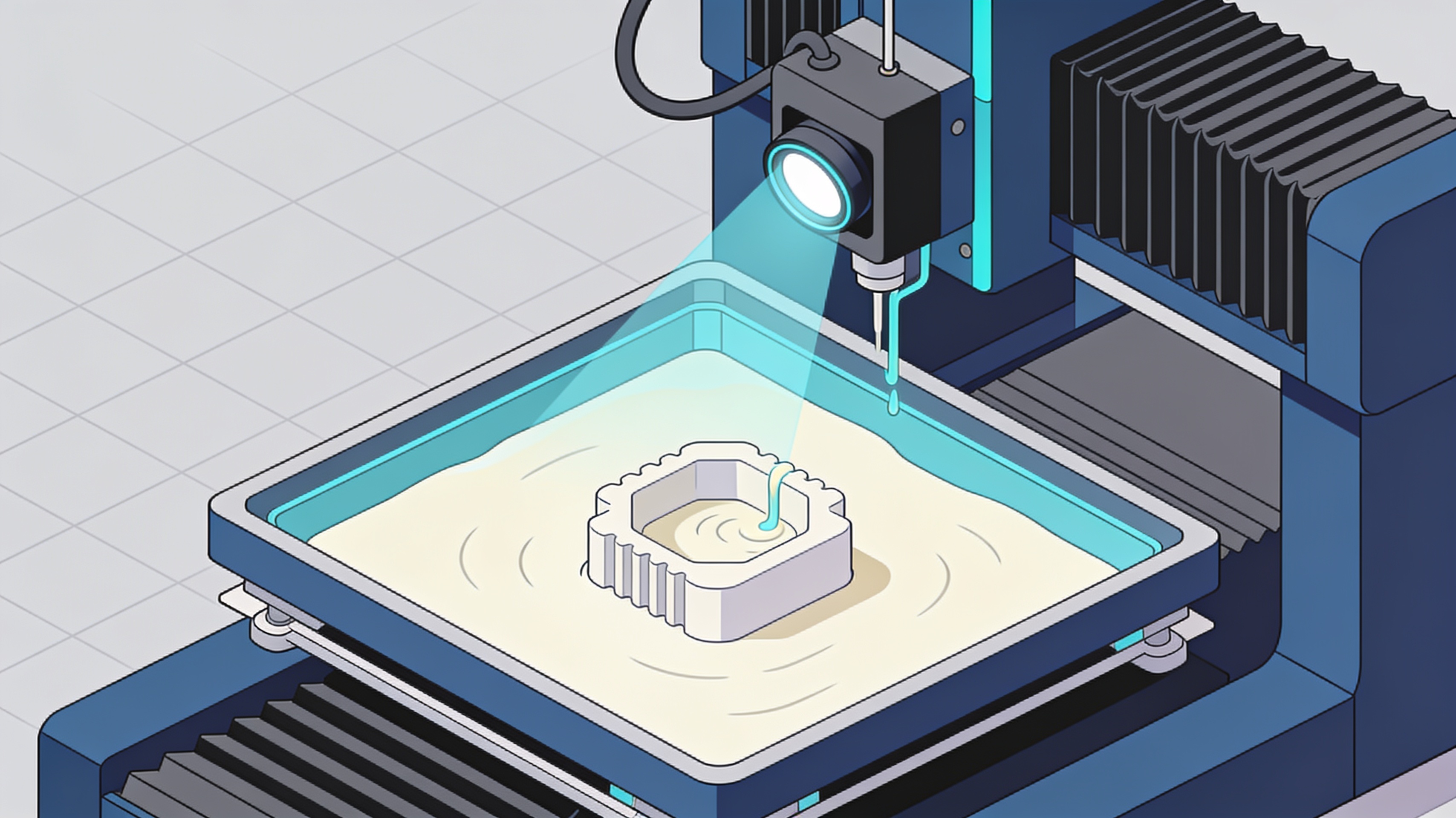
3DCeram launches the CLP50: DLP printer for ceramics at 80,000 euros
French manufacturer 3DCeram presented the CLP50 at Formnext 2026, a new 3D printer for technical ceramics based on top-down DLP technology. With a starting price of 80,000 euros, the machine targets companies that want to enter the ceramic photopolymerization market without immediately taking on high industrial investments.
The CLP50 uses ceramic pastes composed of ceramic powder and photosensitive resin, polymerized via a projector rather than a laser. The top-down configuration builds components from top to bottom, reducing or eliminating support structures.
- Starting price: 80,000 euros
- Technology: top-down DLP with projector
- Target: companies making their first investment in ceramic 3D printing
- Materials: photosensitive ceramic pastes, compatible with alumina
A strategic positioning in the 3DCeram portfolio
3DCeram expands its offering by bridging the gap between research and large-scale industrial production.
For years, 3DCeram has marketed SLA machines equipped with UV lasers, with build platforms from 100 × 100 × 150 mm up to 600 × 600 × 300 mm. In 2017 it introduced the M.A.T (Multi Additive Technology) solution, based on material extrusion and used mainly in laboratories and research centers.
The CLP50 fills a specific gap. Many companies want to integrate ceramic 3D printing to attract new customers, but hesitate when faced with investments of 200,000 euros without contracts already secured.
«It’s a bit the chicken-and-egg story,’ explains Maxence Bourjol, Sales Manager at 3DCeram. »These companies tell us they need ceramic additive manufacturing to convince their customers, but that without those customers they cannot invest 200,000 euros in a machine.«.
| Technology | Main target | Price range |
|---|---|---|
| M.A.T (extrusion) | Research and development | Entry-level |
| CLP50 (DLP) | First industrial applications | From €80,000 |
| SLA (UV laser) | Industrial production | From €200,000 |
Photopolymerization: advantages for complex applications
DLP technology offers specific characteristics that extrusion cannot guarantee in certain applications.
Extrusion meets numerous research and development needs. However, photopolymerization offers specific advantages in terms of geometric definition, surface quality, precision and density.
These parameters are particularly sought after in complex industrial applications. Target customers are looking for a technology based on photosensitive ceramic paste, exactly what the CLP50 provides.
The top-down configuration builds components from top to bottom on the build platform. This approach significantly reduces the necessary support structures or eliminates them completely.
Materials: ceramic pastes and compatibility
3DCeram also announces new material ranges, including an organic base for custom formulations.
The CLP50 works with ceramic pastes composed of ceramic powder and photosensitive resin. The system is compatible with alumina and other technical ceramic materials.
3DCeram has announced CERA-BASE, a ready-to-use organic base for formulating custom ceramic materials. The CERA-XXX ceramic paste ranges will also be marketed for printers from other manufacturers.
This open materials strategy broadens application possibilities. Companies will be able to develop specific formulations for their production needs.
Outlook: from entry to scalability
The CLP50 represents a first step toward larger production volumes, preparing companies for future industrial investments.
Although the machine may be of interest to laboratories and research centers, the main audience remains companies approaching industrial ceramic 3D printing for the first time.
The difficult economic context in many countries makes this gradual approach particularly relevant. The CLP50 allows companies to gain experience and customers before scaling to more expensive systems.
The full presentation of the integration will take place at Formnext 2026 in Frankfurt. 3DCeram thus aims to democratize access to ceramic photopolymerization while maintaining the technical DNA that characterizes its high-end SLA machines.
article written with the help of artificial intelligence systems
Q&A
What is the starting price of the 3DCeram CLP50?
The CLP50 has a starting price of 80,000 euros. It sits between entry-level M.A.T machines and UV laser SLA printers that start at 200,000 euros.
What 3D printing technology does the CLP50 use?
The CLP50 is based on top-down DLP technology with a projector. It uses ceramic pastes composed of ceramic powder and photosensitive resin, polymerized via projector instead of laser.
Why does the top-down configuration reduce support structures?
The top-down configuration builds components from top to bottom. This approach reduces or eliminates the need for support structures compared to other configurations.
What target audience is the CLP50 aimed at?
The CLP50 targets companies that want to enter the ceramic photopolymerization market without immediately facing high industrial investments. In particular, it aims at those hesitating over 200,000-euro machines without already secured contracts.
What advantages does photopolymerization offer compared to extrusion?
Photopolymerization offers advantages in terms of geometric definition, surface quality, precision, and density. These parameters are particularly sought after in complex industrial applications.