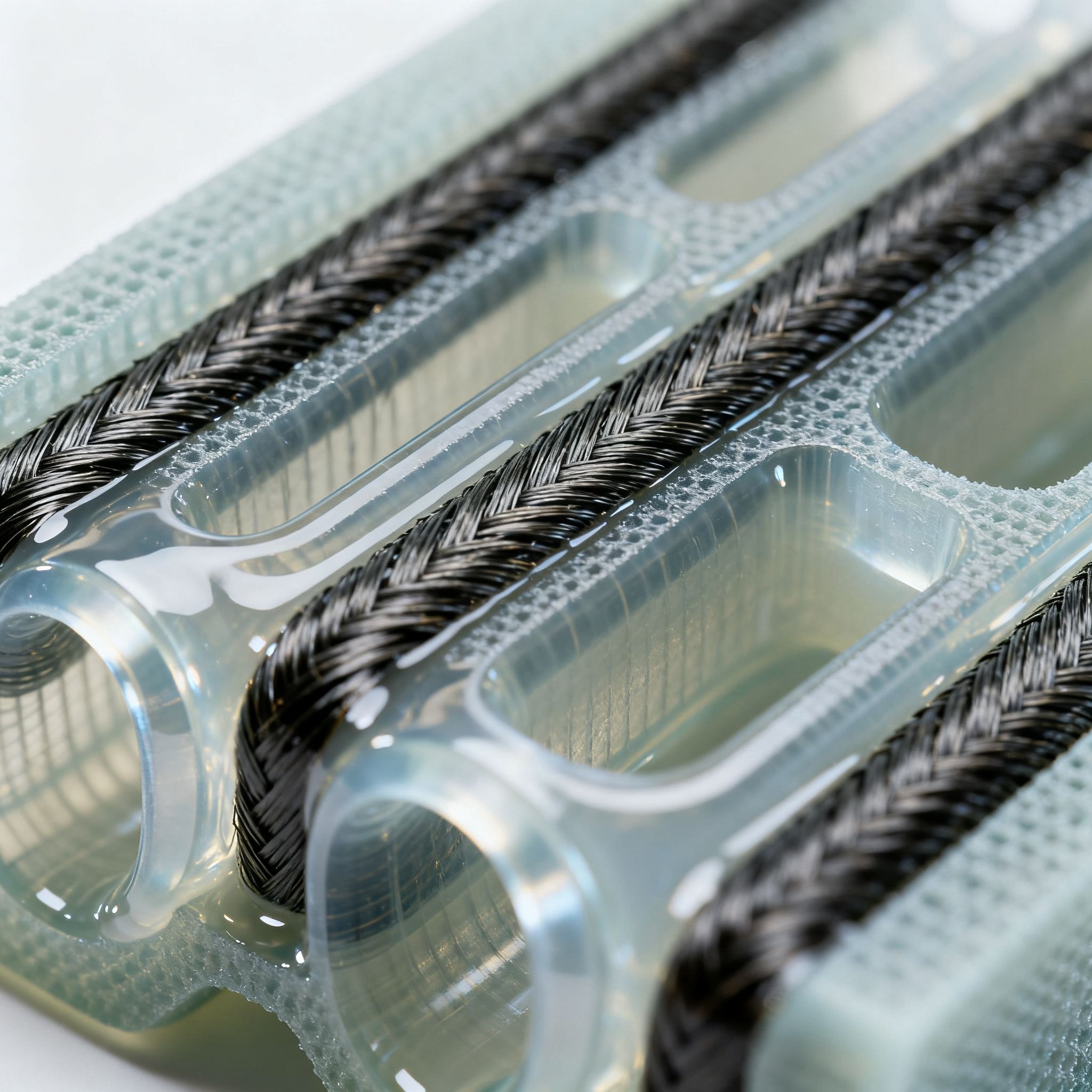
Continuous fibers: the architecture that challenges steel?
3D printing with continuous fibers is not just chemistry: it is geometry. The orientation and arrangement of fibers determine more than half of the final mechanical properties, transforming polymer components into structures that compete with steel and aluminum.
Geometry is strength
The orientation of fibers determines more than half of the final mechanical properties: the internal topology controls stress distribution and impact absorption.
Architected structures with continuous fibers allow controlling how the material responds to loads through geometry, not just through chemical composition. Research on additive acoustic metamaterials has shown that the internal architecture can manipulate wave propagation and stress distribution in ways impossible with conventional manufacturing.
This approach shifts the focus from material chemistry to structural configuration. Continuous fibers aligned with loads have a much greater impact on stiffness, fatigue resistance, and load-bearing capacity compared to randomly dispersed short fibers.
- L’architettura interna determina come tensioni e vibrazioni si propagano nel componente
- Continuous fibers aligned with loads offer superior performance to short fibers
- Structural topology can be designed to deflect loads like sound waves
Intelligent deposition, not random
Continuous flow printing techniques allow precise control of fiber-by-fiber orientation, deciding where to place the reinforcement and how to organize it.
The CFIP (Continuous Fiber Injection Process) injects continuous fibers and resin into tubular cavities designed in the part. The fiber is positioned, consolidated, cut, and integrated into the material consistently along trajectories aligned with the expected loads.
Dual extruder printing systems first deposit the base composite material, then add continuous fibers through a second nozzle. These fibers replace traditional filler, creating reinforcement paths exactly where needed.
Specialized slicing software automatically generates internal carbon fiber structures. It is not just about external geometry: the system reasons about the mechanical function the component will have to perform.
CFIP reinforcement process
- Design: The component is designed with internal channels for fiber injection.
- Injection: Continuous fiber and resin are injected simultaneously into the designed cavities.
- Curing: The fiber-matrix system is consolidated at room temperature or in an oven.
Metamateriali: l’onda strutturale si piega
The internal geometry can be designed to deflect loads and vibrations as if they were sound waves, opening new avenues for advanced structural applications.
The’approach of acoustic metamaterials illustrates how the’printed architecture can manipulate the mechanical response. The internal topology not only serves to support static loads: it can influence how impacts and vibrations propagate through the material.
Such structures allow controlling behavior under complex and dynamic loading conditions. Geometry becomes a tool for designing customized mechanical responses based on expected stresses.
This changes the design paradigm. Instead of choosing a material and adapting the shape, the internal topology is designed to obtain the desired structural response.
A continuous carbon fiber offers a great advantage along the load direction, but much less in unreinforced directions. For this reason, the’orientation must be designed according to the actual stresses.
Conclusion
The true power of continuous fibers is not in the material, but in its architecture. The ability to control fiber orientation and arrangement transforms 3D printing from a geometric replication process into a structural engineering tool.
Applications range from high-strength jigs and fixtures to lightweight aerospace components. Parts that traditionally required assembly of multiple elements can now be made as monolithic components with localized internal reinforcements.
Design the next structural component thinking about geometry, not just the polymer. The’fiber architecture determines whether the part will be truly strong or will have internal defects and poor adhesion.
article written with the help of artificial intelligence systems
Q&A
Why is internal architecture more determinant than material chemistry in continuous fiber 3D printing?
The orientation and arrangement of fibers determine more than half of the final mechanical properties, controlling stress distribution and impact absorption. The internal topology allows managing wave and stress propagation in ways impossible with conventional manufacturing, shifting the focus from chemical composition to structural configuration.
What is the advantage of aligned continuous fibers over dispersed short fibers?
Continuous fibers aligned with loads offer significantly superior performance in terms of stiffness, fatigue resistance, and load-bearing capacity. Randomly dispersed short fibers, on the other hand, do not allow controlling the mechanical response of the component as effectively.
What does the CFIP process consist of and how does it work?
CFIP (Continuous Fiber Injection Process) involves designing internal channels in the component, simultaneously injecting continuous fiber and resin into the cavities, and subsequently curing the fiber-matrix system. The fiber is positioned, consolidated, and cut along trajectories aligned with the expected loads, coherently integrating into the material.
How can additive acoustic metamaterials manipulate loads and vibrations?
The internal geometry of these metamaterials can be designed to divert loads and vibrations as if they were sound waves, controlling their propagation through the material. This allows obtaining customized mechanical responses even under complex and dynamic loading conditions.
Which 3D printing techniques allow controlling the orientation of continuous fibers?
Continuous flow techniques allow controlling the orientation fiber by fiber, while dual-extruder systems deposit the base composite material and add continuous fibers through a second nozzle. Specialized slicing software also automatically generates optimized internal structures based on the required mechanical function.
What limitations do continuous carbon fibers present and how are they addressed?
Continuous carbon fibers offer great advantages along the load direction, but much lower performance in non-reinforced directions. For this reason, the orientation must be designed precisely according to the actual stresses that the component will have to withstand.