Bambu Lab introduces Aimia: from idea to printable 3D model with artificial intelligence
Bambu Lab has announced Aimia, an AI-assisted modeling studio integrated into MakerWorld. The system promises to transform text descriptions or images into print-ready 3D models, without requiring CAD skills.
Access to the service is currently limited to a waitlist. The described features are therefore not yet verifiable on a large scale by independent users.
A unified workflow from description to print
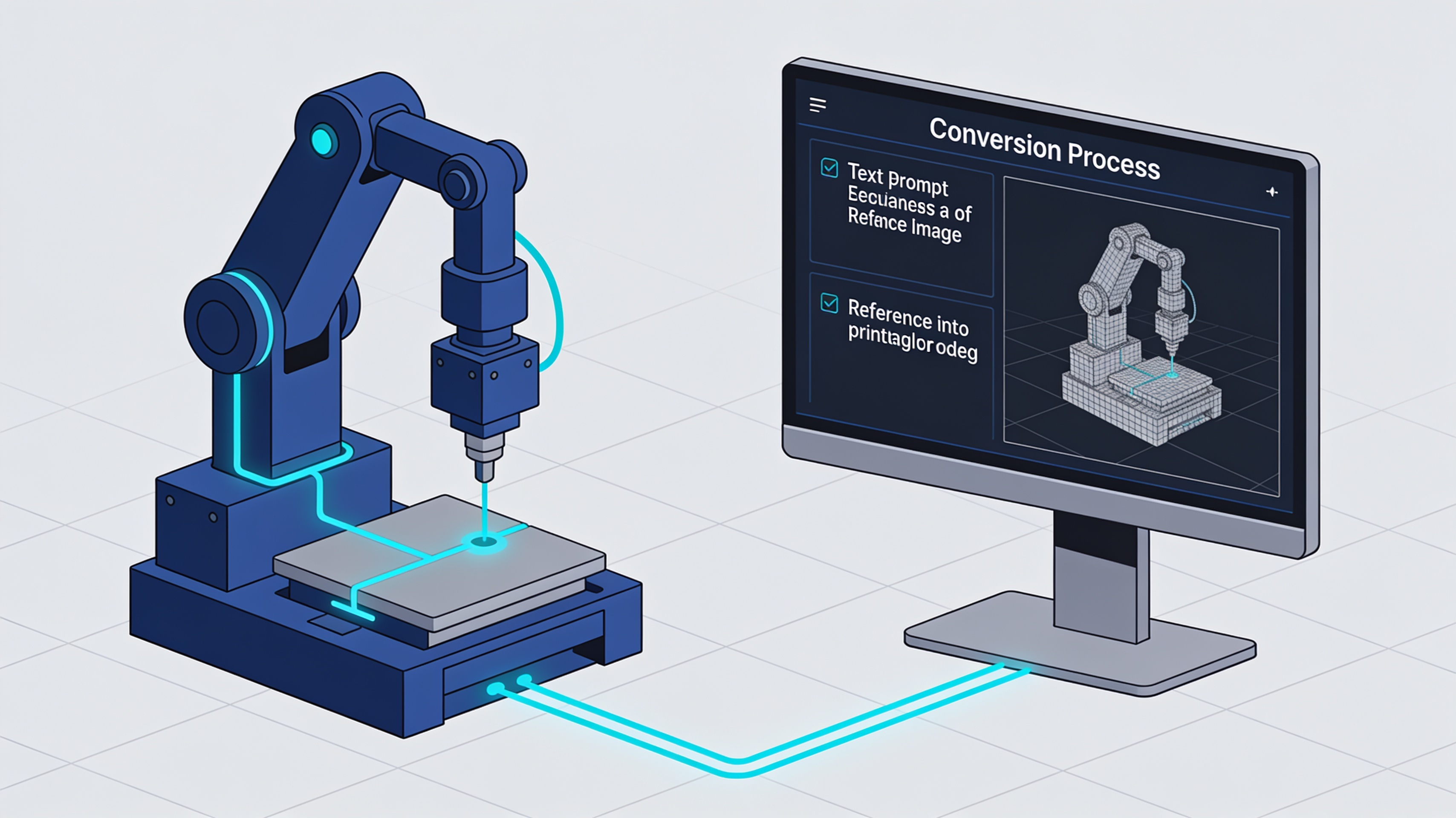
Aimia brings together in a single environment operations that today require separate tools: generation, modification, and preparation of the model for manufacturing.
The system is aimed primarily at those who own a 3D printer but do not habitually use CAD programs. The goal is to simplify the path from initial concept to physical production.
The process starts from a short text instruction or a reference image. A preliminary visual representation is developed that the user can correct with further instructions.
Only after this iterative phase does it move on to producing the actual three-dimensional model.
- Aimia integrates AI generation, modification, and print preparation in a single environment
- Five alternative generative engines: Tripo, Meshy, Hi3D, Rodin and Hunyuan
- Access currently limited to a waitlist on MakerWorld
- Declared support for closed geometries and multicolor printing
Five generative engines compared
The configuration includes five different AI models, presented as comparable alternatives rather than as a single proprietary algorithm.
The available engines are Tripo, Meshy, Hi3D, Rodin and Hunyuan. This is an important distinction: Bambu Lab has not developed a new complete algorithm, but integrates existing technologies.
Quality may vary according to the requested geometry, surface complexity and image interpretation. In the absence of uniform evidence, it is not possible to establish which engine provides the best result in every category.
This choice offers flexibility but requires the user to evaluate which solution best suits their specific case.
What “print-ready” really means”
Aimia promises closed geometries and compatibility with multicolor printing, but the definition of “print-ready” deserves further examination.
A model defined as manifold has a closed and topologically coherent surface. However, this does not guarantee that the object can be produced without intervention.
Critical aspects remain such as overhangs, minimum thicknesses, orientation, fit tolerances, material shrinkage, and the possible need for supports.
Color textures also require significant transformation. A continuous surface image must become a discrete partition of color regions according to the materials actually available on the printing system.
The conversion may introduce simplifications in shades and details. The statement about mesh closure should be interpreted as a characteristic of the software workflow, not as a guarantee of immediate printability.
Implications for the 3D printing market
The integration of generative tools into the MakerWorld ecosystem could lower the entry barrier for new users.
The availability of five alternative generative engines suggests a pragmatic approach: use the best available technologies rather than developing everything internally.
It remains to be seen how the system will handle complex cases requiring dimensional precision or specific mechanical characteristics. Generative modeling produces plausible surfaces from descriptions and implicit constraints, but not always optimal for functional applications.
Access via waiting list indicates a controlled testing phase. It will be important to monitor user feedback once the service becomes available on a broader scale.
article written with the help of artificial intelligence systems
Q&A
What is Aimia by Bambu Lab?
Aimia is an AI-assisted modeling studio integrated into MakerWorld that turns text descriptions or images into print-ready 3D models. It is designed for those who own a 3D printer but do not habitually use CAD programs.
Which AI engines does Aimia use?
Aimia integrates five generative engines: Tripo, Meshy, Hi3D, Rodin and Hunyuan. It is not a single proprietary algorithm, but existing technologies presented as comparable alternatives.
How do you access Aimia?
Access to the service is currently limited to a waitlist on MakerWorld. The described features are therefore not yet verifiable on a large scale by independent users.
How does Aimia's workflow function?
You start from a short text instruction or a reference image; a preliminary visual representation is developed that can be corrected with further input. Only after this iterative phase is the actual three-dimensional model generated.
What does it mean that a model is 'print-ready' in Aimia?
Aimia promises closed (manifold) geometries and compatibility with multicolor printing. However, a manifold model does not guarantee that the object can be produced without intervention: aspects such as overhangs, minimum thicknesses and orientation remain critical.