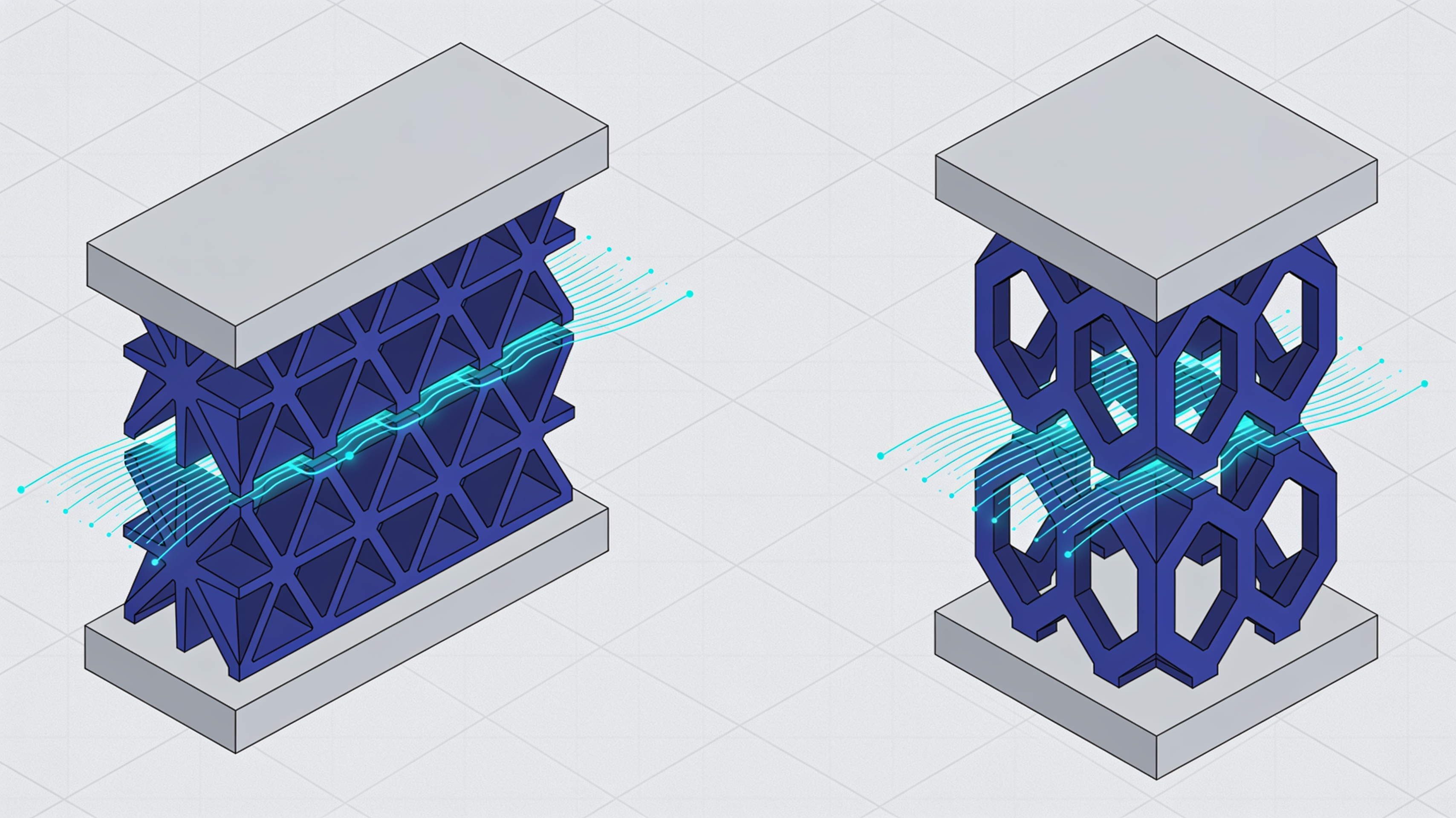
3D-printed auxetic structures: triangular star geometry triples energy absorption
An Indian study compares two auxetic cellular architectures in resin. The triangular star configuration achieves a maximum load approximately four times higher and triple energy absorption compared with the re-entrant hexagonal geometry. The advantage derives from the geometry, not the material.
Geometry versus material: the role of cellular structure
The study by Vellore Institute of Technology demonstrates how the internal architecture influences mechanical performance more than the polymer used.
The research, published in Scientific Reports, used resin 3D printing to fabricate specimens with two different auxetic configurations. Both samples were produced with the same material and the same machine, isolating geometry as the main variable.
The comparison does not establish a universal superiority of star structures. These are results obtained on specific specimens, within a defined experimental protocol.
- Maximum load: star configuration approximately 4 times higher
- Energy absorption: approximately triple compared with the hexagonal geometry
- Same material and production process for both specimens
- Dimensional differences: mass and width not identical
What are auxetic structures
Auxetic behavior arises from the cellular architecture, not from the chemical properties of the polymer.
In conventional materials, longitudinal tension produces transverse thinning. Auxetic structures, however, exhibit a negative Poisson's ratio: they expand laterally when stretched, or contract under compression.
This geometric behavior derives from the relative movement of rods, deformable hinges, and cells. Resins with unusual chemical properties are not required.
Additive manufacturing makes it possible to obtain these complex geometries without manual assembly of hundreds of elements.
The two configurations compared
The specimens exhibit dimensional differences that influence the interpretation of the results.
The study compared a re-entrant hexagonal cell with a triangular star cell. Both have a nominal height of 10 millimeters, 1-millimeter walls, and elements inclined at 30 degrees.
The star configuration also includes spokes with a radius of 6.25 millimetres. The end blocks reach approximately 30 millimetres in height and 20 in depth.
| Parameter | Recessed hexagonal | Triangular star |
|---|---|---|
| Width | 32 mm | 35 mm |
| Mass | 7 g | 10 g |
| Height | ~30 mm | ~30 mm |
| Depth | ~20 mm | ~20 mm |
Differences in width and mass indicate that the specimens are not equivalent in volume or relative density. This aspect must be considered when interpreting the performance advantage.
Using the same polymer and the same machine is useful for comparison, but the dimensional and mass differences between the specimens represent an uncontrolled variable that can influence the results.
Production and experimental protocol
The specimens were manufactured using LCD technology and subjected to a quasi-static compression test.
Production was carried out on a Creality LD-002R printer, using Anycubic Standard Photopolymer Resin. The slicing software used was Chitubox.
The quasi-static compression test made it possible to measure the maximum load and energy absorption for each configuration. The protocol highlighted the performance differences between the two cellular architectures.
Design implications
Research suggests that geometric optimization can amplify mechanical performance without modifying the base material.
The results show how resin 3D printing allows complex auxetic configurations to be explored. The ability to modify the cellular architecture opens opportunities for applications requiring energy absorption or compressive strength.
The observed performance difference confirms that internal geometry is a critical design parameter. However, future studies should normalize mass and volume to fully isolate the effect of the cellular configuration.
The first publication date of the study in Scientific Reports was not confirmed during source verification.
article written with the help of artificial intelligence systems
Q&A
Which auxetic geometry absorbs more energy in the study?
The triangular star configuration absorbs about three times the energy compared to the re-entrant hexagonal geometry. The maximum load is about four times higher. The advantage derives from the cellular architecture, not from the material.
What are auxetic structures?
They are structures with a negative Poisson's ratio: they expand laterally when stretched and contract under compression. The behavior arises from the geometry of rods, deformable hinges and cells, not from the chemical properties of the polymer.
Who conducted the research on 3D-printed auxetic structures?
The study is from the Vellore Institute of Technology (India) and is published in Scientific Reports. It compared two auxetic cellular architectures produced in resin via 3D printing.
Were the two specimens made with different materials?
No, both samples were produced with the same material and the same machine. The geometry was isolated as the main variable of the comparison.
What dimensional differences do the two specimens present?
The re-entrant hexagonal cell is 32 mm wide, the triangular star one 35 mm; the mass is not identical either. Both have a nominal height of 10 mm, 1 mm walls and elements inclined at 30 degrees; the star includes arcs with a radius of 6.25 mm.