3D-printed hydrogel achieves 1.100% elongation: a breakthrough for soft robots
A team from Shanghai Jiao Tong University has developed a 3D-printable hydrogel that achieves an elongation of 1.100% and a tensile strength of 3.7 MPa. The key to the result is a post-print chemical treatment that modifies the material's polymer network.
The study, published in Nature Communications on 13 October 2026, demonstrates how to separate two traditionally conflicting goals: maintaining shape during printing and achieving extreme elasticity in the final component.
- Elongation at break: 1.100% after post-print treatment
- Tensile strength: 3.7 MPa
- Technology: Digital Light Processing (DLP)
- Demonstrated applications: pneumatic grippers and mobile robots
The DLP printing trade-off
Printing elastic hydrogels requires a difficult balance between solidification speed and final deformability. The new approach separates these two phases.
Digital Light Processing uses projected light to solidify successive sections of a photosensitive formulation. To maintain shape during construction, the polymer network must form rapidly.
This requirement leads to numerous crosslinks between chains. Initial stability improves, but subsequent elongation is limited. A material with little deformability is unsuitable for actuators that must swell or bend.
The authors solved the problem by modifying the network after printing. The geometry is fixed with a bond-rich network, then some of these bonds are selectively removed and the structure is reinforced differently.
The formulation and the treatment
The developed formulation combines modified polyvinyl alcohol and methacrylated hyaluronic acid. The post-printing treatment modifies the structure through controlled bond cleavage.
The team used a microArch S140 system to produce the samples via DLP. The photosensitive formulation includes modified polyvinyl alcohol and methacrylated hyaluronic acid as main components.
After printing, a controlled chemical treatment selectively removes some of the crosslinking bonds. This process, combined with hydrophobic modification and phase separation, transforms the rigid material into a highly deformable hydrogel.
The documented results are experimental. These are not robots ready for sale or for clinical use.
Demonstrated applications
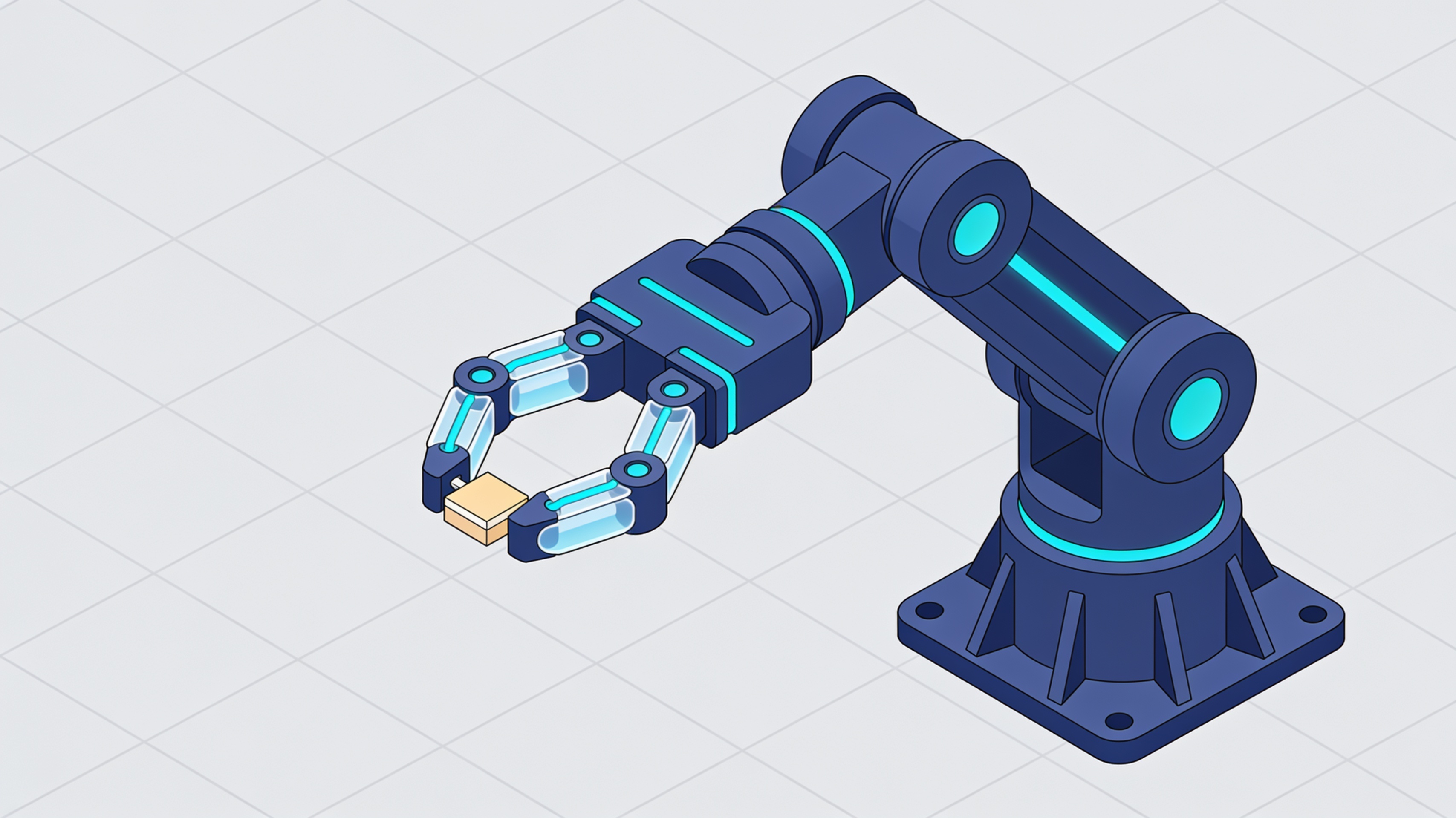
The researchers built functional demonstrators: pneumatic actuators, a gripper, and a tardigrade-inspired mobile robot.
The internal geometries obtainable with DLP allow the creation of pneumatic chambers, thin walls, and lattices that are difficult to produce with traditional molds. These structures are ideal for soft robotics and systems that must adapt to delicate surfaces.
The team has produced several functional prototypes. A pneumatic gripper exploits the high deformability to grasp objects. A quadruped robot inspired by the tardigrade demonstrates the possibility of building complete mobile systems.
The tested pneumatic actuators show repeated deformation capability. Cyclic tests confirm the material's resistance under repeated loads.
Prospects for soft robotics
The separation between the printing phase and the optimization of mechanical properties opens new possibilities for complex functional materials.
Hydrogels are materials formed by a polymer network that retains water. Their softness makes them interesting for soft robotics, microfluidics, and biomedical devices.
The approach developed by the Chinese team overcomes the traditional trade-off between printability and elasticity. Materials fluid enough for rapid photopolymerization form networks that are too rigid. Elastic formulations lose precision during building.
The strategy of modifying the network after printing could be applied to other polymer systems. Independent control of geometry and mechanical properties represents a significant advance for additive manufacturing of functional materials.
article written with the help of artificial intelligence systems
Q&A
What elongation and tensile strength does the 3D-printed hydrogel achieve?
The hydrogel developed by the Shanghai Jiao Tong University team achieves an elongation of 1,100% and a tensile strength of 3.7 MPa after post-printing chemical treatment. These values were documented in the study published in Nature Communications on October 13, 2026.
What 3D printing technology was used to produce the hydrogel?
The samples were produced via Digital Light Processing (DLP), using a microArch S140 system. The photosensitive formulation includes modified polyvinyl alcohol and methacrylated hyaluronic acid as main components.
How is the conflict between printing stability and final elasticity resolved?
The team separated the two phases: during printing the polymer network forms rapidly to maintain the geometry, then a controlled chemical treatment selectively removes part of the crosslinking bonds. This process, combined with hydrophobic modification and phase separation, transforms the rigid material into a highly deformable hydrogel.
What applications have been demonstrated with this hydrogel?
The researchers built functional demonstrators including pneumatic actuators, a pneumatic gripper and a mobile robot inspired by tardigrades. These are experimental results, not products ready for sale or clinical use.
Where was the study on the 3D-printable hydrogel published?
The study was published in Nature Communications on October 13, 2026 and was conducted by a team from Shanghai Jiao Tong University. The research demonstrates how to separate two traditionally conflicting goals: maintaining shape during printing and achieving extreme elasticity in the final component.