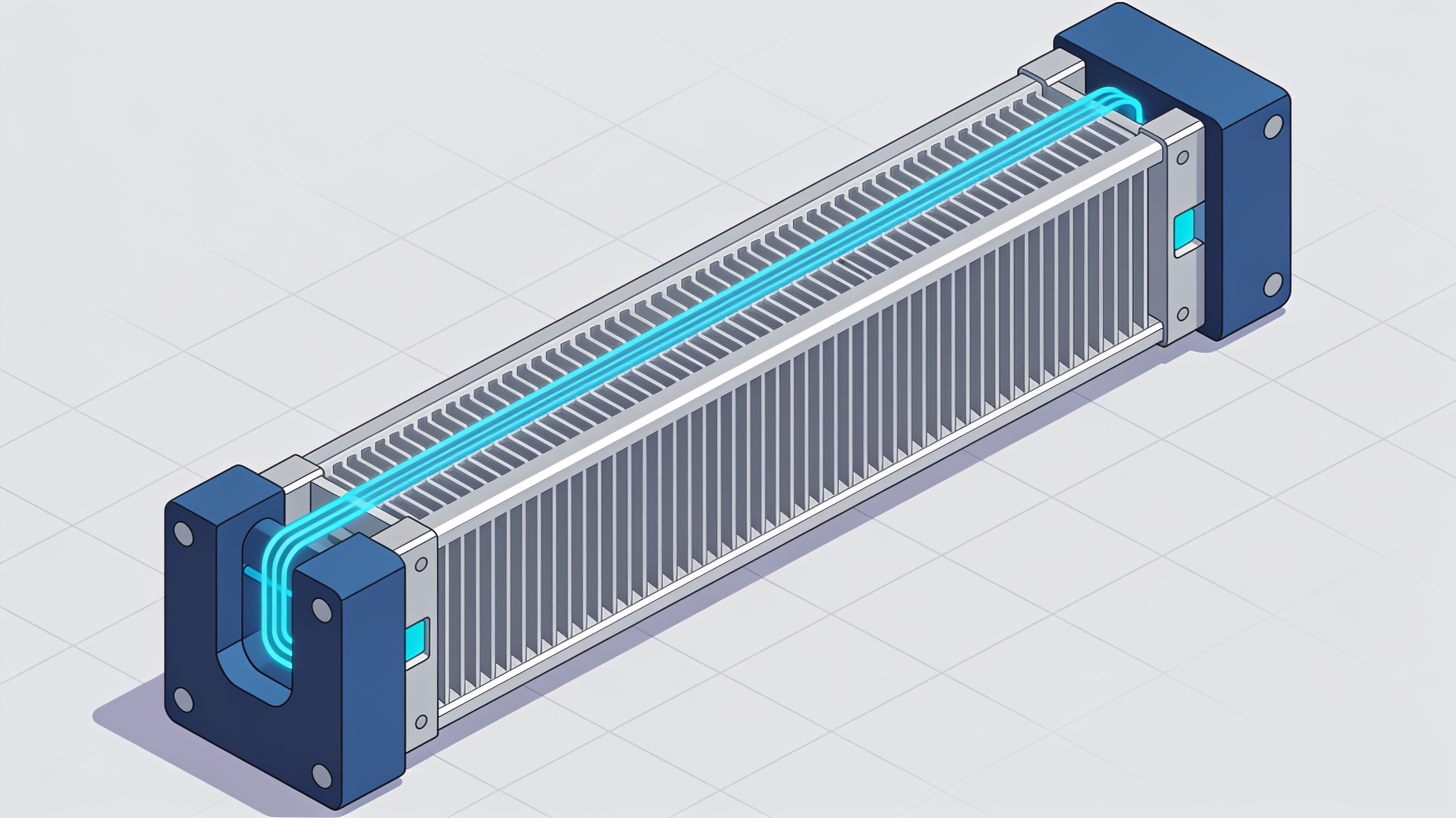
MADIT presents at Formnext 2026 a 200 kW 3D-printed heat exchanger for hydrogen aviation
A demonstrator almost one meter long, made of aluminum using additive technology, promises reductions of 33% in mass and 22% in aerodynamic drag compared with conventional solutions. The component was developed within the European BRAVA project for fuel cell propulsion systems.
MADIT, a company specializing in metal production via laser powder bed fusion, will bring to Formnext 2026 an aluminum heat exchanger that represents a significant step toward hydrogen aviation. The component will be exhibited in Frankfurt from November 17 to 20, 2026.
The device is designed for a heat dissipation capacity of 200 kW. Its dimensions, almost one meter in length, are unusual for an additive application with thin internal channels.
Demonstrator performance
Comparison with conventional architectures reveals significant advantages in terms of mass, volume, and aerodynamics.
Compared with a conventional reference examined under the same operating conditions, the MADIT demonstrator offers measurable improvements:
- Reduction of 33% in mass
- Reduction of the 11% in volume
- Reduction of the 22% in aerodynamic drag
These figures refer to the comparison between heat exchange architectures, not to an already measured reduction in an aircraft's overall consumption. The actual value will emerge from integration into the complete system.
The BRAVA project and thermal management
BRAVA addresses the challenge of aircraft electric propulsion based on fuel cells, where heat management is as crucial as electricity generation.
The problem of hydrogen aircraft propulsion is not limited to the ability to produce electricity on board. Fuel cells also generate heat that must be transferred outside without compromising the benefits of the new architecture.
BRAVA, an acronym for Breakthrough Fuel Cell Technologies for Aviation, is a research program dedicated to aircraft electric generation systems with proton exchange membrane fuel cells (PEMFC). The project is coordinated within a collaboration that includes Airbus and numerous European partners.
In PEMFC fuel cells, part of the chemical energy of hydrogen is converted into electricity, and another part into heat to be removed. Thermal management is therefore a decisive engineering issue for high-power systems.
The overall objective indicated by Airbus concerns electric generation architectures above 2 MW. The device presented by MADIT is a single 200 kW heat exchange demonstrator, a component of the overall system.
Collaboration and expertise
The development of the demonstrator required the integration of specialized expertise in design, simulation, additive manufacturing and experimental validation.
The component was developed with contributions from multiple partners of the BRAVA project:
- MADIT: manufacturing and assembly via Laser Powder Bed Fusion
- Morpheus Designs: design development and analysis of thermal and fluid dynamic passages
- Airbus: coordination and application requirements
- NLR (Dutch aerospace centre): testing activities and experimental verification
The device operates as an air-liquid heat exchanger, cooling a water-glycol circuit using air. This configuration is typical of aeronautical thermal management systems, where the coolant collects heat from the fuel cells and releases it to the outside air.
Production challenges and next steps
The size of the component and the complexity of the internal channels represent a significant challenge for metal additive manufacturing.
Creating a heat exchanger almost one meter long with thin internal channels via metal 3D printing requires overcoming dimensional constraints typical of LPBF technology. MADIT had to manage the assembly of multiple modules through welding processes along the joints.
The demonstrator consists of six assembled modules. This modular architecture makes it possible to overcome the dimensional limits of build chambers and facilitates any repairs or replacements.
Before any certified aeronautical application, the transition from technology demonstration to qualification according to aerospace industry standards remains to be made. This process requires extensive validation of reliability, durability and safety.
The presentation at Formnext 2026 represents an opportunity to assess industry interest in this solution and gather feedback for further developments.
article written with the help of artificial intelligence systems
Q&A
What performance does MADIT's 3D-printed heat exchanger offer compared to conventional solutions?
Compared to a conventional reference examined under the same operating conditions, the MADIT demonstrator reduces mass by 33%, volume by 11% and aerodynamic drag by 22%. This is a comparison between heat exchange architectures, not a reduction already measured on an aircraft's fuel consumption.
With what technology is the 200 kW heat exchanger made?
The component is made of aluminum by laser powder bed fusion, the additive technology in which MADIT specializes. It allows the creation of thin internal channels in a demonstrator almost one meter long, an unusual size for this application.
Where and when will the MADIT heat exchanger be exhibited?
MADIT will bring the demonstrator to Formnext 2026, in Frankfurt, from November 17 to 20, 2026. It is one of the applications presented for hydrogen aviation.
What is the BRAVA project and what is its goal?
BRAVA (Breakthrough Fuel Cell Technologies for Aviation) is a European research program dedicated to aircraft electric power generation systems with proton exchange membrane fuel cells (PEMFC). The project is coordinated in a collaboration that includes Airbus and numerous European partners.
Why is thermal management crucial in hydrogen aviation propulsion?
PEMFC fuel cells convert part of hydrogen's chemical energy into electricity and part into heat to be evacuated. Thermal management is therefore a decisive engineering challenge for high-power systems, as much as electricity generation.