Neil Hopkinson will receive the AMUG Innovators Award 2027 for the invention of High Speed Sintering
The Additive Manufacturing Users Group (AMUG) has announced that Neil Hopkinson, principal inventor of High Speed Sintering (HSS) technology, will receive the Innovators Award during the AMUG 2027 conference. The recognition honors Hopkinson's contribution to the development of one of the most innovative additive manufacturing technologies in recent years.
HSS was developed at Loughborough University and represents an alternative to traditional laser sintering processes. The technology has found applications in critical sectors such as automotive, medical devices, and aerospace.
High Speed Sintering technology
HSS stands out for an innovative approach to sintering polymer powders, with advantages in terms of speed and production efficiency.
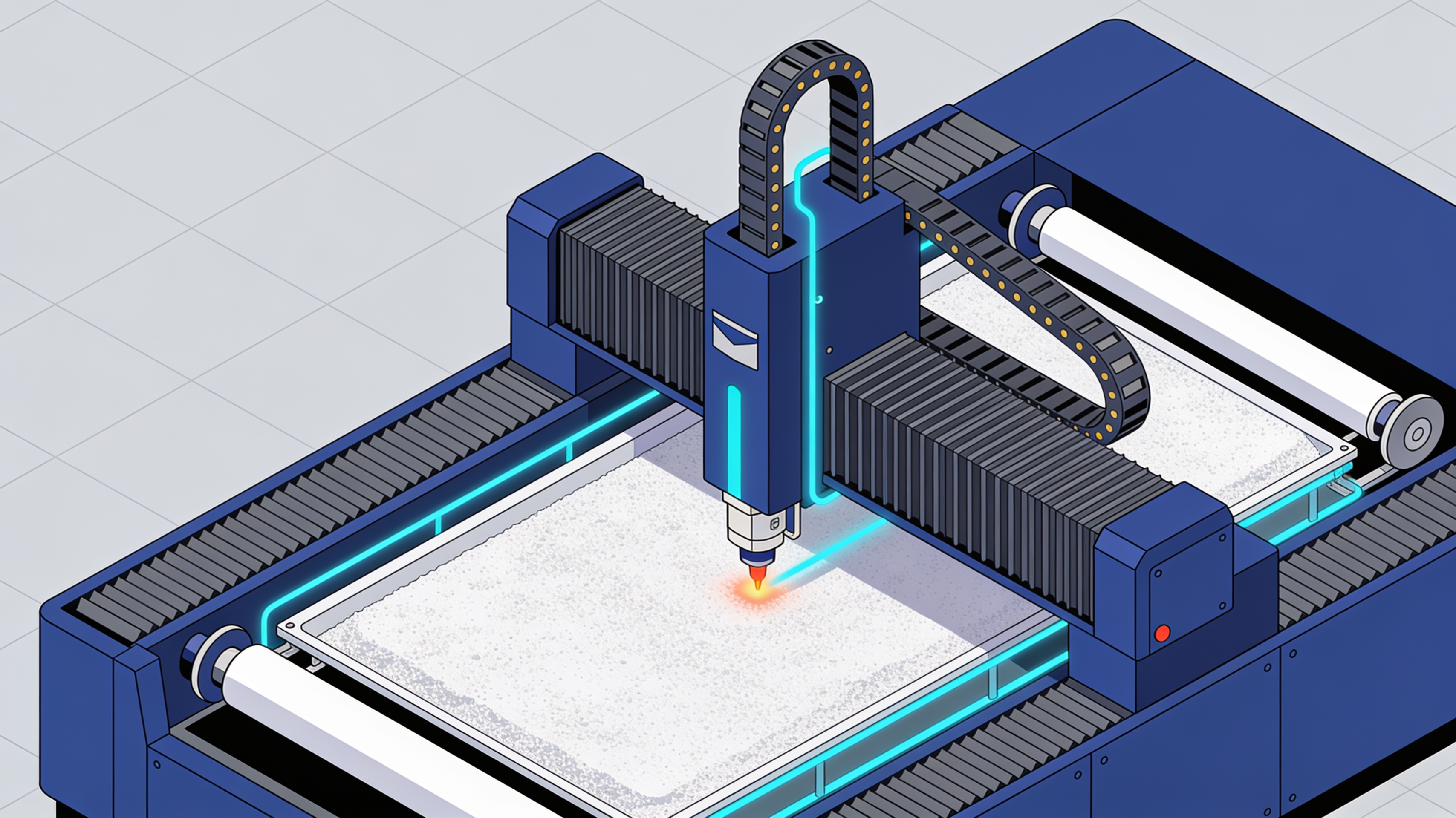
High Speed Sintering uses different principles compared with traditional laser technologies such as SLS. The process involves the selective application of an absorbing agent onto the powder, followed by exposure to infrared radiation that causes localized melting of the material.
This process architecture inspired subsequent developments. SAF (Selective Absorption Fusion) technology, implemented in the H350 printer developed by Xaar 3D and subsequently acquired by Stratasys, is based on the principles of HSS, albeit with its own architecture. HP also developed Multi Jet Fusion technology following similar approaches.
- Neil Hopkinson will receive the AMUG Innovators Award 2027
- HSS was developed at Loughborough University
- The technology finds applications in automotive, medical and aerospace
- It inspired the development of subsequent technologies such as SAF
The AMUG Award
Dallas Martin, president of AMUG, announced the award that will be presented during the 2027 conference, a reference event for the additive manufacturing community.
The AMUG Innovators Award represents one of the most prestigious recognitions in the industrial 3D printing sector. The award celebrates significant contributions to the advancement of additive technologies and their impact on real-world applications.
The choice of Hopkinson underscores the importance of innovation in 3D printing processes. While technologies such as SLA, invented by Chuck Hull, founder of 3D Systems, and FDM, developed by Scott Crump, dominated the first decades of the sector, HSS represents a later generation of solutions for industrial production.
Industrial applications of HSS
The applications of High Speed Sintering range from the production of automotive components to the manufacture of custom medical devices, sectors where speed and reliability are crucial.
In the automotive sector, HSS enables the production of functional prototypes and production components in shorter timeframes. The technology offers advantages for complex geometries that are difficult to produce with traditional processes.
For medical devices, HSS enables mass customization while maintaining high quality standards. Aerospace benefits from the ability to produce lightweight components with controlled mechanical properties.
High Speed Sintering differs from selective laser sintering (SLS) in its use of a selectively applied absorbing agent and diffuse infrared radiation, rather than a focused point-by-point laser.
The context of additive manufacturing
The award to Hopkinson comes at a time of consolidation in the sector, with listed companies such as Stratasys, 3D Systems and Titomic competing on different technologies.
Additive manufacturing has seen significant evolution in recent years. Alongside established technologies such as SLA and FDM, new approaches such as DED (Direct Energy Deposition) developed by companies like Meltio are expanding application possibilities.
The AMUG 2027 conference will be an opportunity to celebrate not only the historic pioneers, but also the innovators who have brought 3D printing toward large-scale industrial applications. The recognition of Hopkinson highlights how innovation continues to guide the sector toward new production frontiers.
article written with the help of artificial intelligence systems
Q&A
Who will receive the AMUG Innovators Award 2027?
Neil Hopkinson, lead inventor of High Speed Sintering (HSS) technology. The award will be presented to him during the AMUG 2027 conference for his contribution to the development of additive manufacturing.
Where was High Speed Sintering technology developed?
HSS was developed at Loughborough University. It represents an alternative to traditional laser sintering processes such as SLS.
How does the High Speed Sintering process work?
The process involves the selective application of an absorbing agent onto the polymer powder, followed by exposure to infrared radiation that causes localized melting of the material. This approach differs from traditional laser processes.
Which technologies were inspired by High Speed Sintering?
The SAF (Selective Absorption Fusion) technology of the H350 printer, developed by Xaar 3D and later acquired by Stratasys, is based on the principles of HSS. HP also developed Multi Jet Fusion following similar approaches.
In which sectors does High Speed Sintering find application?
HSS has found applications in critical sectors such as automotive, medical devices and aerospace. In these fields, speed and production reliability are crucial factors.