Non-Planar 3D Printing: PancakeSlicer Brings Smooth Surfaces to 3-Axis Printers
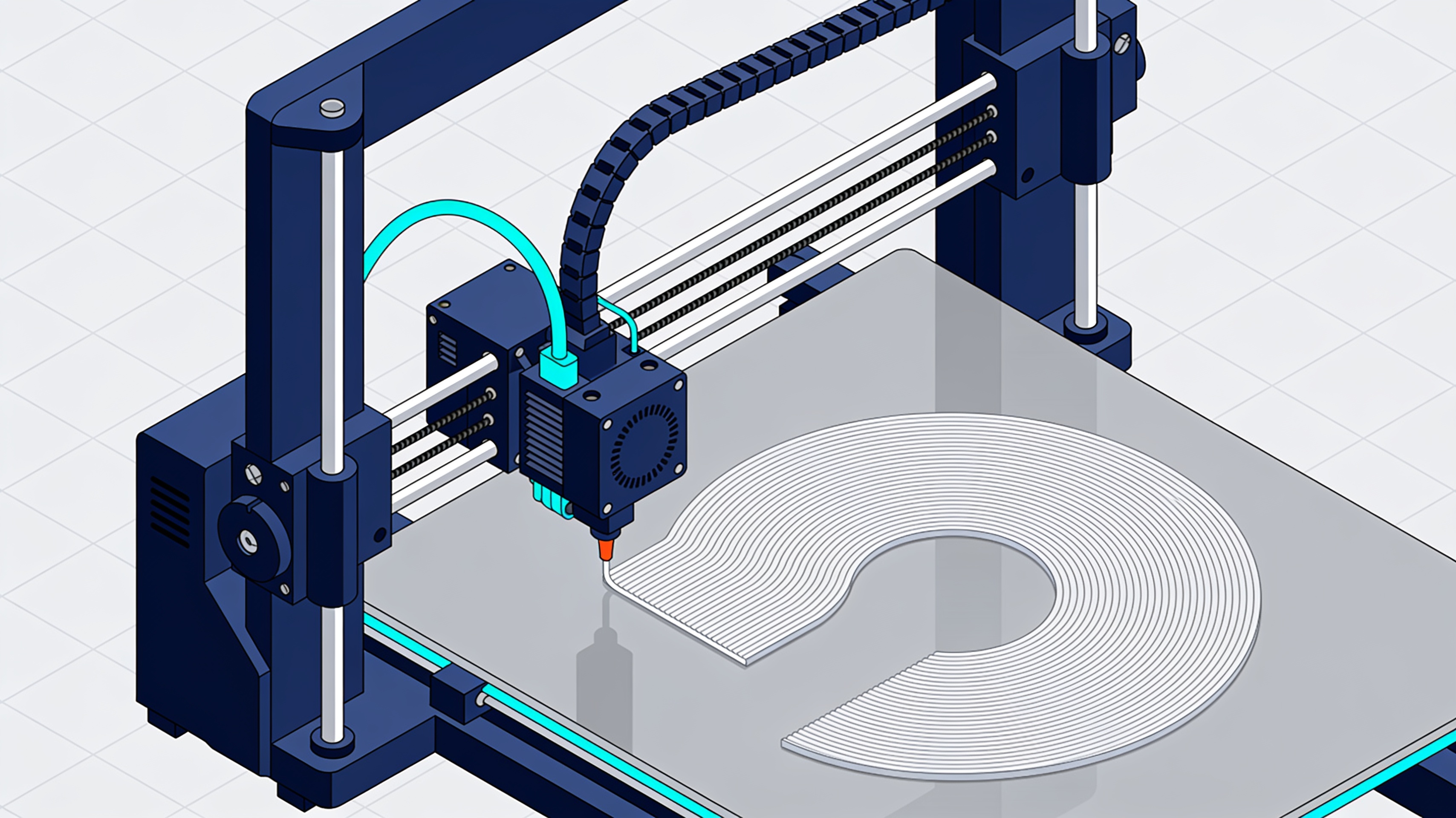
The development of non-planar slicing software represents one of the main bottlenecks for the adoption of this promising technique. Zimeng Xiong of Alpaca Engineering has released PancakeSlicer, a slicer designed to bring non-planar printing to standard three-axis 3D printers.
The software has been tested on a Bambu Lab A1 Mini and promises to eliminate the characteristic “stair-step” effect on top surfaces, without requiring specialized hardware.
Advantages of Non-Planar Printing
Non-planar printing offers significant benefits compared with traditional slicing, but its adoption has been limited by the lack of accessible software.
The technology makes it possible to achieve smoother surfaces by eliminating the stair-step pattern typical of 3D printing. In some configurations, it reduces or completely eliminates support structures. Some implementations also promise greater mechanical strength for printed components.
- Smooth top surfaces without stair-step patterns
- Compatibility with standard 3-axis printers
- Reduction of support structures in some cases
- Potential increase in mechanical strength
Hardware Limitations and Solutions
PancakeSlicer must operate within the physical constraints of three-axis printers, where the printhead geometry limits the possible paths.
The available non-planar paths are limited by the clearance of the printhead on each side of the nozzle. In the case of the A1 Mini, this limitation can be substantially reduced by removing the cooling system from the printhead.
The proposed solution involves the use of a remote static cooling system (RSCS). This system blows cooling air from the sides of the print bed, freeing up space around the nozzle.
Three Slicing Approaches
The software implements progressive strategies of increasing complexity to balance surface quality and extrusion reliability.
Evolution of Slicing Strategies
- Planar structure with overlay: generates a basic planar structure, then overlays some non-planar layers on the top surface. It still leaves traces of the stair-step pattern.
- Morphed structure: eliminates the residual pattern by continuously varying the layer thickness. It can cause under-extrusion in narrow regions where the layers become too thin.
- Conformal slicing: builds a planar base, a morphed transition region, and several conformal layers of constant thickness. It solves the under-extrusion problems.
Surface Identification Algorithm
The first critical step is identifying which surfaces of the model will benefit from non-planar slicing.
PancakeSlicer identifies the surfaces on which to apply the smooth top layer by casting rays downward through the component. The software tracks the intersection points to determine where to apply the non-planar technique.
Where the slicer cannot print a non-planar layer due to head clearance limitations, it automatically falls back to traditional planar slicing.
The conformal slicing approach represents the best compromise between surface quality and print reliability, avoiding under-extrusion problems and maintaining constant-thickness layers in critical areas.
Future Prospects
Despite recent progress, the industry still awaits a universal non-planar slicer capable of handling all geometries and configurations.
Recent years have seen notable progress in the field. Systems for non-planar ironing, non-planar infills, and conformal overlays have been developed. Some manufacturers have even built homebrew printers with fourth and fifth axes to expand the possibilities.
PancakeSlicer represents an important step toward democratizing non-planar printing. Compatibility with standard three-axis hardware significantly lowers the entry barrier for this technology.
article written with the help of artificial intelligence systems
Q&A
What is PancakeSlicer and who developed it?
PancakeSlicer is a non-planar 3D printing slicer developed by Zimeng Xiong of Alpaca Engineering. It is designed to work on standard three-axis 3D printers, without requiring specialized hardware.
On which printer was PancakeSlicer tested?
The software was tested on a Bambu Lab A1 Mini. In this configuration it was possible to improve non-planar paths by removing the cooling system from the toolhead.
What are the main advantages of non-planar printing?
Non-planar printing eliminates the characteristic stair-stepping effect on top surfaces, reduces or eliminates support structures in some configurations, and promises greater mechanical strength of parts.
How is the toolhead clearance problem on 3-axis printers solved?
Non-planar paths are limited by the toolhead geometry around the nozzle. The proposed solution is a remote static cooling system (RSCS) that blows air from the sides of the build plate, freeing up space around the nozzle.
What slicing strategies does PancakeSlicer implement?
The software offers three progressive approaches: planar structure with non-planar overlay, morphed structure with variable thickness, and conformal slicing with constant-thickness layers. The latter solves the under-extrusion problems of narrow regions.