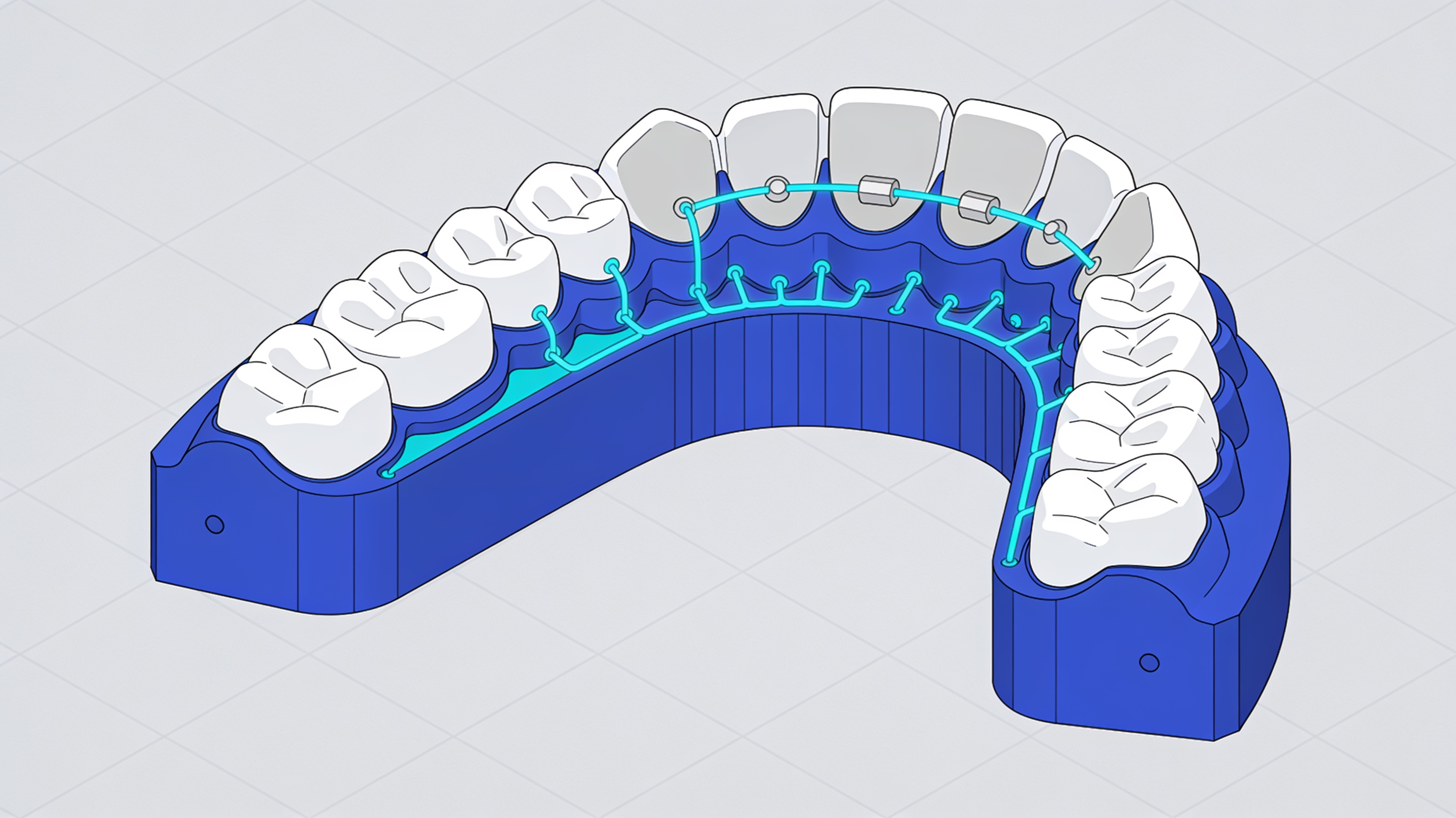
Phase-separated 3D resin: Align's patent for aligners with soft and hard zones
A single photocurable resin could produce a 3D-printed object with soft regions and hard regions. This is what Align Technology's Chinese patent application CN123042453A describes. The approach aims to give orthodontic aligners multiple mechanical properties without printing separate components and assembling them.
- Align Technology has filed Chinese patent application CN123042453A.
- The resin contains at least two polymerizable components with different reaction rates.
- During curing, the faster component forms a polymer-rich phase; the slower one remains available for another phase.
- The result is a composite with a soft phase and a hard phase in the same printed object.
- The intended application concerns orthodontic appliances such as aligners, retainers, and expanders.
The limitation of monolithic materials
Most resin processes aim for a uniform material throughout the part. For different properties, separate components are printed.
Most resin 3D printing processes aim to create a single, consistent material throughout the part. If different mechanical properties are needed, separate components are usually printed with different parameters or materials, then assembled. The Align patent describes an alternative approach.
How the resin works
The resin contains components with different reaction rates. Curing selects which phase forms first.
The resin contains at least two polymerizable components with different reaction rates. The faster component reacts first and forms a polymer-rich region; the slower one remains available to form another phase. The expected result is a composite with a softer phase and a harder phase, joined in the same printed object.
Procedure
- Formulation: the resin contains at least two polymerizable components with different reaction rates.
- Initial curing: the faster component polymerizes first and forms a polymer-rich region.
- Separation: the slower component remains available and forms a second polymer phase.
- Result: a composite with a soft phase and a hard phase in the same object, with continuous phases and gradients.
Separation would not always be visible as two distinct blocks. The patent describes continuous phases and gradients. The chemistry would determine where the material becomes more flexible and where it is more resistant to deformation.
The phase-separated photopolymerizable resin is designed to separate the components during curing. This generates polymer phases with different mechanical properties in the same object.
Second route: different curing conditions
In addition to chemistry, the patent envisions varying the exposure conditions. Different lights or temperatures can activate the components selectively.
The patent describes a second way to create the difference: exposing portions of resin to different curing conditions. These conditions may include different wavelengths of light or different temperatures. One region could be cured with a first set of conditions and another with a second set, causing the two components to polymerize differently.
Thus a resin 3D printer would not need two reservoirs or a complicated material-changing system, which several companies have attempted to create. The material itself would act as two materials, while the curing process would determine which phase is active.
Chemistry and hardness
The proposed formulations use methacrylate and acrylate chemistry. Some versions combine radical and ionic polymerization.
The proposed resin systems include methacrylate and acrylate chemistry, along with combinations of radical and ionic polymerization. Some versions use a more reactive component for the soft phase and a slower one for the hard phase. The document indicates exemplary hardness ranges from 60 to 85 Shore D for the two regions.
Orthodontic applications
The intended application is orthodontic. The device may have a flexible section in contact with the tooth and a more rigid one to apply force.
The intended use concerns orthodontic appliances, including aligners, retainers, expanders and other devices used to reposition teeth. A dental appliance may contain a flexible section that adapts to the tooth and a more rigid section that applies force. The source also cites clear aligners as a possible application.
Outlook
The patent is an application, not a product already on the market. The source considers it a potentially popular approach.
The source defines this approach as potentially very popular. If applied, it could simplify the production of parts with variable mechanical properties, avoiding separate printing and assembly. However, it is a patent application, not a product already available.
article written with the help of artificial intelligence systems
Q&A
What is Align Technology's patent application number?
The Chinese patent application is CN123042453A, filed by Align Technology. It describes a photopolymerizable resin capable of producing a 3D printed object with soft and hard regions.
How does Align's phase-separated resin work?
The resin contains at least two polymerizable components with different reaction rates. During curing, the faster component polymerizes first forming a polymer-rich phase, while the slower one remains available to form a second phase. The result is a composite with a soft phase and a hard phase in the same object.
What applications does the Align patent cover?
The intended application concerns orthodontic appliances such as aligners, retainers and expanders. The goal is to achieve multiple mechanical properties without printing separate components and assembling them.
Is the separation between soft and hard phase sharp?
No, the patent describes continuous phases and gradients, not two sharply separated blocks. The transition between regions occurs gradually within the same printed object.
Why are monolithic materials a limitation for aligners?
Most resin processes seek a uniform material throughout the part. To achieve different mechanical properties, separate components must be printed with different parameters or materials and then assembled, with greater complexity.