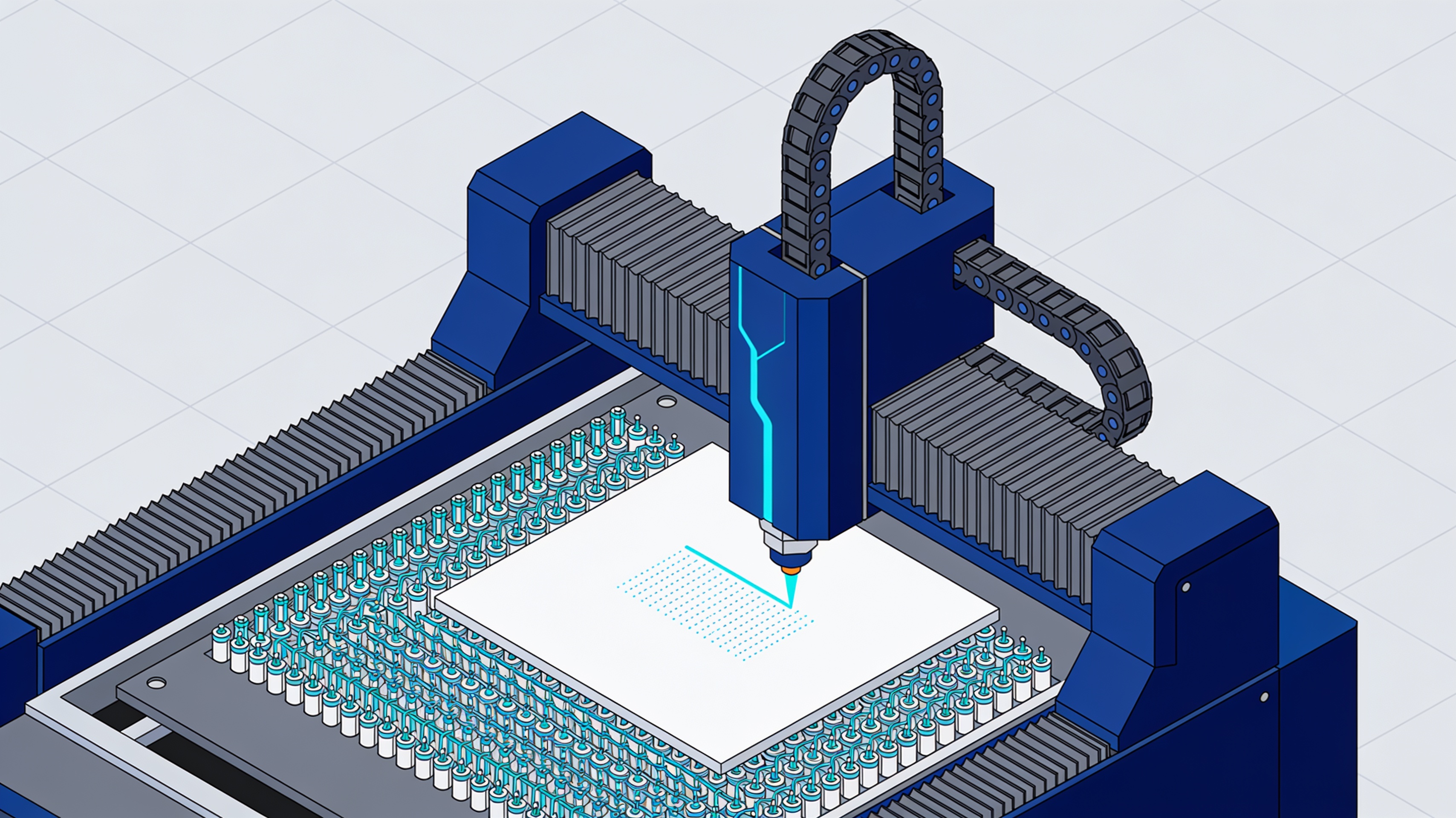
VECTRON presents VLS325: polymer 3D printing up to 20 times faster
Speed has long been one of the biggest challenges in industrial 3D printing. Manufacturers want to produce more parts, reduce costs, and make additive manufacturing competitive with traditional methods.
At the Formnext 2026 trade fair, VECTRON, a company based in Singapore, presented VLS325, a new polymer 3D printing system based on Voxel Laser Sintering (VLS) technology.
VECTRON claims a speed up to 20 times higher than conventional selective laser sintering (SLS) and up to twice as high as HP's Multi Jet Fusion (MJF). The comparisons concern the printing process and exclude preheating and cooling times.
- VECTRON presented VLS325 at Formnext 2026.
- Voxel Laser Sintering technology uses thousands of individually controlled lasers.
- VECTRON claims performance up to 20× compared with SLS and 2× compared with HP's MJF.
- The system handles PA12, PA11, and TPU; PP support planned for Q1 2027.
Voxel Laser Sintering technology
VLS replaces the mobile laser of SLS with thousands of individually controlled lasers. Each laser acts as a pixel and fuses different areas of the powder bed at the same time.
In traditional SLS, a laser moves across the powder bed and follows the shape of each part to fuse selected areas. Then the machine applies a new layer of powder and starts again.
In the VECTRON system, each laser delivers energy to a specific position. By activating multiple lasers simultaneously, the system fuses an entire layer without tracing each part individually.
VLS325 also uses a high-speed powder recoating system designed to reduce time between layers. With reduced sintering times, powder recoating has become the main factor: according to VECTRON, this stage limits the process speed.
The near-infrared laser array operates without conventional moving laser scanning optics. The software controls how energy is distributed across the powder bed to reproduce fine details.
VLS works with standard polymer powders, without additional fusing or detailing agents. By eliminating these consumables, the process could reduce costs, especially for large batches of parts.
Another advantage concerns laser exposure time, which remains largely constant even when more parts are added to the build. VECTRON claims that the technology can fuse an area of 600 × 600 mm in less than two seconds.
Speed comparisons refer to the printing process and do not include preheating and cooling.
Supported materials and industrial applications
The system is ready for PA12, PA11 and TPU. Polypropylene support is planned for Q1 2027. VECTRON is testing a low-cost PLA powder.
VLS325 is ready to process PA12, PA11, and TPU. Support for polypropylene (PP) is expected in the first quarter of 2027. VECTRON is also testing a low-cost PLA powder for more cost-sensitive applications.
| Material | Status | Notes |
|---|---|---|
| PA12 | Ready | — |
| PA11 | Ready | — |
| TPU | Ready | Useful for flexible parts |
| Polypropylene (PP) | Expected Q1 2027 | Low weight, chemical resistance, durability |
| PLA powder | In testing | For cost-sensitive applications |
TPU is particularly useful for flexible parts. Polypropylene is valued for its low weight, chemical resistance, and durability.
VECTRON sees an opportunity in the automotive sector, where automakers already use PP in many conventional components.
Comparison with SLS and MJF
VECTRON compares VLS with SLS and with HP's Multi Jet Fusion. The stated data relate only to the printing process, without preheating and cooling.
VECTRON claims that VLS325 can print up to 20 times faster than conventional SLS and up to twice as fast as HP's MJF. The company speaks of potentially lower production costs. The comparisons cover the printing process and exclude preheating and cooling.
The difference lies in the way the powder is melted. In SLS, a laser moves across the bed and follows the shape of each part. In the VECTRON system, each laser acts as a pixel and activates multiple areas simultaneously, so the entire layer can be melted without tracing each part.
VLS325 was presented at Formnext 2026. The technology aims to make additive manufacturing more competitive with traditional production methods.
article written with the help of artificial intelligence systems
Q&A
What is Voxel Laser Sintering (VLS) technology by VECTRON?
VLS replaces the moving laser of SLS with thousands of individually controlled lasers. Each laser acts as a pixel and fuses different areas of the powder bed simultaneously, without tracing each part individually.
How much faster is VLS325 compared to SLS and MJF?
VECTRON claims a speed up to 20 times higher than conventional SLS and up to 2 times higher than HP's Multi Jet Fusion. The comparisons concern the printing process and exclude preheating and cooling.
Which materials does VLS325 support?
The system handles PA12, PA11 and TPU. Support for PP is planned for Q1 2027.
Why is powder recoating important in VLS325?
With reduced sintering times, powder recoating has become the main factor limiting speed. VLS325 uses a high-speed recoating system designed to reduce the time between layers.
Does VLS325 require fusing or detailing agents?
No, VLS works with standard polymer powders without additional fusing or detailing agents. By eliminating these consumables, the process could reduce costs, especially for large batches of parts.