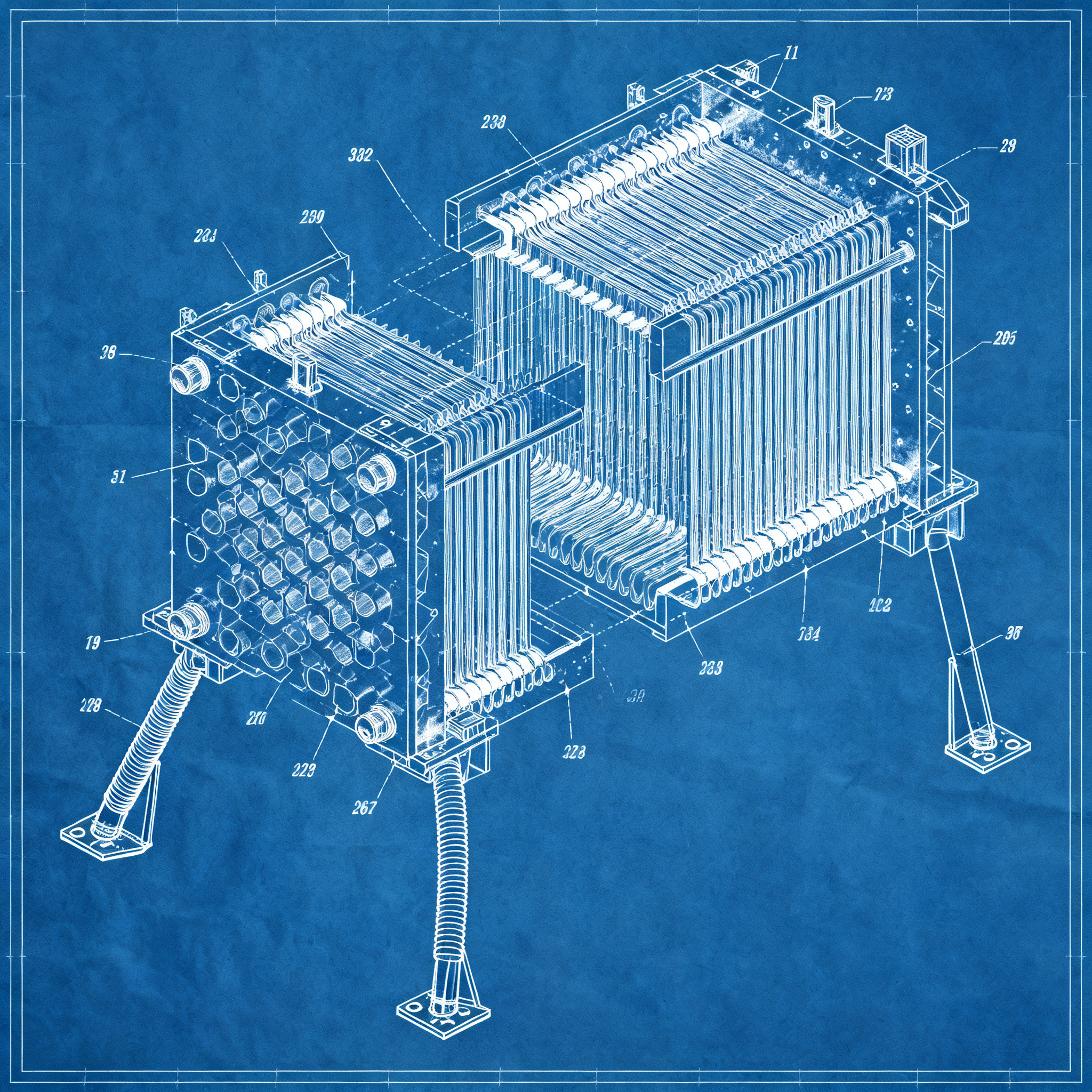
3 patents, 1 thermal revolution
Thanks to 3D printing, designers can now build heat exchangers that were once impossible to manufacture, opening new paths for industrial efficiency.
- Additively Manufactured Heat Exchanger Supports and Method of Manufacture — April 1, 2026
- Heat Exchanger and Method for Exchanging Heat — June 3, 2026
Two recent patents show how additive manufacturing enables previously unattainable thermal geometries. The benefits are concrete: greater efficiency, reduced costs, improved production repeatability.
The innovations described are already plausible for advanced sectors like aerospace and automotive. But how do these technologies really work?
Intelligent supports for impossible geometries
A new approach to in-print supports enables building heat exchangers with greater precision and robustness, reducing deformation and waste.
The patent “Additively Manufactured Heat Exchanger Supports” introduces temporary external support structures. These are built during 3D printing and removed afterwards, leaving the final component intact.
The problem they solve is real. Heat exchangers have external manifolds that must connect to internal ducts. During additive manufacturing, these protruding elements risk deformations and dimensional inaccuracies.
How the process works
- Integrated printing: the core of the exchanger, the external fairing and the manifolds are printed together with external support structures.
- Compliant support: the structures include flexible members that absorb thermal stresses during construction and cooling.
- Selective removal: after printing, specific segments of the supports are removed, leaving the manifold free to expand thermally during operation.
As described in the patent, the supports connect the manifold to the fairing or an external base. They include two legs separated by a gap and a compliant member that absorbs thermal expansion differences.
The tangible advantage? Improved positioning accuracy and reduced risk of deformations. In an aerospace department, this means less waste and more reliable components.
The patent specifies that the fluids can be air, water, lubricants, or supercritical fluids. The exchangers can also operate as two-phase systems, converting water into steam with exhaust gas.
3D design that multiplies efficiency
Thanks to interconnected structures achievable only with additive manufacturing, thermal flow paths are optimized and footprints are reduced, increasing thermal efficiency.
The patent “Heat Exchanger and Method for Exchanging Heat” proposes a radically different structure. Instead of stacked plates, it creates three-dimensionally interwoven volumes.
The exchanger handles three or more fluids simultaneously. The separating structure forms distinct volumes that interweave in a primary region inside the housing.
- Superior heat transfer rate thanks to optimized surfaces
- Reduced pressure losses compared to traditional stacked configurations
- Smaller volumetric footprint for the same performance
- Possibility of thinner walls thanks to greater structural reliability
As specified in the patent, production occurs via additive manufacturing, specifically powder bed fusion with selective laser melting. This technology allows the interlaced structure to be realized with precision and efficiency.
The design uses repeated unit cells. The patent indicates at least 10 cells, but preferably at least 50 in the primary region. All can be identical, simplifying design and production.
An interesting feature: the fluid in the external volume can be less chemically reactive. This increases the heat exchanger's lifespan and allows thinner walls, further improving heat transfer.
The patent also describes transition regions. These connect the interlaced primary region to secondary regions where the volumes progressively separate to connect to inlets and outlets.
Trade-offs and limitations
Despite the advantages, the’adoption of these technologies requires initial investments and specific skills to manage the design and production complexity.
The patent on additive supports highlights a critical issue: the removal of supports. After printing, specific segments must be cut away. This step could introduce new dimensional problems if not performed correctly.
Initial costs for advanced additive manufacturing equipment are significant. Not all companies can afford the’investment necessary to adopt these technologies.
The patent on the interwoven volume heat exchanger requires complex thermo-fluid-dynamic validation. The intricate geometries are difficult to simulate and test with traditional methods. Specific materials are needed to ensure reliable separation between different fluids.
The patent “Additively Manufactured Heat Exchanger Supports” mentions that the heat exchangers operate in environments with wide thermal fluctuations. This includes aerospace applications where stresses are extreme.
Additive manufacturing requires specialized skills. Designing for AM is not like designing for traditional processes. Engineers trained on print constraints, part orientation, and support management are needed.
The patent on the interwoven heat exchanger does not specify all the details on the necessary materials. This gap represents an unknown for anyone wishing to implement the technology.
Reality check: when will they arrive?
The innovations described are already plausible for advanced sectors such as aerospace and automotive, with an estimated adoption horizon of 2 to 5 years.
AM technology is already widespread in aerospace and automotive. These sectors have budgets and motivations to adopt innovations that improve performance and reduce weight.
The patent on supports describes a modular and scalable improvement. It does not require revolutions in existing processes, only an evolution of printing and post-processing practices.
| Sector | Likely application | Main driver |
|---|---|---|
| Aerospace | Heat exchangers for propulsion systems | Weight and footprint reduction |
| Automotive | Thermal management of electric batteries | Efficiency and compactness |
| Fuel cells | Multi-fluid heat exchangers | Energy efficiency |
The patent on the interwoven heat exchanger is compatible with established AM technologies such as SLM. This reduces the barrier to entry for companies that already possess the equipment.
A concrete example from the patent: a fuel cell component factory could adopt the interwoven heat exchanger to improve energy efficiency and reduce the system footprint.
The next 24 months will be crucial. If the first industrial implementations are successful, adoption will accelerate rapidly.
The next generation of heat exchangers will not only be more efficient but also more adaptable thanks to 3D printing. Impossible geometries become productive reality.
Keep an eye on the next 24 months: you might see these technologies enter the most demanding industrial systems. The thermal revolution has just begun.
article written with the help of artificial intelligence systems
Q&A
What is the main problem solved by the patent on additive supports for heat exchangers?
Heat exchangers feature protruding external manifolds that, during 3D printing, risk deformations and dimensional inaccuracies due to thermal stress. The patent introduces temporary support structures with compliant members that absorb thermal expansion differences, improving positioning accuracy and reducing production scrap.
How do the compliant support structures described in the April 1, 2026 patent work?
The structures include two legs separated by a gap and a flexible member that absorbs thermal stresses during the build and cooling. After printing, specific segments of the supports are selectively removed, leaving the manifold free to expand thermally during operation without compromising the final component.
What advantages does the three-dimensional interlaced structure of the June 3, 2026 patent offer?
The interlaced geometry optimizes exchange surfaces, ensuring a higher heat transfer rate and reducing pressure losses compared to traditional stacked configurations. Additionally, it allows for a reduction in volumetric size while maintaining equivalent performance, and enables the production of thinner walls thanks to greater structural reliability.
What are the main limitations and trade-offs in adopting these 3D printing technologies for heat exchangers?
Adoption requires significant initial investments in advanced equipment and specialized skills in design for additive manufacturing. Selective removal of supports can introduce dimensional issues if not performed correctly, while intricate geometries require complex thermo-fluid dynamic validations and specific materials to ensure reliable separation between fluids.
In which industrial sectors will these innovations find their first application and what is the estimated time horizon?
These innovations are already plausible for advanced sectors such as aerospace, automotive, and fuel cells, with an estimated adoption horizon of 2 to 5 years. The next 24 months will be crucial to verify the success of the first industrial implementations, which could accelerate adoption thanks to drivers of weight reduction, compactness, and improved energy efficiency.
Which additive manufacturing technology is specified for producing the interlaced-volume heat exchanger?
The patent specifies production via additive manufacturing, particularly powder bed fusion with selective laser melting (SLM). This technology enables the precise realization of the three-dimensional interlaced structure composed of repeated unit cells, simplifying the production of geometries that would otherwise be unrealizable.