How to print 1000°C of competitive advantage?
Additive manufacturing is no longer a novelty, but a competitive necessity for those producing high-performance parts in automotive and motorsport. Integrating 3D printing into production workflows means reducing development times, optimizing components under extreme stress, and maintaining flexibility without disrupting existing lines.
From prototype to production: operational cases in motorsport
Motorsport teams and Tier 1 suppliers are using 3D printing to produce functional components that withstand extreme thermal and mechanical stress, drastically reducing iteration times.
Dunlop Systems and Components has documented significant savings using carbon fiber 3D printing for critical components. The technology has allowed for replacing traditional parts with lighter and more resistant alternatives.
Pankl Racing Systems, a supplier specialized in motorsport components, has integrated additive manufacturing to produce heat-resistant parts for engines and exhaust systems. The ability to iterate designs rapidly allows for testing new solutions on the track without waiting weeks for traditional casting.
- Reduction of development times from weeks to days for prototype components
- On-demand production of spare parts for competition vehicles without the need for a warehouse
- Topology optimization to reduce weight while maintaining safety factors
General Motors has used 3D printing for the Cadillac CELESTIQ program, demonstrating that additive manufacturing can be applied to final components on high-performance production vehicles. The link between luxury automotive and motorsport shows how expertise developed in one area can be transferred to the other.
Choose the right process: SLS, SLA, binder jetting
The choice of additive technology depends on required thermal resistance, surface finish, and production volumes. There is no universal solution for all critical automotive applications.
Global supplier Brose has adopted SLS (Selective Laser Sintering) technology to produce final parts for automotive components. The choice fell on this technology for its ability to process high-performance nylon without the need for supports.
SLS technology offers superior production throughput compared to other polymer solutions. In continuous configuration, modern systems achieve 32.25 parts per hour considering post-processing, compared to 9.47 parts/hour of metallic Powder Bed Fusion.
| Technology | Parts/hour (continuous) | Post-processing | Typical application |
|---|---|---|---|
| SLS (nylon) | 32,25 | Depowdering, finishing | Structural components, connectors |
| Binder Jetting | 32,25 | Sintering (36h) | Medium-high volumes, complex geometries |
| Metal PBF | 9,47 | Support removal, heat treatment | Critical engine parts, suspensions |
| VPP (resin) | 14,00 | Washing, UV curing | Prototypes, tools, masks |
For automotive applications requiring high thermal resistance, material selection is more critical than the technology itself. Components exposed to temperatures above 150°C require advanced polymers or specific metal alloys.
Racing Materials: Advanced Polymers and Their Applications
High-performance polymers used in motorsport must meet requirements for mechanical strength, thermal stability, and specific safety certifications for the automotive sector.
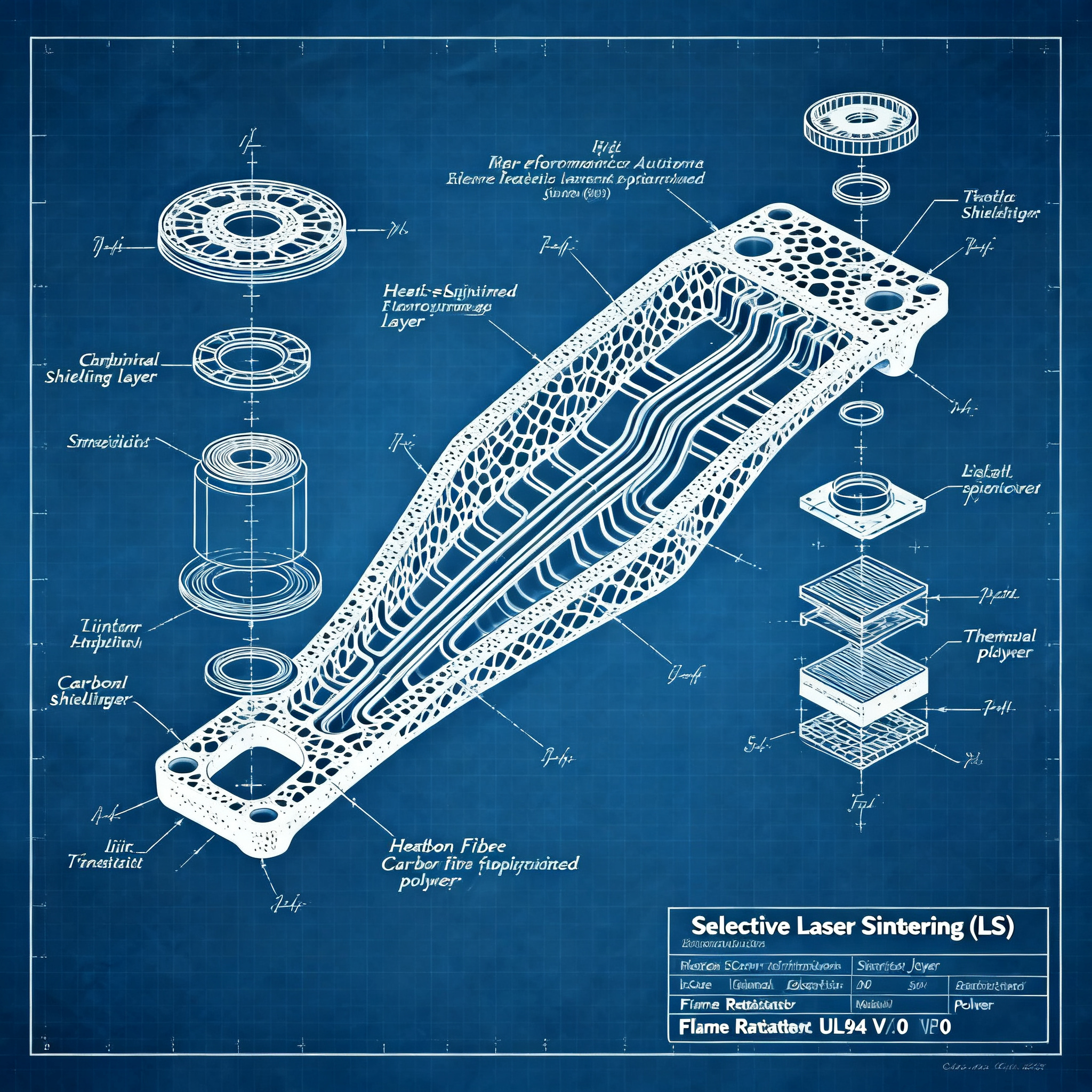
Flame-retardant materials with UL94 V-0 classification are used for structural components of battery packs in competition electric vehicles. This classification guarantees rapid self-extinguishing and no flaming drips during vertical tests.
Printable carbon fiber, used by suppliers such as Dunlop Systems, offers a superior strength-to-weight ratio compared to standard polymers. It is applied to suspension components and engine mounts where cyclic stresses are high.
3D-printed Uddeholm Corrax steel is used for mold inserts in the automotive sector. Toyota Europe produced a 156 kg insert for a hybrid transmission housing, replacing traditional processes that had reliability issues and long lead times.
Studies on optimized suspension components show significant weight reductions while maintaining or improving safety factors. Tier 1 suppliers use dedicated software platforms to compare multiple production scenarios before investing in new lines.
Integrate AM into the workflow without stopping the line
The integration of additive manufacturing in active production environments requires specific strategies to maintain quality and timelines without operational interruptions.
Volkswagen Autoeuropa has integrated 3D printers to produce custom tools and prototypes without interrupting existing assembly lines. The strategy involves dedicated cells operating in parallel with traditional processes.
Lights-out production (without night shift) has become standard practice for teams that need to maximize machine utilization. Remote monitoring systems allow evening prints to be started and find components ready in the morning for immediate testing.
Operational integration of AM
- Critical component identification: Select a part that currently has high costs in terms of time or performance as a pilot project.
- Parallel validation: Produce additive versions while the traditional process continues, comparing results without production risks.
- Digital infrastructure: Create a digital library of on-demand printable parts to reduce warehouse costs and enable distributed production.
- Integrated post-processing: Plan workflows that include depowdering, heat treatments, and finishing without creating bottlenecks.
MacLean Additive, collaborating with Fraunhofer ILT, has produced a 156 kg tool insert for Toyota that solved reliability issues of traditional processes while maintaining equivalent costs. This demonstrates that AM can compete economically even on large-scale components.
Managing additive production as an “internal service” allows teams to balance internal production for immediate needs and shared infrastructure for different materials or technologies. Universities such as Texas A&M have implemented prototyping centers that support motorsport teams with access to specific machines and materials.
Conclusion
The adoption of additive manufacturing in the automotive and motorsport sector requires targeted choices on technology, materials, and operational integration. Documented cases show that competitive advantages emerge when 3D printing is strategically integrated into existing workflows, not as a total replacement but as an intelligent complement.
Evaluate your first AM project starting from an existing critical component: what is the part that costs you the most today in terms of time or performance? Starting with a clear and measurable use case is the most effective way to build internal expertise and justify future investments.
article written with the help of artificial intelligence systems
Q&A
What are the main advantages of 3D printing in the automotive and motorsport industry?
3D printing drastically reduces development times, allows optimization of components under extreme stress, and enables on-demand production without the need for inventory. Additionally, it allows for complex geometries impossible with traditional methods.
How is SLS technology used in the automotive sector?
SLS (Selective Laser Sintering) technology is used to produce high-performance nylon final parts without the need for supports. Brose adopted it for its ability to work with advanced materials and for superior production throughput compared to other technologies.
What materials are used in 3D printing for high-temperature applications in motorsport?
For applications requiring thermal resistance above 150°C, advanced polymers or specific metal alloys are used. These include printable carbon fiber and flame-retardant materials with UL94 V-0 certification for structural components.
How is additive manufacturing integrated into existing production lines?
Integration is achieved through dedicated cells that operate in parallel with traditional processes, without interrupting production lines. Strategies such as lights-out production and remote monitoring are used to maximize operational efficiency.
What are the most commonly used 3D printing technologies and their typical uses?
SLS is used for structural components and connectors; Binder Jetting for medium-high volumes and complex geometries; Metal PBF for critical engine parts; VPP for prototypes and tools. Each technology is chosen based on specific requirements for strength, finish, and volume.