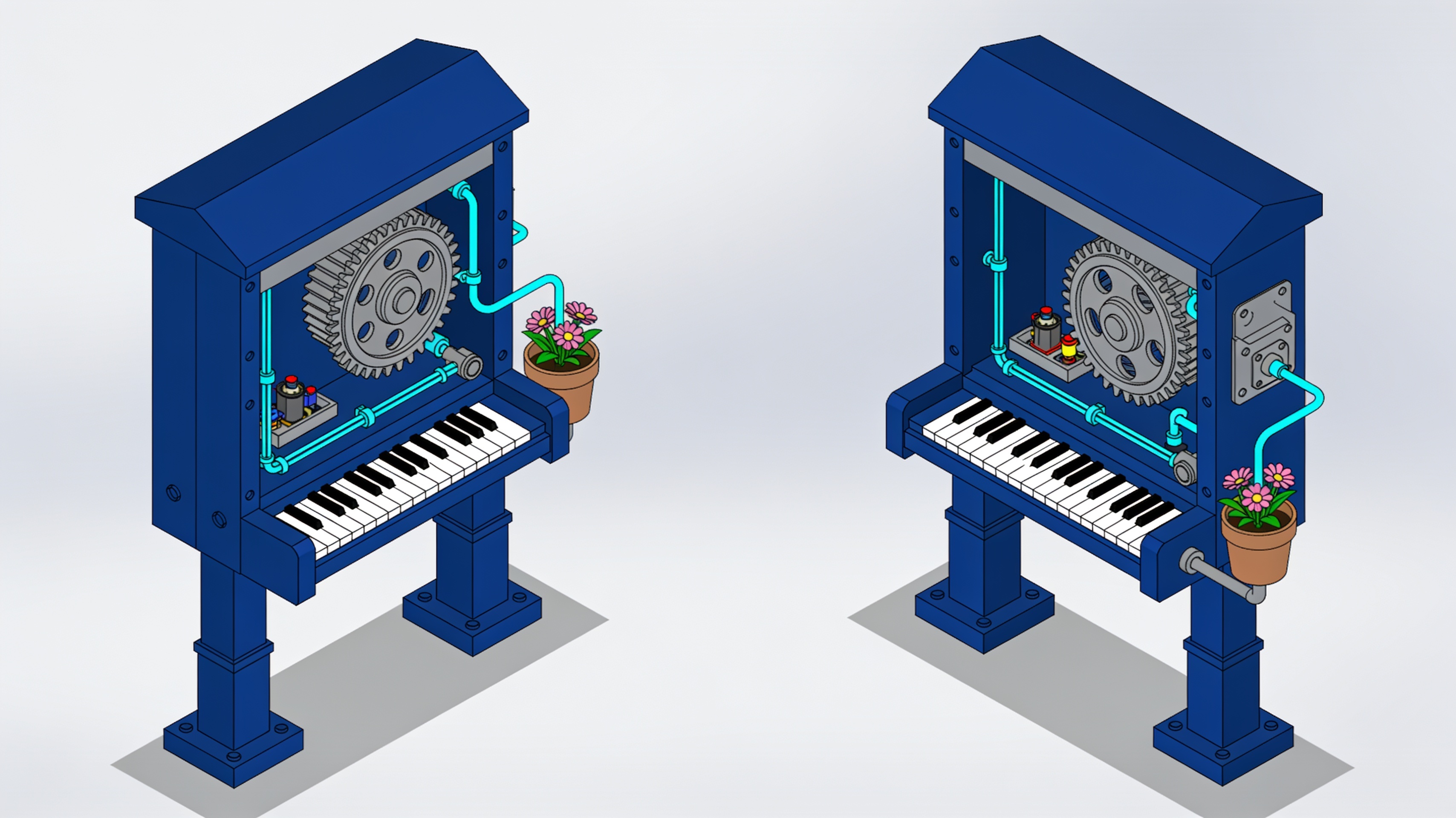
LEGO integrates a 3D-printed piano into the new Venetian Neighbourhood set
The LEGO Group has included a component made with additive manufacturing in the LEGO Icons Venetian Neighbourhood set, an architectural reconstruction of Venice. It is a small street piano with a working mechanism, identified as 3D-printed by TCT Magazine on 16 October 2026.
This is not the first time LEGO has used 3D printing in products intended for the public. In 2025, the group had already introduced a 3D-printed miniature locomotive.
- 5,682-piece set with 17 minifigures dedicated to a Venetian neighbourhood
- 3D-printed piano with a rotating mechanism that produces notes
- Second application of additive manufacturing in a LEGO consumer product
- SLS technology hypothesized for the production of the component
A functional component at reduced scale
The piano is not just decorative: it incorporates a mechanical mechanism that allows it to produce sounds in an extremely limited space.
Set 11388 includes buildings, artisan workshops, a glassworking workshop, an astronomical clock, and a gondola. The assembled model measures over 48 centimeters in height, 64 in width, and 33 in depth.
The piano is placed along the street of the Venetian quarter. A vase with flowers, positioned on top of the instrument, activates a rotating mechanism that produces a short sequence of notes.
The available documentation does not describe a working musical keyboard like that of a real piano. There is no information on integrated electronic systems or synthesizers. The distinctive element is the mechanical function implemented in very small dimensions.
Why 3D printing instead of injection molding
LEGO produces most components by injection molding, an extremely efficient process for millions of identical pieces. Additive manufacturing is chosen for complex geometries or limited volumes.
Injection molding guarantees very short production times and high repeatability after the initial investment in the mold. It is the ideal process for components with established geometries and the precise tolerances required by the brick coupling system.
3D printing does not replace this production model. According to what is reported, its role is different and complementary.
TCT Magazine hypothesizes the use of laser sintering of polymer powders (SLS) for the piano. This technology is suitable for functional prototypes and medium-volume production.
The industrial context of the choice
Ronen Hadar, head of Additive Design and Manufacturing at LEGO, previously explained the group's multi-year work on additive technology.
The group has developed specific expertise in additive manufacturing over the years. The integration of 3D-printed components into consumer products represents a concrete application of this journey.
SLS technology, developed by companies such as EOS, makes it possible to create complex geometries that are impossible or uneconomical with traditional processes. It is particularly suitable when production volumes do not justify investment in dedicated molds.
A product for adult collectors
The Venetian Neighbourhood set is intended for an adult audience, recommended for people aged 18 and over. LEGO presents it as an object to build and display rather than as a traditional toy.
The price and complexity of the model confirm this positioning. With 5,682 pieces and 17 minifigures, the set belongs to the Icons line, dedicated to detailed architectural reconstructions and adult themes.
The inclusion of 3D-printed components in this product category suggests a targeted strategy. LEGO uses additive manufacturing where it can add value through mechanical details or geometries that would otherwise be unachievable, without compromising compatibility with the traditional building system.
article written with the help of artificial intelligence systems
Q&A
In which LEGO set was the 3D-printed piano integrated?
The 3D-printed piano was included in the LEGO Icons Venetian Neighbourhood set, identified by the number 11388. It is an architectural reconstruction of Venice consisting of 5,682 pieces and 17 minifigures.
Does the piano in the LEGO Venice set actually produce sounds?
Yes, the piano incorporates a rotating mechanism that produces a short sequence of notes. A vase with flowers placed on top of the instrument activates the mechanism. However, it is not a functioning musical keyboard like that of a real piano.
Which 3D printing technology was hypothesized for the LEGO piano?
TCT Magazine hypothesizes the use of laser sintering of polymer powders, known as SLS. This technology is suitable for functional prototypes and medium-volume production, consistent with the small size of the component.
Why did LEGO choose 3D printing instead of injection molding for this component?
Injection molding remains LEGO's primary process for millions of identical pieces with established geometries. Additive manufacturing is chosen for complex geometries or limited volumes, as in the case of the piano. The role of 3D printing is therefore complementary, not substitutive.
How many times has LEGO used 3D printing in products intended for the public?
The piano in the Venetian Neighbourhood set represents the second known application of additive manufacturing in a LEGO consumer product. In 2025 the group had already introduced a 3D-printed miniature locomotive.