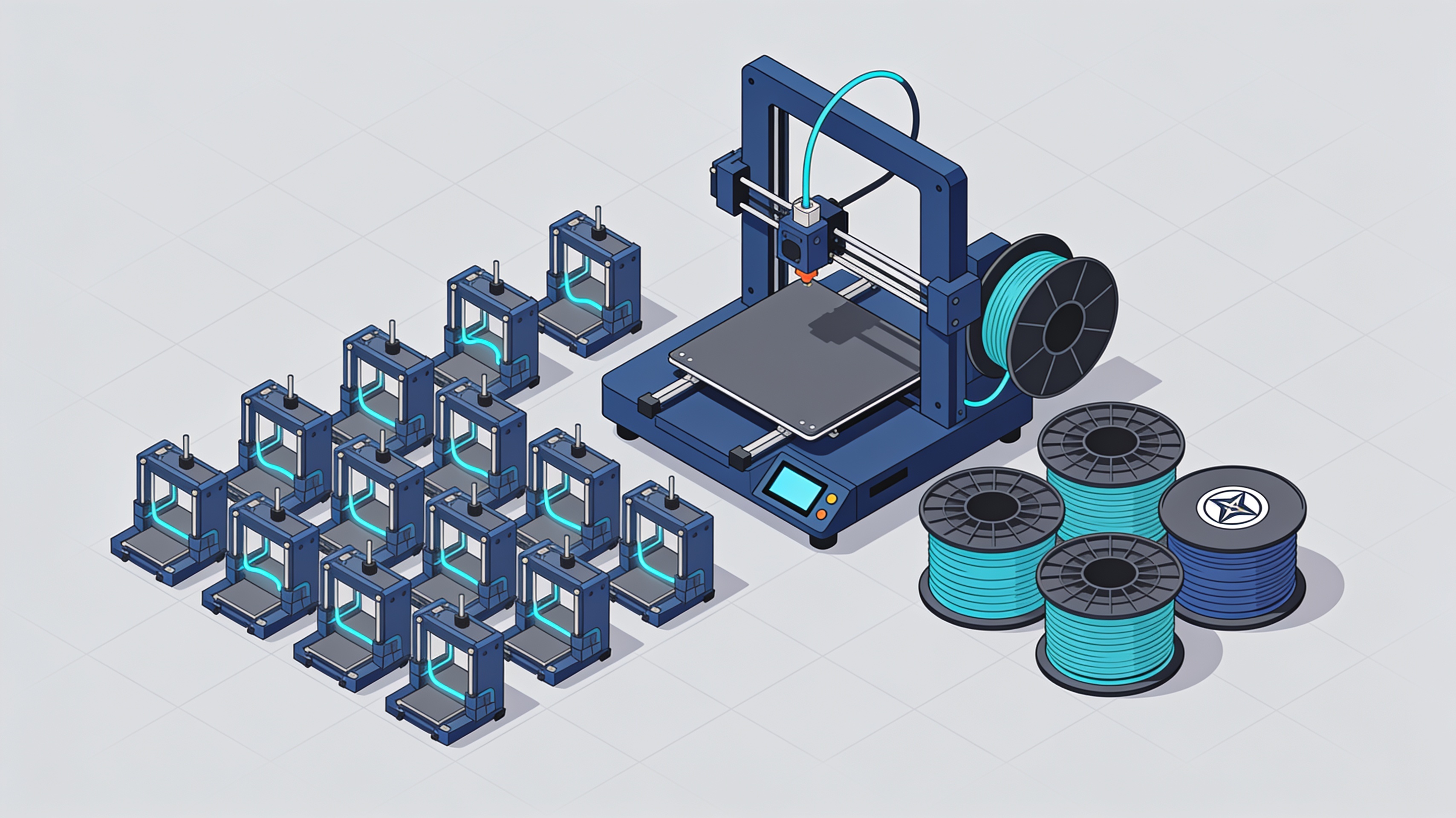
When 3D printers become valuable enough to be stolen: the case of the 20 machines stolen in Calgary
A theft of 20 desktop 3D printers in Calgary, worth more than $20,000, offers an unexpected insight into the maturity reached by the consumer and prosumer additive manufacturing market.
In Calgary, Canada, a break-in at a home led to the theft of 20 3D printers along with various accessories. According to the Calgary Police Service, the total value of the stolen goods exceeds $20,000.
The owner recognized several devices in for-sale listings posted online a few days after the theft. The identification was made thanks to distinctive features on the machines. The investigation led to the recovery of 17 printers and six spools of filament.
An indicator of market maturity
The case does not signal a new crime wave, but reveals how desktop 3D printers have become assets liquid and recognizable enough on the market to represent an attractive target for theft.
Someone considered twenty desktop printers a set of easily resellable goods. Ten or fifteen years ago, it would have been a decidedly less obvious bet.
The episode does not indicate the existence of a new crime wave specifically dedicated to 3D printers. It does, however, show how much the perceived value of desktop hardware has changed.
- 20 3D printers stolen from a home in Calgary
- Total value over $20,000
- 17 machines recovered after online listings were posted
- The case highlights the liquidity achieved by the desktop market
The value comes from accumulation, not from a single machine
The police statement does not assign the same value to each printer. The total includes hardware from different tiers, from consumer to prosumer.
Over $20,000 for the entire lot, not for a single machine. The total includes twenty machines and accessories and may include devices from different tiers.
From the images released by the authorities, the presence of consumer and prosumer hardware is evident. This is not a single very high-value industrial machine.
This makes the case even more interesting. We are not talking about a metal AM machine worth hundreds of thousands of euros stolen from a factory.
We are talking about relatively compact and now fairly common objects. They are found in homes, school labs, small businesses, makerspaces, and print farms.
Print farms as a new high-risk asset
A single desktop printer can cost a few hundred or a few thousand euros. A farm made up of twenty, thirty, or fifty units quickly becomes an asset worth tens of thousands.
It is precisely the print farm that changes the nature of the risk. When a 3D printer was a single experimental object on an enthusiast's workbench, the economic risk was similar to that of many other electronic devices.
A print farm, by contrast, concentrates numerous similar, relatively compact, and easily separable assets. The value arises from accumulation.
Print farms are configurations with dozens of desktop printers operating in parallel for serial production. They represent an increasingly widespread business model among micro-enterprises and service providers.
Implications for physical and digital security
The case raises questions not only of physical security, but also of traceability and asset management in the desktop additive manufacturing sector.
The owner's ability to recognize their own machines thanks to distinctive features enabled recovery. But not all operators have effective identification systems.
The second-hand market for desktop 3D printers is now mature and liquid. This facilitates the resale of stolen devices, but also complicates traceability.
Modern desktop 3D printers increasingly implement connected features. Wi-Fi, cloud, account binding, and remote management are now standard on many mid-range and high-end models.
These features could offer new opportunities for traceability and recovery. However, they also raise cybersecurity and fleet management issues for print farm operators.
Conclusions
The Calgary theft is a local news story. But it offers an interesting snapshot of the transformation undergone by the desktop 3D printing market.
3D printers are no longer niche devices for enthusiasts. They have become widespread production tools, with an active secondary market and an economic value recognizable even outside the maker community.
For print farm operators and those managing printer fleets, the case suggests the importance of implementing asset management and physical security strategies suited to the concentrated value.
article written with the help of artificial intelligence systems
Q&A
How many 3D printers were stolen in the Calgary incident?
Twenty desktop 3D printers along with various accessories were stolen during a break-in at a residence. The total value of the haul was estimated at over $20,000.
How were the stolen 3D printers recovered?
The owner recognized the devices thanks to particular features noticed in some for-sale listings posted online a few days after the theft. The police investigation led to the recovery of 17 of the 20 machines.
What does this theft indicate about the 3D printer market?
The event signals the maturity of the market, demonstrating that desktop printers have become liquid and easily resellable goods. Unlike ten years ago, they now represent an attractive target for thefts.
What type of hardware was involved in the theft?
The stolen batch included a mix of consumer and prosumer hardware, not individual ultra-high-cost industrial machines. These are compact devices now common in homes, schools, and print farms.
Besides the printers, what else was recovered by the authorities?
In addition to the 17 printers returned, the investigation led to the recovery of six spools of filament. These materials were among the accessories stolen along with the machines.