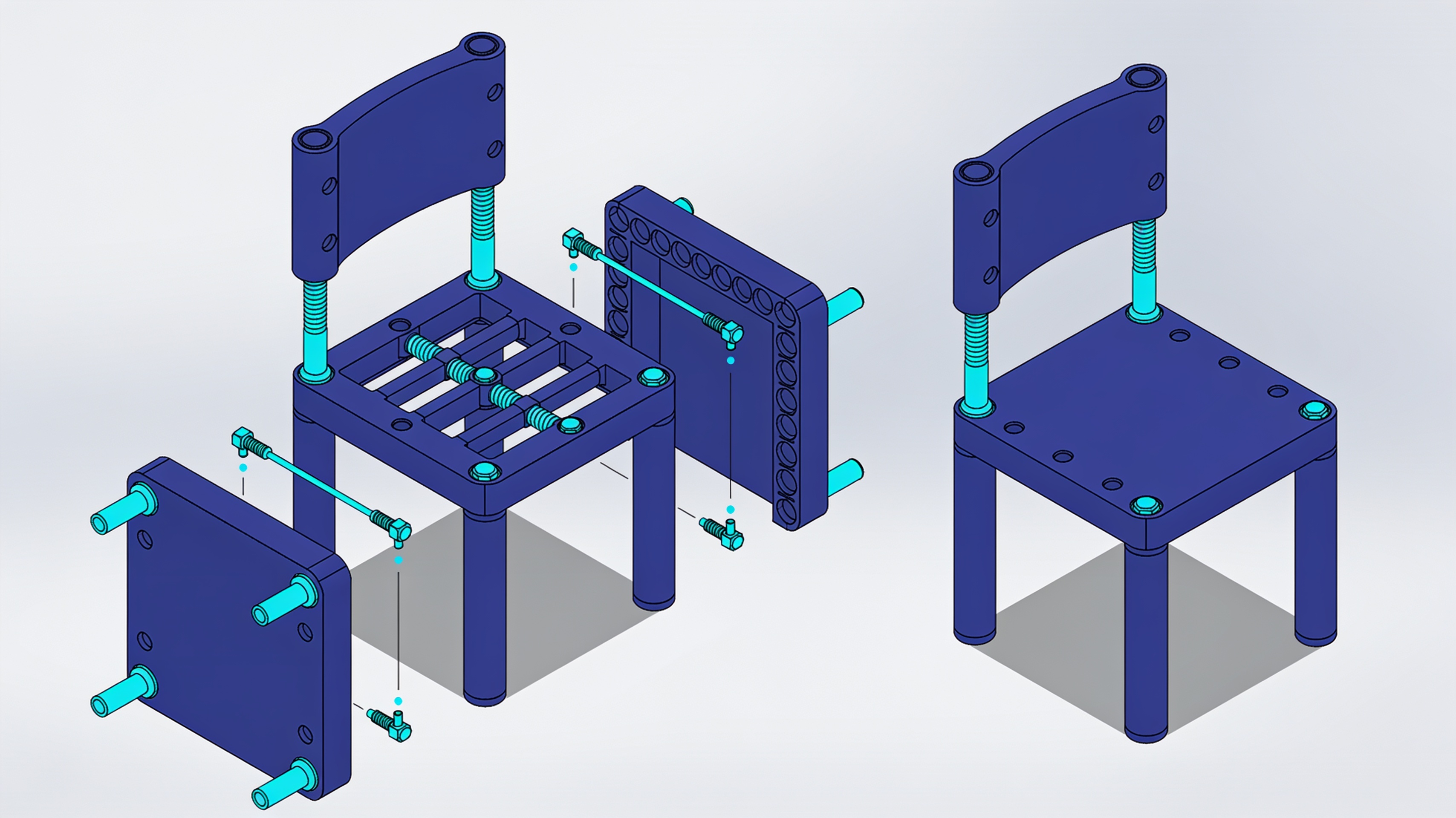
SNAP3D: from image to glue-free assemblable 3D printing
A system developed at Carnegie Mellon University generates 3D models from a single photo and makes them physically assemblable. Six objects were printed in PLA and manually assembled without fasteners.
AI-based 3D generators can reconstruct objects from photographs. The problem is that the resulting models can rarely be printed, divided into components, and assembled in physical reality.
SNAP3D bridges this gap between visualization and fabrication. The system does not merely segment a model into semantic parts: it corrects geometric intersections, identifies the necessary contact points, and automatically generates peg-and-socket connections.
How physical grounding works
SNAP3D applies physical simulation to optimize the position, orientation, and dimensions of the generated components, transforming visually correct meshes into truly assemblable parts.
The research group composed of Yu-Rou Tuan, Hao-Tang Tsui, Nicolás Ugrinovic, Kris Kitani, and Xiaoxuan Ma published the preprint on arXiv on September 11, 2026.
The system uses physical simulation to verify that the generated parts can actually fit together. This optimization phase modifies geometry and positioning while maintaining fidelity to the original model.
- Simulated stability: 95% versus 0-2% for existing part-aware systems
- Six objects printed in PLA on a Bambu Lab A1 mini and assembled without fasteners
- Geometric fidelity maintained after physical optimization
The problem with current 3D generators
Models such as XPart, OmniPart, and PartCrafter correctly identify semantic parts but generate geometries that intersect or do not touch where they should.
A chair leg and seat can look perfect when viewed separately. But a portion of the leg can occupy the same space as the seat, making physical printing impossible.
These systems produce representations useful for editing and animation. For real fabrication, geometric and physical constraints are needed that standard generators do not consider.
From simulation to physical printing
The team verified the results by printing six complete objects and assembling them manually, demonstrating that the system works beyond simulation.
The objects were printed in PLA on a Bambu Lab A1 mini. Assembly took place without glue, screws, or other external fastening elements.
This transition from simulation to physical reality is crucial. Many 3D generation systems remain confined to the digital domain without ever addressing the constraints of real additive manufacturing.
SNAP3D still does not turn a photograph into a certified mechanical product. The system mainly generates rigid assemblable objects and verifies stability under simplified physical models, without considering assembly sequence, elastic deformation, material strength, or real structural loads.
Implications for additive manufacturing
The system opens interesting scenarios for rapid prototyping and reverse engineering, but it still requires development before critical industrial applications.
The ability to generate assemblable parts from a single image could accelerate the prototyping process. A designer could photograph a physical sketch or an existing object and obtain printable components.
Structural or functional applications still require engineering analysis. SNAP3D does not consider fatigue, manufacturing tolerances, or the thermal behavior of materials.
The benchmark used by the authors shows a clear leap: the compared part-aware systems achieve a simulated stability between 0 and 2%, while SNAP3D reaches 95%.
Future perspectives
The research demonstrates that the gap between AI generation and physical manufacturing can be bridged with approaches that integrate simulation and geometric optimization.
Future developments could include composite materials, articulated joints, and more sophisticated structural analysis. Integration with slicing software could automate the entire flow from photo to G-code.
article written with the help of artificial intelligence systems
Q&A
What is SNAP3D and what sets it apart from AI-based 3D generators?
SNAP3D is a system developed at Carnegie Mellon University that generates 3D models from a single photo, making them physically assemblable. Unlike generators such as XPart, OmniPart, and PartCrafter, it doesn't just segment semantic parts: it corrects geometric intersections and automatically generates peg-and-socket connections.
How does SNAP3D's physical grounding work?
The system applies physical simulation to verify that the generated parts can actually fit together. This phase optimizes the position, orientation, and dimensions of the components, transforming visually correct meshes into truly assemblable parts while maintaining fidelity to the original model.
What results has SNAP3D achieved in terms of stability?
SNAP3D achieves 95% simulated stability, compared to 0-2% for existing part-aware systems. This indicates that the generated parts remain reliably assembled in physical simulation.
Has SNAP3D been tested with real 3D prints?
Yes, the team printed six complete objects in PLA on a Bambu Lab A1 mini and assembled them manually without glue, screws, or other external fastening elements. This demonstrates that the system works beyond digital simulation alone.
Who developed SNAP3D and when was it published?
The research group consists of Yu-Rou Tuan, Hao-Tang Tsui, Nicolás Ugrinovic, Kris Kitani, and Xiaoxuan Ma. The preprint was published on arXiv on September 11, 2026.