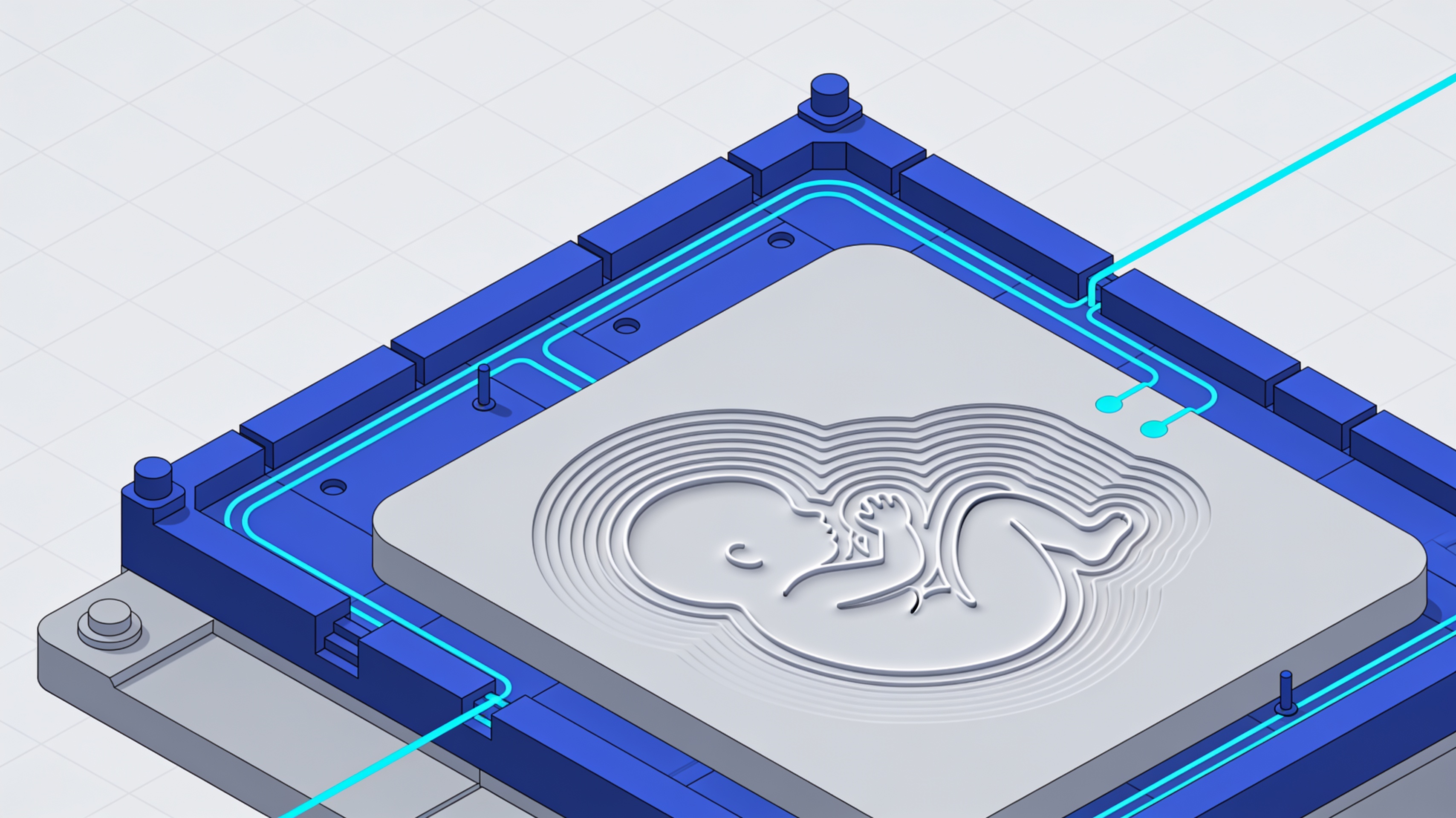
3D-printed tactile ultrasound scans for blind parents: the British First Hello initiative
The UK's leading sight loss charity has launched a pilot programme that uses 3D printing to make ultrasound scans accessible to blind expectant parents. The initiative responds to a need that emerged from a survey of 2,000 adults with visual impairment.
A real need revealed by the data
A survey of 2,000 British adults with visual impairment revealed that more than half consider standard ultrasound scans not very inclusive.
Guide Dogs, the UK's leading sight loss charity, conducted a survey that highlighted significant data. 54% of respondents believe that standard ultrasound scans should be more inclusive.
Eight in ten people said that all parents should be able to experience the important moments of pregnancy, such as seeing the first ultrasound scan. Almost 64% said that family members with visual impairment would feel more included if they could physically touch an ultrasound scan.
- 54% consider standard ultrasound scans not very inclusive
- 80% believes that all parents should experience the key moments of pregnancy
- 64% would like to be able to physically touch ultrasound scans
The First Hello program
The pilot initiative transforms two-dimensional ultrasounds into tactile three-dimensional models using additive manufacturing technology.
First Hello is the name of the program launched by Guide Dogs to respond to this need. The service offers blind or visually impaired parents in the United Kingdom tactile ultrasounds: 3D-printed models of the 20-week pregnancy ultrasound.
These models allow expectant parents to physically perceive the contours of the unborn child. The technology transforms the two-dimensional ultrasound image into a tangible three-dimensional object.
The service is also available to sighted parents who have family members with visual impairment. In this way, grandparents, aunts and uncles, and other relatives can also participate in this important moment.
The organization's statements
Kerry Bevan, head of support services at Guide Dogs, commented on the initiative in clear terms. “Every parent, grandparent, and loved one deserves to experience the joy of the early moments of parenthood.”.
“Too often, people with sight loss are excluded from significant life moments that others take for granted,” added Bevan. The statement emphasizes that accessibility is not only a technical issue but also an emotional and social one.
For blind people, touching objects with their fingers is the main way to “see.” 3D printing makes it possible to transform two-dimensional images into three-dimensional objects that can be explored tactilely.
Broader applications of the technology
3D printing is demonstrating growing potential in making experiences and content accessible to people with visual impairments.
Additive manufacturing technology is already used in various contexts to improve accessibility. Applications range from sporting events to museums, where tactile models make it possible to “see” with your hands.
In education, 3D printing helps blind students learn complex concepts. Geometry, biology, and sex education become more accessible through three-dimensional models.
There are also promising future developments. The technology could make it easier for blind patients to take medication and allow blind women to read pregnancy tests independently.
A necessary cultural change
The First Hello initiative represents more than a simple technological service. It highlights how inclusive design must consider the needs of all people from the outset.
Ultrasounds are an emotionally charged moment for all parents. Making this experience accessible means recognizing every person's right to fully experience the important moments of their life.
3D printing proves to be an enabling technology not only for industrial production but also for social inclusion. Its use in fields such as healthcare demonstrates how technological innovation can have a direct impact on people's quality of life.
article written with the help of artificial intelligence systems
Q&A
What is the First Hello initiative?
First Hello is a pilot program launched by Guide Dogs that transforms two-dimensional ultrasounds into tactile 3D models. The goal is to allow blind or visually impaired parents to physically perceive the fetus.
What data motivated the First Hello project?
A survey of 2,000 adults with visual impairments revealed that 54% find standard ultrasounds insufficiently inclusive. Additionally, 64% expressed a desire to physically touch an ultrasound image.
Who can request 3D-printed tactile ultrasounds?
The service is primarily aimed at expectant blind or visually impaired parents in the UK. It is also available to sighted parents who wish to share the experience with family members affected by visual disabilities.
At what stage of pregnancy does the 3D model correspond?
The 3D-printed models created under the First Hello program reproduce the ultrasound image taken at 20 weeks of pregnancy. This allows for a detailed perception of the baby's contours.
What is the stated social purpose of Guide Dogs with this project?
The organization aims to include people with vision loss in significant life moments often taken for granted. Kerry Bevan emphasizes that every parent and loved one deserves to experience the joy of these early moments.