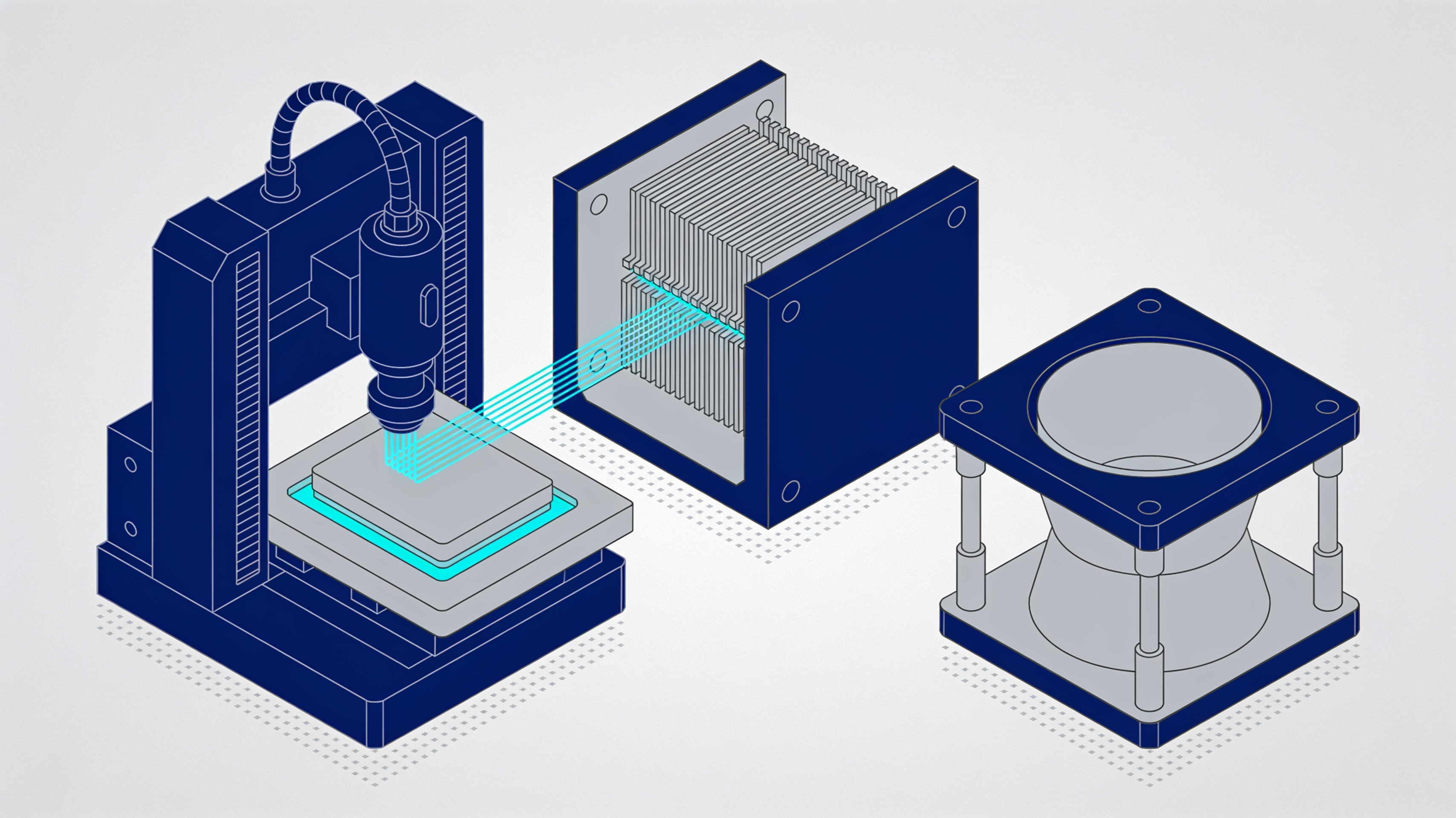
Short or continuous fiber: which type of reinforcement to choose for 3D printed parts?
- Le fibre corte si disperdono nella matrice plastica come rinforzo distribuito, simile all’armatura nel calcestruzzo
- Continuous fibers are long filaments that run through the entire component, offering superior mechanical properties
- The choice depends on the application: short fibers are more versatile, continuous ones guarantee maximum strength
Composites in 3D printing: two approaches compared
Composite materials combine a polymer matrix with fiber reinforcements to achieve superior mechanical properties, sometimes comparable to metals. Extrusion technology offers two distinct modes of fiber integration.
When 3D printing composites, the choice of reinforcement type determines the final performance of the component. Short and continuous fibers represent two different construction philosophies, each with specific advantages.
Composite materials consist of at least two components: a polymer matrix (PLA, ABS, PETG, polypropylene, HIPS) and a fiber reinforcement (carbon, glass, or aramid). The matrix acts as a binder, while the fiber provides the mechanical properties.
Short fibers: distributed reinforcement
Short fibers are fragments of fibrous material ranging from millimeters to centimeters, uniformly dispersed in the plastic matrix.
This approach works like reinforcement in concrete. The fiber fragments are distributed in the polymer during extrusion, creating a homogeneous reinforcement throughout the volume.
The reduced length allows the fibers to flow through the printer nozzle together with the thermoplastic material. The process remains similar to traditional 3D printing, with limited hardware modifications.
Continuous fibers: maximum directional strength
Continuous fibers are uninterrupted filaments that run through the entire length of the component, integrated into the plastic matrix during printing.
These long threads maintain structural continuity along specific directions. The result is a composite with significantly superior mechanical properties compared to short fibers.
The integration requires dedicated technologies. Companies such as Anisoprint, Markforged, Continuous Composites, CEAD, Moi Composits, SphereCube, Fabheads, 9T Labs, Arevo, Reinforce 3D, and Roboze have developed specific systems for this application.
| Feature | Short fiber | Continuous fiber |
|---|---|---|
| Fiber length | Millimeters or centimeters | Entire length of the component |
| Reinforcement distribution | Homogeneous in volume | Directional |
| Hardware compatibility | Standard printers (modified) | Dedicated systems |
| Mechanical properties | Moderate, isotropic | High, anisotropic |
Composition and operation
Both systems share the same basic structure: reinforcement plus matrix, bonded by a resin that ensures adhesion between the components.
The reinforcement provides strength and stiffness. The polymer matrix contains the fibers and transfers loads. A resin ensures adhesion between fiber and polymer during production.
This combination makes it possible to obtain materials that outperform the individual components. In some cases, 3D printed composites achieve strengths comparable to certain metals.
Selection criteria for the application
The selection of the type of reinforcement depends on the mechanical requirements, the geometry of the part, and the available technologies.
Short fibers offer greater geometric versatility. They can fill complex shapes without directional constraints. The reinforcement is uniformly distributed, resulting in nearly isotropic properties.
Continuous fibers provide superior performance along specific directions. They are ideal for structural components with defined loads. However, they require careful design of deposition paths.
Material extrusion is the most widespread technology for 3D printing composites, both with short and continuous fibers. Other technologies exist but have limited market penetration.
Available materials
The most common reinforcements in the 3D printing industry are carbon fiber, glass fiber, and Kevlar (aramid), each with specific characteristics.
Carbon fiber offers the best strength-to-weight ratio. Fiberglass ensures good performance at a low cost. Kevlar provides excellent impact and abrasion resistance.
Polymer matrices range from commodity materials (PLA, ABS) to advanced engineering polymers (PETG, TPU, Onyx). The choice depends on the operating temperatures and required chemical properties.
The final decision between short and continuous fibers must consider the trade-off between mechanical performance, manufacturing complexity, and costs. Short fibers democratize access to composite materials, while continuous fibers push the limits of achievable performance with additive manufacturing.
article written with the help of artificial intelligence systems
Q&A
What are the main differences between short and continuous fibers?
Short fibers are fragments of fibrous material dispersed in the plastic matrix, while continuous fibers are uninterrupted filaments that run through the entire length of the part, offering superior mechanical properties.
In which applications is it recommended to use short fibers?
Short fibers are more versatile and can be used in applications where high directional strength is not required, making them suitable for prototypes and less stressed parts.
What technologies are necessary for the integration of continuous fibers?
The integration of continuous fibers requires dedicated technologies, such as those developed by companies like Anisoprint and Markforged, which use specific systems to ensure structural continuity.
What is the role of the polymer matrix in composite materials?
The polymer matrix acts as a container for the fibers and contributes to giving the composite the desired mechanical properties, combining the advantages of the fibers with the characteristics of the polymer.
How does fiber length affect mechanical properties?
Fiber length affects reinforcement distribution: short fibers offer homogeneous reinforcement, while continuous fibers provide directional strength, improving mechanical performance in specific directions.