Can you really recycle your 3D filament at home?
Creality is developing a 3D filament recycling system designed for home use, composed of a shredder and an extruder that turn print failures into new, ready-to-use filament.
How desktop recycling works
The process starts with the fragmentation of waste plastic, then moves on to its melting and re-extrusion into usable filament.
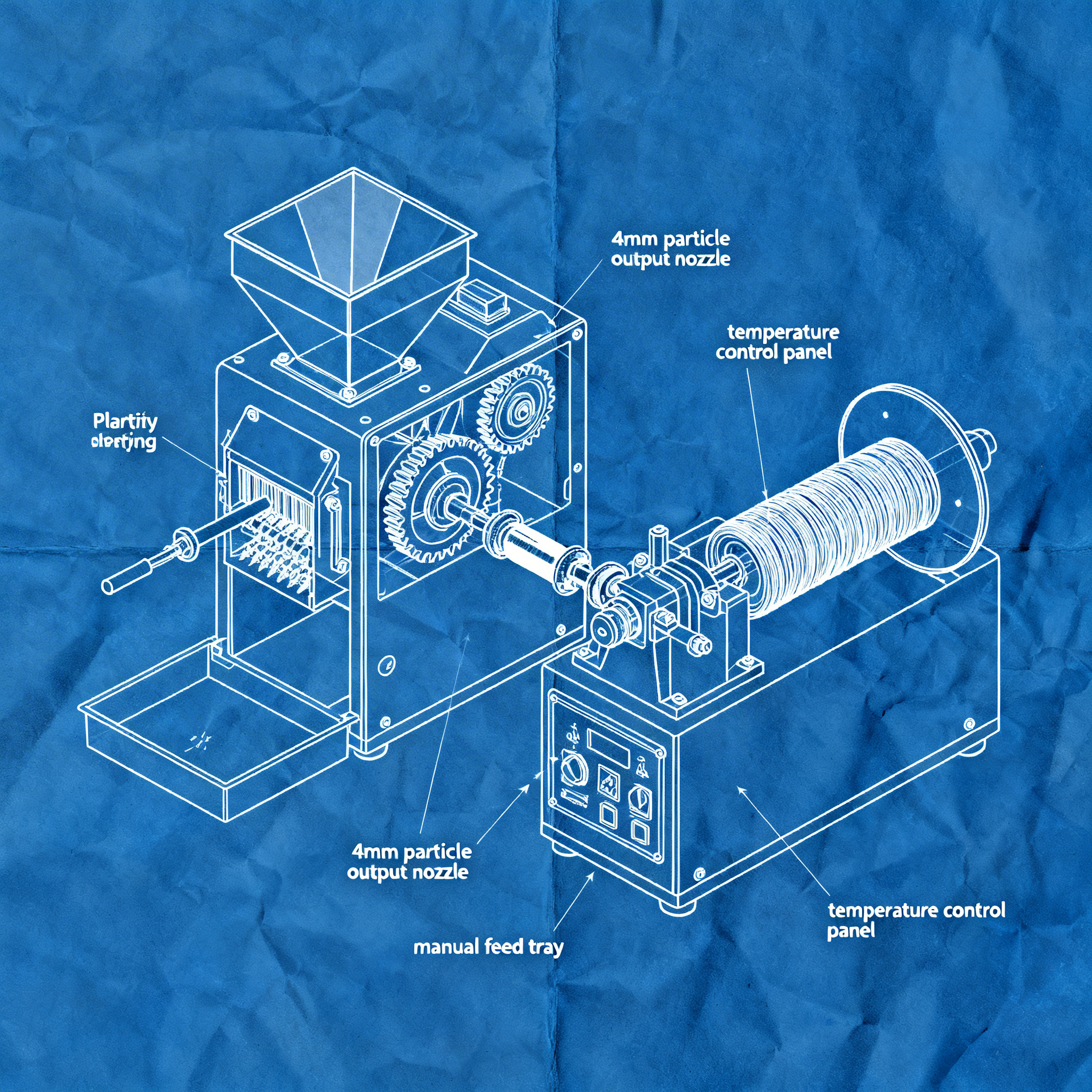
The Creality system is based on two distinct machines that work in sequence. The first reduces plastic waste into uniform particles. The second melts the material and extrudes it in the form of filament.
The overall dimensions are comparable to a large Core XY printer, with a height of 560 mm. When placed side by side, the two units occupy just under one meter in length.
- Declared production: 1 kg/h of filament
- Tolerance with virgin pellets: ±0.05 mm
- Tolerance with recycled material: ±0.1 mm
- Compatible materials: PLA, PETG, ABS, ASA, PA, PC, TPU, PET
Shredder R1: the first phase
The Shredder R1 shreds and dries plastic waste, preparing it for extraction. It is the entry point of the recycling system.
The task of the Shredder R1 is twofold: to fragment and to dry. Print failures are reduced to uniform particles of a maximum of 4 mm. This size ensures a constant flow in the next phase.
Drying is fundamental for hygroscopic materials like nylon. Residual moisture would compromise the quality of the final filament. The particles are removed manually and transferred to the extruder hopper.
Filament Maker M1: custom extrusion
The Filament Maker M1 allows for the production of filaments with controlled tolerances and opens the door to creative experimentation thanks to its compatibility with additives.
The Filament Maker M1 melts the particles and extrudes them through a calibrated nozzle. A moving carriage pulls the emerging filament through several cooling points. This lowers the temperature of the plastic until it stabilizes.
The carriage slides on guides and features a handle, suggesting it may require manual movement. The operator must then insert the filament into the spool to begin the winding process.
The system allows for mixing virgin pellets with recycled material, adding natural fillers like coffee grounds or scented materials, and creating custom color gradients with patience.
The tolerance of ±0.1 mm for recycled material is higher than professional standards (±0.05 mm or less), but remains usable on well-calibrated printers. Tests with prototypes have confirmed that the produced filament prints effectively, although with imperfect results due to diameter variations.
Limits and potential of the system
Although it still requires manual intervention, the system offers flexibility and direct control over the quality of the produced filament.
Desktop recycling systems have historically faced three main obstacles. The cost of equipment often exceeds the savings on recycled filament. Management requires constant attention and technical expertise. The quality of the final product remains inferior to commercial filament.
The Creality system does not completely eliminate these problems. It still requires manual intervention at various points in the process. Separation of materials by type and color remains the user's responsibility.
| Appearance | Commercial filament | M1/R1 System |
|---|---|---|
| Diameter tolerance | ±0.02-0.05 mm | ±0.05-0.1 mm |
| Manual intervention | None | Required |
| Customization | Limited | Wide |
| Process control | External | Direct |
The main advantages lie in flexibility. Users can experiment with custom blends, unique colors, and specific additives. Direct control over the production process allows for rapid iterations for particular applications.
PLA and PETG are considered the easiest materials to recycle professionally into filament. Compatibility with eight different materials expands possibilities, but the actual quality with each remains to be verified in real conditions.
Conclusion
This system represents a tangible first step towards a circular economy in the maker sector, while still leaving room for improvement. The technology is not yet fully automated nor does it reach industrial quality standards.
The main value lies in returning control of the raw material to the users. For those who print frequently and generate a lot of waste, the system can reduce operational costs. For those seeking extreme customization, it opens creative possibilities that would otherwise be inaccessible.
Want to try recycling your print waste on your own? Keep an eye on the official Creality news for the commercial launch.
article written with the help of artificial intelligence systems
Q&A
- What are the main components of the Creality recycling system?
- The system consists of two distinct machines: an R1 Shredder to shred and dry plastic waste, and an M1 Filament Maker to melt and extrude the material into new filament.
- What materials can be recycled with this system?
- Compatible materials include PLA, PETG, ABS, ASA, PA, PC, TPU, and PET, allowing for a wide range of applications.
- How much filament can the system produce per hour?
- The declared production is approximately 1 kg/h of filament, making it suitable for domestic but not industrial use.
- What is the tolerance of the produced filament compared to commercial ones?
- The tolerance is ±0.05 mm with virgin pellets and ±0.1 mm with recycled material, slightly higher than professional standards but still usable.
- What are the main limitations of the Creality desktop recycling system?
- Among the limitations are the need for manual intervention in various stages, the manual separation of materials, and a filament quality that is still inferior to commercial ones, despite the greater customization possible.