Polymaker HT-PLA Pro: thermal and impact resistance in a single filament
Polymaker has introduced HT-PLA Pro, a new filament for FFF 3D printing that combines ease of printing, high temperature stability and resistance to repeated impacts. The material originates from the integration of two previous development lines of the company: PLA Pro for toughness and HT-PLA for thermal resistance.
The analysis published by Fabbaloo, a publication of Terran Data Corporation, examined the material's performance through comparative tests with other polymers, including traditional PLA, ABS, PETG, polycarbonate and PA12.
- HT-PLA Pro combines thermal resistance and toughness in a PLA filament
- Comparative tests show a favorable balance between cyclic impact and heat stability
- Maintains the ease of printing typical of traditional PLA
- Exceeds the thermal limits of standard PLA (55-60°C)
The limits of traditional PLA
Il PLA è il materiale più diffuso nella stampa FFF, ma presenta criticità note quando esposto a temperature elevate o sollecitazioni meccaniche ripetute.
Il PLA tradizionale domina il mercato dei filamenti per la facilità d’uso. Il ritiro contenuto e l’ottima adesione al piano permettono stampe affidabili senza camera riscaldata.
I problemi emergono in condizioni operative critiche. La temperatura di transizione vetrosa si colloca tra 55-60°C: oltre questa soglia, la parte amorfa del polimero acquisisce mobilità e il componente perde rigidità sotto carico.
La fragilità rappresenta l’altro limite significativo. Un pezzo in PLA standard può resistere alla trazione ma si rompe in modo fragile sotto urti o deformazioni ripetute.
L’evoluzione della gamma Polymaker
Polymaker aveva già sviluppato soluzioni separate per tenacità e resistenza termica. HT-PLA Pro integra entrambe le caratteristiche.
PLA Pro è stato formulato per aumentare tenacità e resistenza agli urti rispetto al PLA comune. HT-PLA si concentra invece sulla stabilità termica.
HT-PLA-GF aggiunge fibre di vetro per incrementare rigidità e controllo dimensionale. Questa variante offre prestazioni meccaniche superiori ma richiede ugelli resistenti all’abrasione.
| Material | Main feature | Typical application |
|---|---|---|
| PLA tradizionale | Printability | Prototipi estetici |
| PLA Pro | Toughness | Impact-resistant components |
| HT-PLA | Thermal stability | Heated environments |
| HT-PLA-GF | Rigidity with fibers | Structural parts |
| HT-PLA Pro | Thermal + toughness | Cyclic hot stresses |
Comparative tests
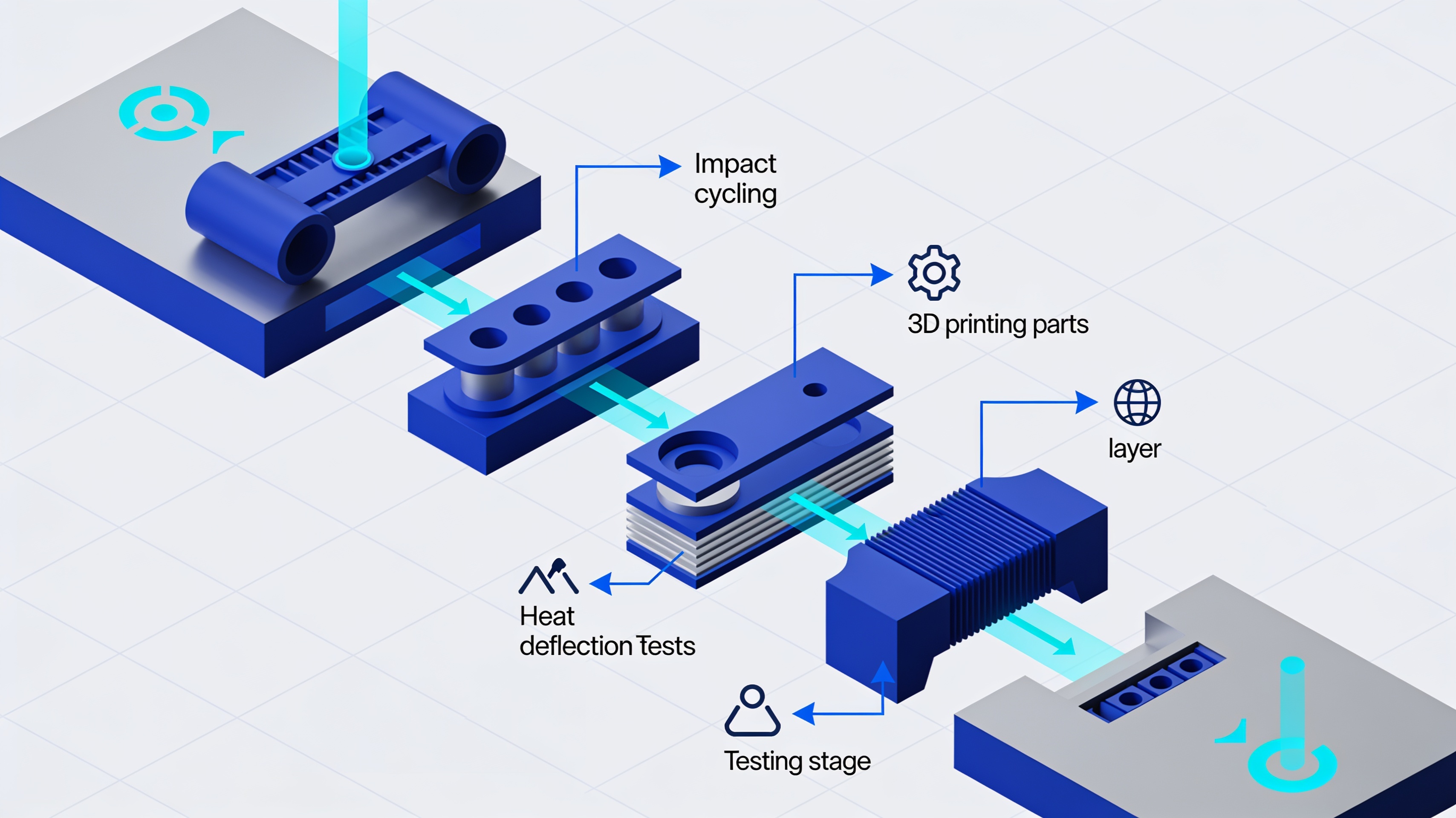
Polymaker has developed a specific test bench to evaluate behavior under repeated stresses in a heated environment.
The comparison included Polymaker's entire PLA range plus alternative materials such as ABS, PETG, polycarbonate, and PA12. The tests evaluated cyclic impact resistance and thermal behavior.
The results show that HT-PLA Pro maintains a favorable balance with the geometry and printing parameters used by Polymaker. The material is not automatically superior to every polymer in any application.
The results depend on the sample geometry, printing parameters, and type of stress. Performance may vary in real applications with different conditions.
Target applications
HT-PLA Pro is intended for components that must operate in heated environments while maintaining impact resistance.
The material retains the typical workability of PLA, allowing prints without a heated chamber. This feature reduces hardware requirements compared to materials like polycarbonate or PA12.
Applications include mechanical components exposed to moderate temperatures, parts subject to vibrations or repeated impacts, and functional prototypes for testing under realistic operating conditions.
The thermal stability superior to standard PLA expands the range of use in automotive, household appliances, and industrial equipment sectors where operating temperatures exceed 60°C.
article written with the help of artificial intelligence systems
Q&A
What are the main features of Polymaker HT-PLA Pro?
HT-PLA Pro combines the printability of PLA with enhanced heat resistance and toughness against repeated impacts. This filament integrates the properties of previous PLA Pro and HT-PLA lines.
What is the thermal limit of traditional PLA compared to HT-PLA Pro?
Traditional PLA loses rigidity above 55-60°C due to its glass transition temperature. HT-PLA Pro is specifically designed to overcome these operational limits while maintaining hot stability.
How does HT-PLA Pro differ from the HT-PLA-GF variant?
While HT-PLA-GF adds glass fibers to increase stiffness and requires abrasion-resistant nozzles, HT-PLA Pro focuses on combining toughness and thermal stability without abrasive additives.
For which applications is HT-PLA Pro most suitable?
This material is ideal for components subject to cyclic stresses in heated environments, where standard PLA would fail due to brittleness or thermal deformation.
Which materials were used in the comparative tests cited in the article?
Fabbaloo's analysis compared HT-PLA Pro with traditional PLA, ABS, PETG, polycarbonate, and PA12 to evaluate its mechanical and thermal performance.