Photocentric's JENI: when 3D printing challenges injection molding in high volumes
The British company Photocentric presents an automated production platform that promises to produce hundreds of thousands of components per day. The goal: to compete with injection molding on cost and volume, eliminating tooling times and costs.
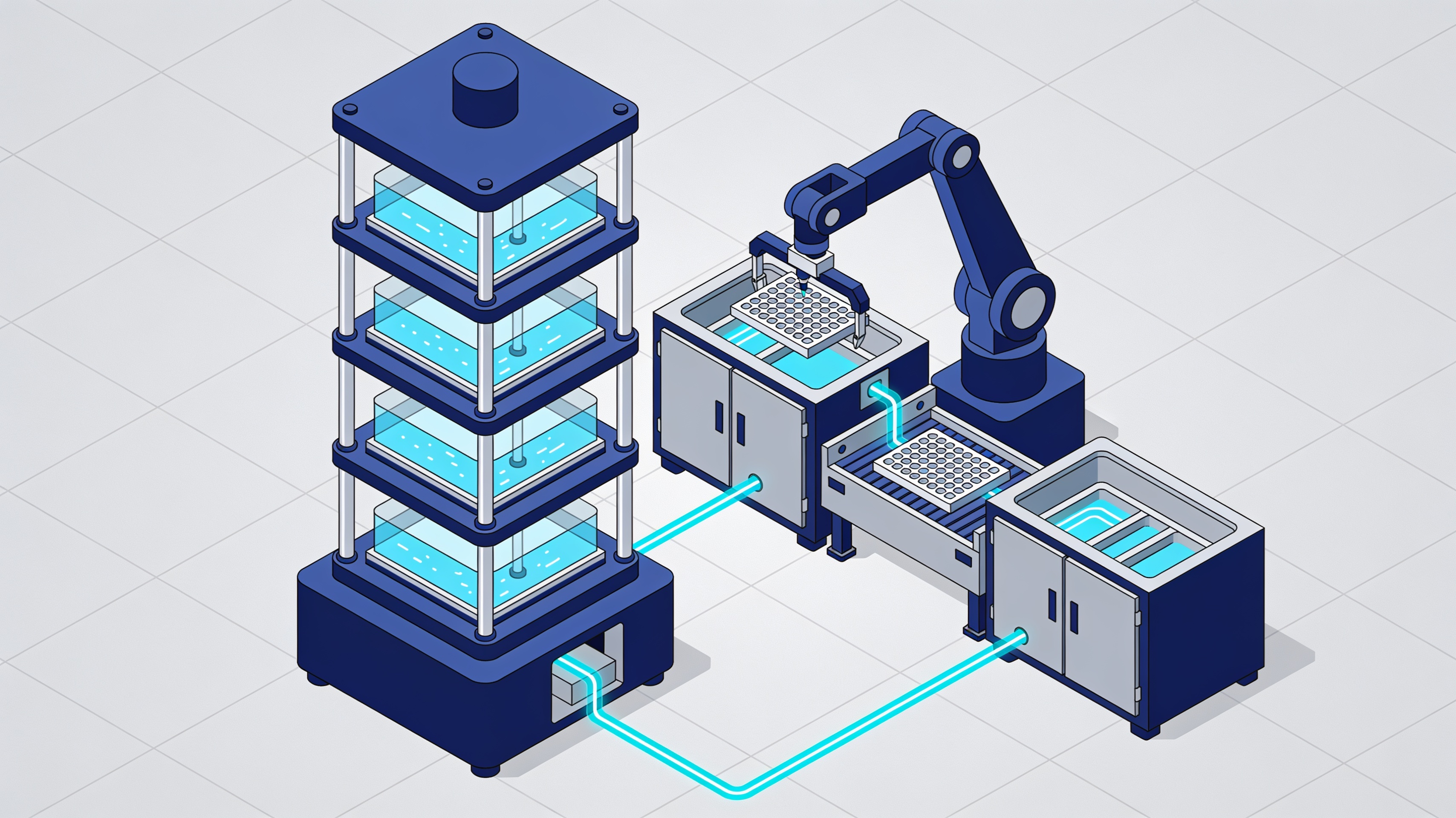
JENI does not look like a conventional 3D printer. It is a modular tower illuminated by intense red light, with stacked sections reminiscent of a server farm's infrastructure. Photocentric designed it to fully automate additive manufacturing, from printing to post-processing.
- JENI combines high-resolution LCD 3D printing with robotic post-processing
- A single module produces up to 238,000 spacers per day at less than $0.02 each
- Expandable modular system: nodes can be added to increase production capacity
- Compatible with 405 nm resins, including bio-based formulations
Tooling-free mass production
Photocentric describes JENI as “tooling-free injection molding,” focusing on automation and competitive costs for industrial volumes.
The British company claims that 3D printing has never been the limit for mass production. The real obstacles would have been labor, manual handling, batch-to-batch variability, and material cost.
JENI eliminates these bottlenecks by operating continuously and without supervision. Each job carries with it specific process parameters that the system applies automatically. The result: labor costs reduced to zero and materials becoming the main budget item.
In the case of plastic spacers, simple components but produced in millions of units, a JENI module reaches 238,000 pieces per day. The unit cost drops below two cents.
Modular and scalable architecture
The system grows in modules: it starts with a robotic controller and a process node, then expands based on production requirements.
JENI integrates high-resolution LCD 3D printers with post-processing nodes connected to high-speed robotic systems. The modular architecture makes it possible to add production capacity without redesigning the entire plant.
The digital file sent to the platform contains both the printing instructions and the entire sequence of subsequent operations. Washing, polymerization, and other phase times are predefined in the file itself.
JENI operational workflow
- File upload: The digital file includes complete geometry and process parameters
- Automatic assignment: JENI monitors every node and assigns the job to the first available one
- LCD printing: High-resolution production with photopolymer resins
- Robotic post-processing: Washing, curing, and finishing without manual intervention
The system monitors every node in real time and assigns the job to the first one that meets the technical requirements. This distributed approach maximizes efficiency and reduces downtime.
Materials and applications
JENI works with 405 nm photopolymer resins, both proprietary and third-party, opening up to technical and bio-based formulations.
Users can choose between resins formulated by Photocentric and other materials compatible with a 405 nm wavelength. This openness makes it possible to select specific formulations for the final application.
Among the proprietary materials is Durable DL902 Plant-Based, a technical resin with bio-based raw materials. Compatibility with third-party materials avoids the technological lock-in typical of many additive manufacturing systems.
The LCD technology used by JENI offers high resolution and higher printing speeds compared with other photopolymer technologies. The 405 nm wavelength is an industry standard, ensuring wide availability of compatible materials.
Toward a new economics of additive manufacturing
With JENI, Photocentric aims to redefine the boundary between prototyping and series production, making 3D printing economical even for simple high-volume components.
Additive manufacturing has always excelled at making prototypes and complex or customized components. Clips, caps, connectors, and cable glands have remained the domain of injection molding for economic reasons.
Photocentric argues that this division is now outdated. With advanced automation and the elimination of tooling costs, JENI would make 3D printing competitive even for simple components produced in hundreds of thousands or millions of units.
In some cases, according to the company, a single installation can exceed one million components per day. Numbers that bring additive manufacturing closer to the typical volumes of traditional mass production.
article written with the help of artificial intelligence systems
Q&A
How many components can a single JENI module produce per day?
A single JENI module is capable of producing up to 238,000 spacers per day. This high volume allows it to compete directly with traditional mass production methods.
What is the estimated unit cost for parts produced with JENI?
The unit cost drops below two cents of a dollar ($0.02) per component. This result is achieved by eliminating labor costs thanks to the complete automation of the process.
What type of printing technology does the JENI platform use?
JENI combines high-resolution LCD 3D printers with robotic post-processing nodes. The system operates continuously without human supervision to ensure efficiency and consistency.
What materials are compatible with the Photocentric JENI system?
The platform is compatible with 405 nm photosensitive resins, including bio-based formulations. Materials represent the main budget item since labor costs are eliminated.
How does the scalability of the JENI modular architecture work?
The system grows by adding process nodes to a central robotic controller without redesigning the plant. Each new module increases total production capacity while maintaining integrated automation.