PEEK and MXene: 98,75% reduction in the laser energy required for polymer 3D printing
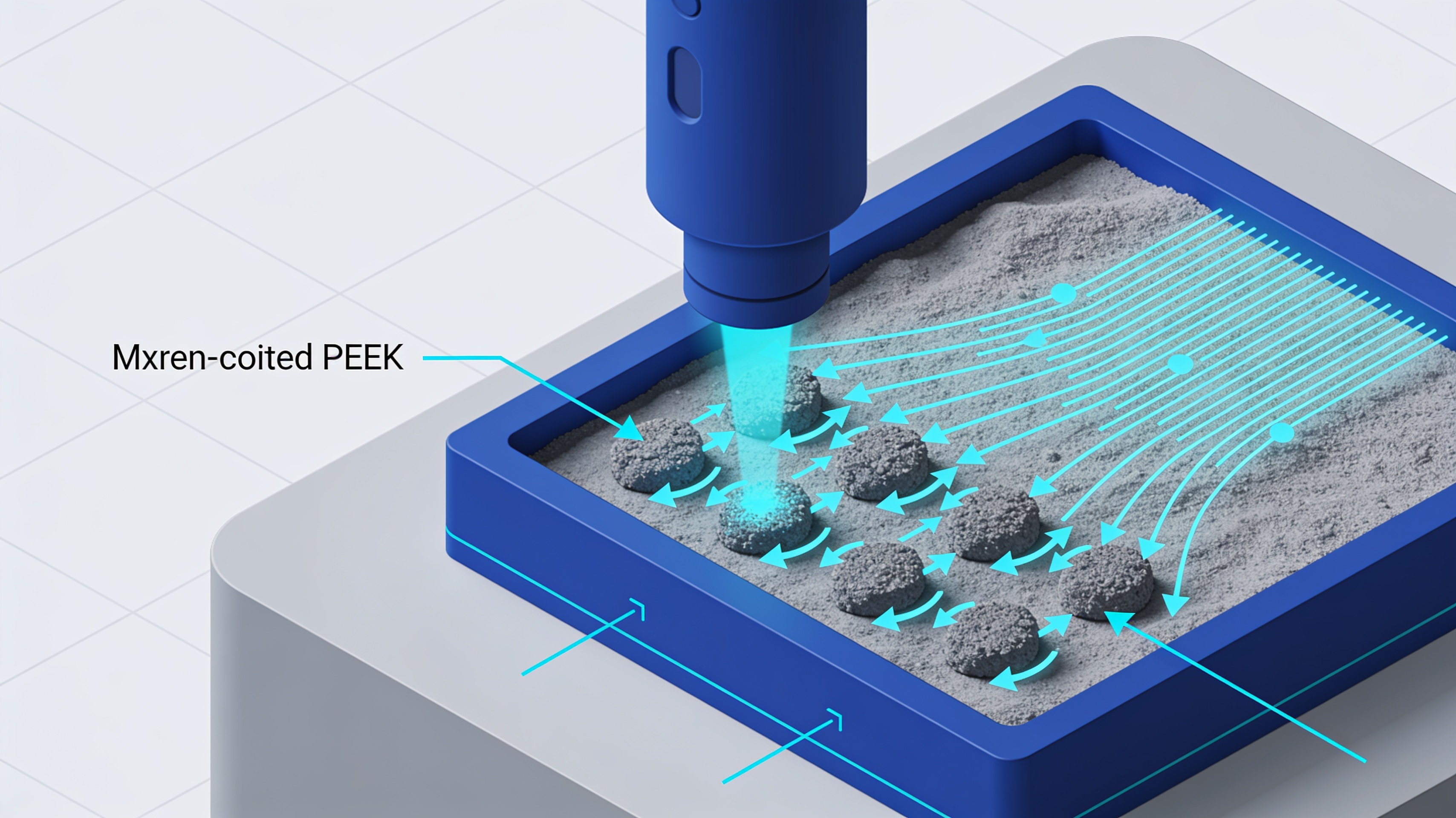
A Chinese research group has demonstrated that coating PEEK particles with MXene nanosheets makes it possible to drastically lower the laser energy density required for powder bed fusion. The study, published in Virtual and Physical Prototyping, opens an alternative route to increasing the power of laser sources.
- Volumetric laser energy density reduced from 26.667 to 0.333 J/mm³
- Surface coating with Ti3C2Tx nanosheets applied via electrostatic assembly
- PEEK/M1 (1% by weight of MXene) identified as the optimal formulation
- Research conducted by Peking University and other Chinese institutions
The problem of laser absorption in PEEK
Polyether ether ketone does not effectively absorb radiation in the near infrared typical of industrial fiber lasers. This physical limitation complicates 3D printing of an otherwise excellent material for technical applications.
PEEK is a semicrystalline polymer valued for its chemical resistance, thermal stability, and use in biomedical components. However, 3D printing of complex geometries remains difficult to control.
The process window requires temperatures sufficient for particle coalescence. At the same time, deformation, shrinkage, thermal degradation, and local variations in crystallinity must be avoided.
Fiber lasers used in metal additive manufacturing operate in the near infrared. Unmodified PEEK converts this radiation into heat with insufficient efficiency for a stable process.
Simply increasing energy input does not solve the problem. It can instead cause carbonization and localized overheating.
The solution: two-dimensional nanosheets on the particle surface
Instead of modifying the laser source, the researchers altered the optical and thermal properties of the powder itself. Coating with MXene transforms the material's behavior during melting.
The study, titled “Conformal MXene surface engineering enables ultra-low-energy fibre-laser powder bed fusion of PEEK composites,” describes the application of two-dimensional nanosheets to the powder surface.
MXenes constitute a family of two-dimensional materials derived from transition metal carbides or nitrides. The research used Ti3C2Tx, where the Tx surface groups influence the chemical properties.
The electrostatic assembly technique made it possible to distribute the nanosheets uniformly over the surface of the PEEK particles.
Volumetric laser energy density is a specific process parameter, not a direct measure of the printer's total electricity consumption or cost per part.
The experimental results
The PEEK/M1 formulation, containing 1% by weight of MXene, represented the optimal compromise between laser absorption and the final properties of the material.
The most evident finding is the change from 26.667 to 0.333 J/mm³ in the required volumetric laser energy density. The difference corresponds to 98.75%.
| Parameter | Standard PEEK | PEEK/M1 |
|---|---|---|
| Laser energy density | 26.667 J/mm³ | 0.333 J/mm³ |
| MXene content | 0% | 1% by weight |
The research concerns the process window of a specific experimental configuration. It measures the consequences on the properties of the samples, not the overall energy consumption of the system.
The samples were subjected to tensile tests and bending tests to characterize the resulting mechanical properties.
Implications for polymer powder bed fusion
This approach could make PEEK processing accessible with existing laser systems, without requiring higher-power sources.
The strategy of modifying the surface of the particles instead of increasing the source power represents a paradigm shift. It makes it possible to use standard fiber lasers for previously problematic materials.
The research was conducted by Peking University together with other Chinese institutes. The study was published online on October 20, 2026.
Practical application will require further validation on complex geometries and real production conditions. The process window identified in the laboratory will need to be transferred to industrial powder bed fusion systems with fiber lasers.
article written with the help of artificial intelligence systems
Q&A
What is the main result of the study on MXene-coated PEEK?
Research has shown that coating PEEK particles with MXene nanosheets reduces the volumetric laser energy density from 26.667 to 0.333 J/mm³, corresponding to a decrease of 98.75%. This enables powder bed fusion with low-energy fiber lasers.
Why is unmodified PEEK problematic in 3D printing with fiber lasers?
PEEK does not effectively absorb radiation in the near-infrared range typical of industrial fiber lasers, converting the beam into heat with insufficient efficiency. Increasing laser power does not solve the problem and can cause carbonization and localized overheating.
How were MXenes applied to the PEEK powder?
The researchers used the electrostatic assembly technique to uniformly distribute the two-dimensional Ti3C2Tx nanosheets on the surface of the PEEK particles. The optimal formulation identified is PEEK/M1, with 1% by weight of MXene.
Which MXene material was used in the research?
The study used Ti3C2Tx, a two-dimensional material derived from transition metal carbides or nitrides, in which the Tx surface groups influence the chemical properties. The nanosheets were applied as a conformal coating on the PEEK powder.
Who conducted the research and where was it published?
The study was conducted by Peking University and other Chinese institutions and was published in the journal Virtual and Physical Prototyping. The title is 'Conformal MXene surface engineering enables ultra-low-energy fibre-laser powder bed fusion of PEEK composites'.