Medical Implants and Metal Sensitivity: Balancing Biocompatibility, Durability and Costs
The choice of material in medical implants today requires a careful evaluation of trade-offs between durability, biocompatibility, and the need for secondary procedures.
In the current landscape of reconstructive surgery, the selection of material for medical implants represents a complex clinical decision that balances multiple factors: from the patient's biological response to long-term healthcare costs. While permanent metals such as titanium have dominated for decades, the emergence of bioresorbable materials and advanced polymers such as PEEK is redefining the options available to surgeons and patients.
Bioresorbable Materials vs Permanent Metals: Comparative Analysis
The comparison between bioresorbable materials and permanent metals highlights different clinical and economic advantages, with significant impacts on the need for secondary procedures and on the patient's inflammatory response.
Bioresorbable materials, particularly magnesium alloys, offer temporary mechanical support that gradually dissolves after the critical healing phase. This characteristic eliminates the need for secondary surgical procedures to remove the implant, reducing both patient risks and the overall costs of treatment. OsseoLabs has developed bioresorbable magnesium implants that provide structural support during the bone healing phase, then fully resorb, avoiding the permanent presence of foreign hardware.
By contrast, permanent titanium implants guarantee long-term mechanical stability and have demonstrated excellent biocompatibility over decades of clinical use. However, they can cause complications related to the permanent presence of metal, including inflammatory reactions to wear debris and anatomical adaptation problems due to the material's rigidity. The “fundamental mismatch” between standardized implants and each patient's unique anatomy can lead to suboptimal load distribution and implant migration.
PEEK (polyether ether ketone) represents a third way: this high-performance polymer offers radiolucency, allowing postoperative imaging without artifacts, and an elastic modulus closer to that of bone than titanium, reducing stress shielding. Materialise has recently integrated PEEK into its craniomaxillofacial implant portfolio, offering surgeons the freedom to choose between titanium and PEEK based on the specific needs of the clinical case.
Bone Integration and Advanced Structures: The Role of TPMS
TPMS surfaces significantly improve osseointegration but require advanced additive manufacturing technologies and rigorous quality controls, increasing complexity and initial costs.
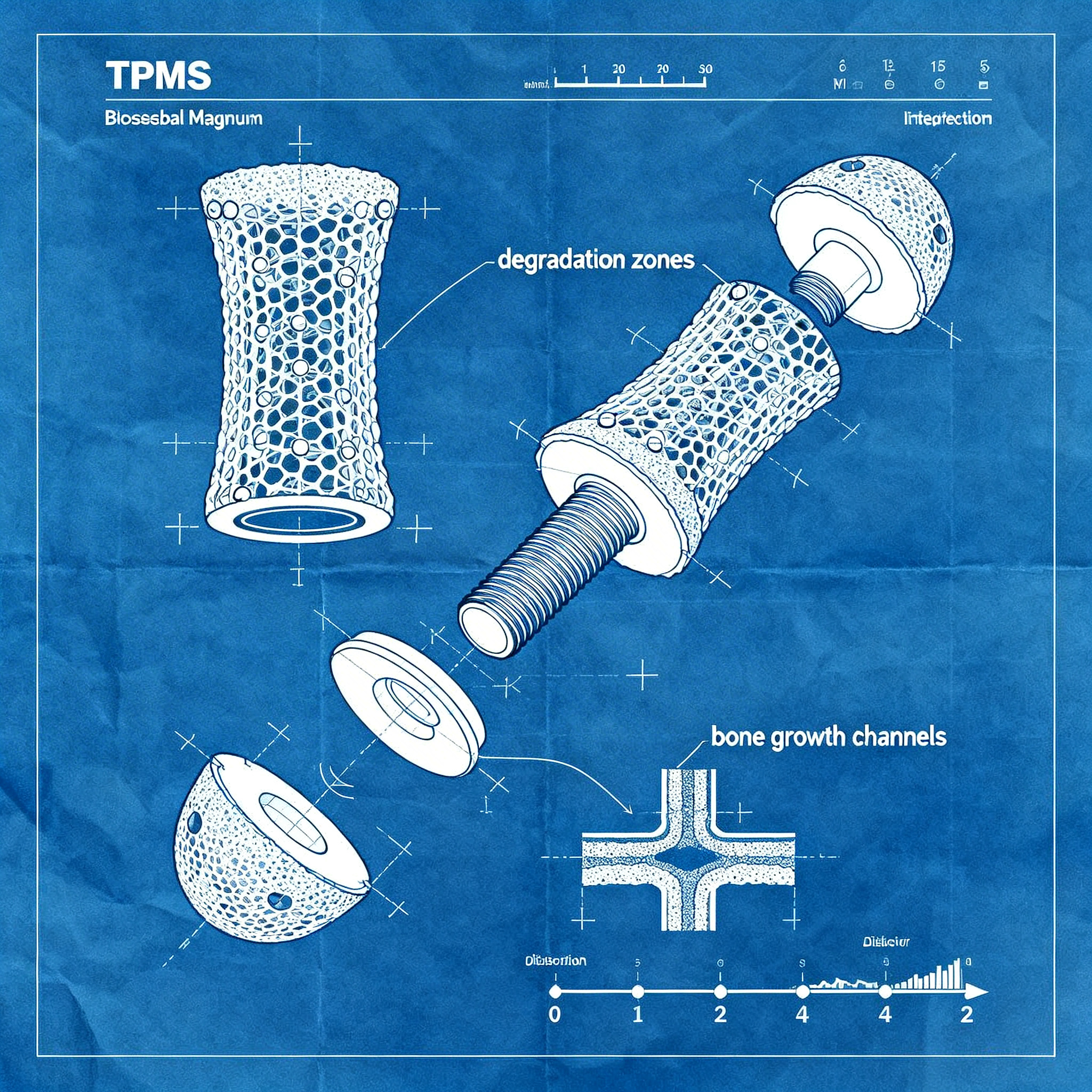
TPMS (Triply Periodic Minimal Surfaces) structures represent a significant innovation in implant engineering. The OsseoMatrix™ TPMS architecture developed by OsseoLabs promotes superior bone integration by creating a porous structure that facilitates bone tissue growth within the implant. These complex geometries also reduce stress shielding, a phenomenon in which an overly rigid implant prevents the surrounding bone tissue from receiving adequate mechanical stimuli, causing it to weaken.
The production of bioresorbable magnesium TPMS structures presents considerable technical challenges. Magnesium has a low melting point, high reactivity, and sensitivity to process instability, making additive printing particularly complex. OsseoLabs has invested significantly in the development of AI-driven design rules, topological optimization, and tightly controlled additive manufacturing processes, including proprietary laser pulsing and degradation modeling techniques.
Implants with hollow regions can be filled with bone graft to further accelerate fusion and bone growth. Pilot clinical studies in dentistry and maxillofacial surgery show good integration, volumetric bone increase, and a reduction in the number of necessary procedures compared with traditional techniques using metal meshes.
Personalization and AI: Reducing Errors and Operating Times
Artificial intelligence and personalized manufacturing transform surgical planning, reducing operating times by 30-50% in complex cases, but introduce greater design complexity and higher initial costs.
The OsseoVision™ platform uses artificial intelligence to complete segmentation and 3D anatomical reconstruction within one hour of uploading the high-resolution CT scan. Surgical planning and device design typically require 1-2 days, during which the system automates much of the implant and guide generation, including fixation strategy, topological optimization, and integration of porous structures.
For surgeons, the main advantage is pre-operative confidence: they can digitally plan the procedure, review fixation strategies, and confirm implant positioning before entering the operating room. This reduces trial and error during surgery, decreases intraoperative adjustments, and shortens surgical times, often by 30-50% in complex cases. It also reduces cognitive load, particularly important in reconstructions where small decisions can have large downstream effects.
The digital workflow integrates design, simulations, production, and documentation under ISO 13485-certified systems. Polymer guides can be delivered within 24-48 hours, while titanium or bioresorbable magnesium metal implants typically require 3-7 days for printing, post-processing, and quality control. Materialise produces approximately 280,000 custom 3D-printed instruments and implants per year, with partners such as Ad Mirabiles ensuring PEEK implant production within 72 hours of surgical plan approval.
Long-Term Costs and Real Clinical Impact
The economic analysis of custom implants must consider not only the higher initial costs but also the savings from fewer revisions, reduced operating times, and accelerated patient recovery.
At the healthcare system level, the benefits of personalization and advanced materials translate into concrete economic advantages. Faster planning, shorter procedures, fewer complications, and a reduction in revision or removal procedures translate into lower total costs per case. For payment systems and public healthcare, this is not only about economic savings but about the possibility of making advanced reconstructive care scalable and accessible.
Bioresorbable implants completely eliminate the need for secondary removal procedures, with estimated savings of thousands of euros per patient and reduced risks associated with additional surgical procedures. Faster recovery allows patients to return to daily activities sooner, with indirect socioeconomic benefits.
However, the initial costs of customized implants and advanced technologies are significantly higher than those of standardized implants. The production of magnesium TPMS structures, with rigorous quality controls and proprietary processes, requires considerable technological investments. The regulatory complexity of customized devices, which lie at the intersection of customization and compliance, adds further documentation and risk management costs.
The choice between PEEK and titanium also entails economic considerations: PEEK requires printing systems with closed and heated chambers, high-temperature build plates, and careful management of the thermal profile to control the polymer's crystallinity. These specific technical requirements can affect production costs and delivery times.
Conclusion
Selecting the ideal material for a medical implant requires a multidimensional assessment that takes into account safety, efficacy, and economic sustainability, balancing immediate clinical benefits with long-term outcomes.
The future of medical implants does not lie in the supremacy of a single material, but in the ability to select the optimal solution for each specific case. Bioresorbable materials offer significant clinical and economic advantages by eliminating secondary procedures, while PEEK and titanium retain important roles where long-term stability and specific characteristics are priorities. TPMS technologies and AI-guided planning represent powerful tools for optimizing bone integration and reducing surgical risks, justifying higher initial investments through superior clinical outcomes and reduced overall costs.
Explore the solutions best suited to your clinical and engineering needs, considering both the immediacy of the intervention and the long-term effects. Data-driven customization and the integration of advanced materials are transforming reconstructive surgery from artisanal execution to engineering precision.
article written with the help of artificial intelligence systems
Q&A
What are the main advantages of bioresorbable materials compared to permanent metals in medical implants?
Bioresorbable materials, such as magnesium alloys, provide temporary mechanical support that dissolves after healing, eliminating the need for secondary interventions to remove the implant. This reduces patient risks and overall treatment costs.
How does PEEK differ from titanium in medical implants?
PEEK is a polymer with radiotransparency that allows post-operative imaging without artifacts and has an elastic modulus more similar to bone, reducing stress shielding. Titanium, on the other hand, provides long-term mechanical stability but may cause inflammatory reactions and anatomical adaptation issues.
What are TPMS structures and what role do they play in medical implants?
TPMS (Triply Periodic Minimal Surfaces) structures are porous architectures that improve osteointegration by promoting bone tissue growth within the implant. They also reduce stress shielding and require advanced manufacturing technologies such as 3D printing.
How does artificial intelligence contribute to the customization of medical implants?
Artificial intelligence accelerates surgical planning by automating segmentation and 3D reconstruction, reducing operating times by 30-50%. It also enables topological optimization and custom implant design, improving precision and clinical outcomes.
What are the main economic disadvantages of custom implants compared to standardized ones?
Custom implants have higher initial costs due to design complexity, additive manufacturing, and required quality controls. Additionally, specific regulations for custom devices increase documentation and risk management costs.