
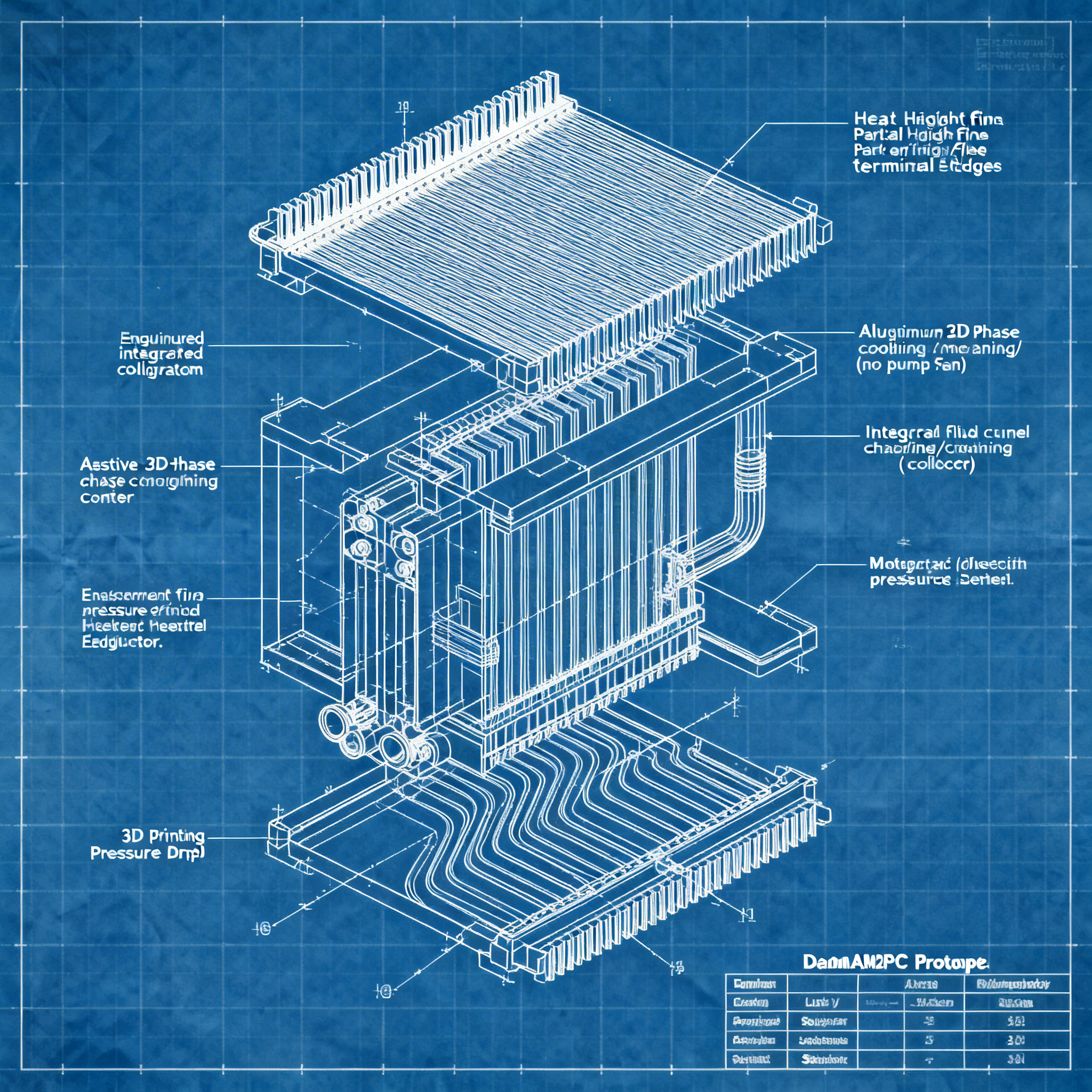
Smart heat exchangers: thermal efficiency comes from patents
While data centers devour energy and aircraft engines seek lighter solutions, a new generation of 3D-printed heat exchangers promises to cool better while consuming less, without pumps or fans.
Patents cited
- HEAT EXCHANGERS INCLUDING PARTIAL HEIGHT FINS HAVING AT LEAST PARTIALLY FREE TERMINAL EDGES — September 4, 2025
- ENGINE-INTEGRATED HEAT EXCHANGER — January 14, 2026
What problem does it solve
Traditional heat exchangers must balance thermal efficiency, weight, and integration complexity: improving one of these aspects often means worsening the others.
Conventional cooling systems come up against stringent physical constraints. In aircraft engines, every gram counts: adding heat exchange surfaces means making the system heavier. In data centers, air or liquid cooling with pumps can consume up to 40% of the facility's total energy. And when it comes to integrating a heat exchanger into an engine bay or a server rack, assembly and maintenance logistics become a nightmare: pipes, connections, and gaskets that must be assembled in tight spaces.
The AM2PC project at the Danish Technological Institute demonstrated that an aluminum-printed evaporator can achieve 600 watts of cooling capacity without pumps or fans, exceeding the initial target by 50%. Passive two-phase cooling exploits the natural evaporation of the refrigerant: vapor rises due to density difference, condenses releasing heat, and falls by gravity. No energy spent moving fluids, just elementary physics applied with complex geometries.
The idea in 60 seconds
Two patents show how rethinking the internal geometry of heat exchangers and their integration into systems can unlock significant gains in efficiency and operational simplicity.
The first patent introduces fins at “partial height” with free terminal edges. Instead of extending completely between two parallel surfaces, these fins stop earlier, leaving a gap that reduces resistance to fluid flow. The structure is monolithic: parallel substrates define separate paths for different fluids, while the partial fins optimize heat transfer without blocking the passage. The single body eliminates brazing and joints, typical weak points of assembled exchangers.
The second patent addresses the problem of integration in aircraft engines. The heat exchanger is preinstalled on the engine before it enters the bay: when the engine slides into position, an air inlet manifold automatically seals with the engine bay gasket. Cooling air passes through openings distributed circumferentially in the manifold, crosses the exchanger and exits into the engine bay. The connections for oil, coolant or fuel are already ready: during engine insertion, the pipes engage automatically. No more manual operations in impossible spaces.
Both solutions use 3D printing to create geometries impossible with traditional methods. The partial fins require precision in managing internal spaces; the engine-exchanger integration benefits from the ability to print manifolds with complex shapes and optimized internal channels.
What really changes (tangible improvements)
The partial fins and preloaded integration promise measurable energy savings and reduced assembly times, with direct impacts on operating costs and reliability.
Free-edge fins improve thermal efficiency by reducing pressure drop: the fluid flows more freely, so less energy is needed to pump it. At the same time, the exchange surface remains high because the fins still cover much of the path. The monolithic body eliminates leaks: no brazing that breaks under thermal stress, no gaskets that fail. And weight drops: less material to achieve the same (or better) heat transfer.
In the case of the AM2PC project, passive two-phase cooling has been shown to remove heat at temperatures between 60 and 80°C, higher than traditional air systems. This means that waste heat can be reused directly in district heating networks or nearby industrial processes, without the need for additional energy. Preliminary life cycle analyses indicate a reduction in total emissions of 25-30% per unit, thanks to the single-material structure (aluminum) that is easily recyclable.
Preloaded integration in the aircraft exchanger cuts assembly times. Multimatic Motorsports used a configurable oil cooler from Conflux Technology, printed in two weeks and installed in a very tight space. The component completed an endurance race without problems, providing 20% more heat dissipation than the previous solution in the same footprint. In aircraft production, where every hour of assembly costs thousands of euros, eliminating manual connection operations means direct savings and fewer human errors.
Esempio in azienda / sul mercato
Some HVAC manufacturers and aerospace builders are already testing similar solutions at the prototype stage, with results that confirm the theoretical advantages.
The AM2PC project, recently concluded with a budget of 10 million Danish kroner, involved Danish Technological Institute, Heatflow, Open Engineering and Fraunhofer IWU. The aluminum prototype was printed on a Nikon SLM280 system with dual laser, with printing times of 90 minutes per part. Paw Mortensen, CEO of Heatflow, emphasizes that “with our two-phase solution we can remove heat passively without pumps or fans, significantly reducing energy consumption for cooling.”
In motorsport, Multimatic integrated Conflux's configurable oil cooler into a circuit shared with the engine coolant to manage gearbox oil temperatures. Julian Sole, Design Manager at Multimatic Motorsports, confirms: “The Conflux cooler, built from their configurable design and efficiently packaged into a very tight space, provided the reliability required for the entire distance of an endurance race.”
Conflux Technology has already supplied printed heat exchangers for high-profile applications: a water-charge air cooler for the Donkervoort P24 RS Supercar, a heat exchanger for the Pagani Utopia hypercar, and thermal solutions for Airbus's ZEROe project and the Honeywell-led TheMa4HERA consortium for next-generation hybrid-electric aircraft.
There are still no mass-production announcements for heat exchangers with partial fins or for preloaded integration in commercial engines, but field tests indicate that the technology is mature for high-performance niche applications.
Trade-offs and limitations
The complexity of the geometries can limit compatibility with common materials and require specific validations for each use case.
Partial fins work well in theory, but every application has different thermo-fluid-dynamic constraints. The optimal distance between fins and the upper substrate, the fin distribution, the orientation relative to the flow: everything must be calibrated. There is no universal solution. And printability depends on the material: aluminum lends itself well, but stronger alloys or composite materials could present difficulties in producing such thin and complex geometries.
Preloaded integration requires standardization. Every engine manufacturer has different specifications for connections, gaskets, tolerances. Preinstalling the heat exchanger means that everything must fit perfectly on the first attempt, with no possibility of manual adjustments. And during transport, the preloaded component must be protected: impacts or vibrations could damage delicate connections before the engine even reaches the assembly line.
The patent on the engine-integrated heat exchanger mentions the need for a compliance element (a radial “jog” in the cross-section of the manifold's outer wall) to absorb tolerances and thermal expansions. This detail suggests that the solution is not plug-and-play: accurate engineering is needed to handle dimensional variations under real operating conditions.
Finally, it is not clear how scalable these designs are beyond niche applications. The AM2PC project has produced prototypes for data centers, but moving from a component tested in the laboratory to thousands of units installed in data centers scattered around the world requires long-term reliability validations, certifications, and a supply chain capable of supplying printed parts with consistent quality.
Reality check: what is needed to reach production
Assembly procedures must be standardized and compatibility with existing production chains must be ensured.
For heat exchangers with partial fins, a library of validated configurations is needed for common applications: HVAC, automotive, aerospace. Thermal design software must integrate reliable predictive models for these geometries, so that designers can size the heat exchanger without lengthy experimental test campaigns.
On the engine-heat exchanger integration front, aircraft manufacturers will have to agree on interface standards: manifold dimensions, port positioning, gasket specifications. Without this, every program will require a custom design, nullifying the time and cost advantages.
The preloading logistics is another issue. The heat exchangers must arrive at the assembly site already prepared, with protected and verified connections. A traceability system is needed to ensure that every component has been tested and has not suffered damage during transport.
Finally, material qualification: aluminum works well for many applications, but in high-temperature environments or with aggressive fluids, special alloys or protective coatings are needed. 3D printing of these materials is still maturing, with issues of porosity, cracks, and mechanical properties that vary from batch to batch.
The patents analyzed open up interesting scenarios for a more energy-efficient future, provided that logistical and technical critical issues are addressed. Partial fins and preloaded integration are not fantasies: working prototypes exist and have passed real tests. But there is still a way to go between a successful prototype and an industrial solution. Follow the developments of these technologies: they could redefine the very concept of industrial thermal efficiency.
article written with the help of artificial intelligence systems
Q&A
What main problems do the smart heat exchangers described in the article solve?
These heat exchangers resolve the trade-off between thermal efficiency, weight, and integration complexity. They offer more effective cooling without using pumps or fans, reducing energy consumption and simplifying assembly.
How does passive two-phase cooling work in 3D-printed heat exchangers?
Passive two-phase cooling exploits the natural evaporation of the coolant. The vapor rises due to density differences, condenses releasing heat, and then falls back by gravity, without needing energy to move the fluids.
What innovations do the cited patents introduce regarding fins and integration into engines?
The 'partial height' fins with free edges reduce flow resistance, improving thermal efficiency. Preloaded integration into engines allows automatic installation of the heat exchanger, eliminating complex manual operations.
What practical benefits arise from using these new heat exchangers?
Energy savings, reduced weight, greater reliability thanks to the absence of joints and leaks, and shorter assembly times are achieved. Moreover, waste heat can be recovered for external uses.
In which sectors or applications is this technology already being tested?
The technology is being tested in the HVAC and aerospace sectors. It has also been successfully employed in motorsport, such as with Multimatic Motorsports, and in advanced projects like those of Airbus and Pagani.


