
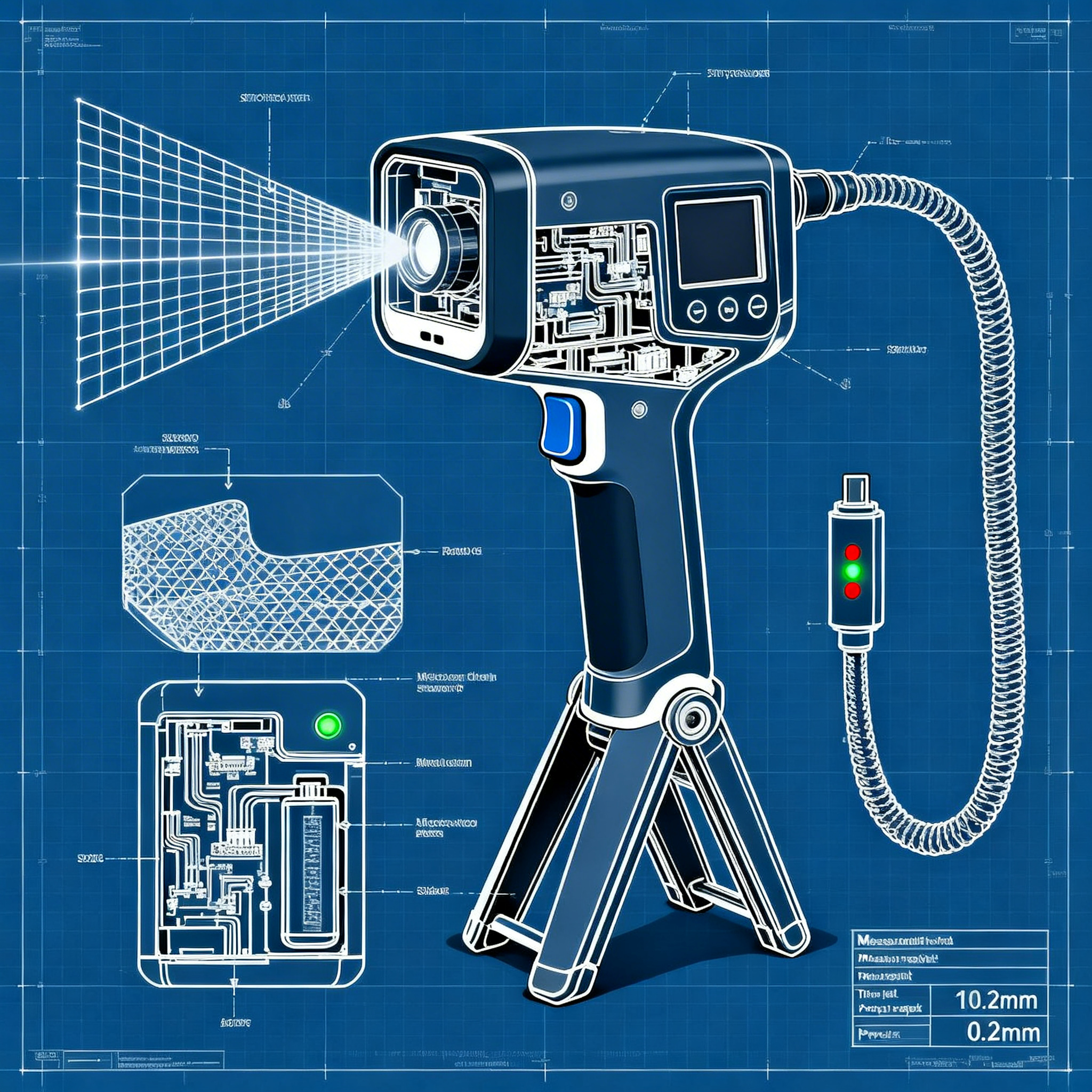
Practical Guide to Using Consumer-Grade LiDAR: Tools, Workflow, and Maker vs Industrial Use Case
Introduction to 3D Scanning Technologies for Consumer Use
The consumer 3D scanning landscape today offers accessible solutions ranging from LiDAR integrated into smartphones to dedicated portable scanners, each with specific advantages and limitations compared to traditional photogrammetry.
Choosing the right tool for 3D scanning today means balancing portability, cost, and precision. The consumer-grade market has evolved rapidly, bringing technologies once reserved for industry into the hands of makers, designers, and small technical studios. The two main technologies available are LiDAR (Light Detection and Ranging) and photogrammetry, each with distinctive characteristics.
LiDAR measures distances by projecting laser light and calculating the return time, generating point cloud (point clouds) three-dimensional in real time. Photogrammetry, on the other hand, reconstructs 3D models from series of photographs, requiring controlled lighting and greater post-processing. Apps like KIRI Engine leverage photogrammetry to generate models from photos taken with smartphones, offering an interesting trade-off for those who do not want to invest immediately in dedicated hardware, particularly useful for AR/VR assets and visualization, provided that lighting and shot quality are taken care of.
The series Raven by 3DMakerpro, launched in March 2026 starting at 999 dollars, represents a turning point: it brings professional accuracy (up to 20 mm) and acquisition speed (150,000 points/second) to an accessible price, bridging the gap between hobbyist tools and industrial surveying equipment.
Integrated LiDAR in Mobile Devices: When Your Own Smartphone Is Enough
The LiDAR sensors integrated into iPhone and iPad allow rapid modeling of large environments and objects, proving sufficient for concepts, pre-design, and educational or creative applications without additional hardware investments.
On devices equipped with LiDAR, scanning apps can quickly produce models of large environments, rooms, and objects. This solution serves as preliminary tool for surveys, interior design, and documentation. It does not replace a metrological scanner, but it is more than sufficient for concept and pre-design.
The mobile workflow is extremely simplified: you launch the dedicated app, frame the object or environment by moving the device slowly, and the software automatically generates the 3D model. The integrated depth sensors allow capturing volumes up to several meters away, ideal for documenting interior spaces or creating quick dimensional references.
Practical applications include scanning rooms for interior design, creating assets for augmented reality, and preliminary documentation of objects to be reproduced. It is interesting for schools, design studios, and makers who want to scan faces, busts, and surfaces that are not too complex without investing in dedicated hardware.
The main limitation remains precision: mobile sensors offer tolerances in the order of centimeters, inadequate for precision reverse engineering but perfectly usable for conceptual modeling and visualization.
Consumer-Grade Portable Scanners: 3DMakerpro Lynx and Toucan Compared
3DMakerpro Lynx and Toucan represent two entry levels into the world of dedicated scanning: the first for beginners with limited budgets, the second for professionals who need operational flexibility and stand-alone mode.
3DMakerpro Lynx positions itself as an accessible portable scanner designed for beginners who want a versatile device for objects and small design projects. It is suitable for those who want to enter the world of 3D scanning without immediately moving up to more demanding budgets, offering a balanced compromise between cost and functionality.
3DMakerpro Toucan stands out instead for the ability to operate in stand-alone mode, without a PC, with onboard processing and modes such as Single Shot, marker tracking, and wireless file management. It is designed for advanced users who need greater flexibility in laboratory, studio, and on-site contexts.
The main difference lies in operational autonomy: while Lynx requires a connection to a smartphone or computer for processing, Toucan integrates a processor and display, allowing you to view the point cloud in real time and complete the scan without external devices. This translates into greater mobility for field surveys and reduced setup times.
Both scanners use structured light or laser technology, generating three-dimensional meshes exportable in standard formats (STL, OBJ) compatible with CAD software and slicers for 3D printing. Toucan also offers advanced marker-based tracking functions, useful for complex objects or multi-angle scans that require precise alignment.
Practical Workflows for Makers and Small Productions
The complete workflow for consumer 3D scanning includes object preparation, guided acquisition, automated post-processing, and CAD integration, with times ranging from a few minutes for simple meshes to hours for complex parametric modeling.
The process begins with the preparation: for small objects or those with reflective surfaces, applying adhesive markers (target stickers) improves tracking and accuracy. Modern scanners use real-time indicators that show depth of field and tracking quality, minimizing motion errors during acquisition.
The phase of scanning requires from a few seconds to a few minutes, depending on the size of the object. Guided systems use visual feedback: displays that turn red if too close, blue if too far, green in the optimal zone. This visual assistance drastically reduces the learning curve, allowing even beginners to obtain usable results.
The’data processing takes place through dedicated software. Systems such as VXelements or the proprietary suites of various manufacturers generate meshes directly from raw data in about 1-2 minutes for medium-sized parts, without the need for manual conversion from point cloud. The functions of automatic mesh repair fill holes, correct geometries, and produce watertight models ready for 3D printing in standard formats.
For CAD reverse engineering, the mesh model is imported into specialized software (VXmodel, Geomagic Design X). Automatic wizards analyze the mesh, dividing it into geometric regions (planes, cylinders, surfaces). Sketch tools project profiles onto work planes, allowing the original design intent to be reconstructed with parametric dimensions and geometric constraints.
The’deviation analysis compares in real time the acquired mesh with the reconstructed CAD model, highlighting areas with significant deviations and allowing finishing iterations. The final model is exported for 3D printing, spare parts production, or integration into larger projects.
Criteria for Choosing the Scanner: Budget, Accuracy, and Objectives
Selecting the ideal scanner depends on three key variables: available budget, the accuracy required by the application, and the user's technical skills, with solutions ranging from €0 (smartphone) to €1,500 for advanced stand-alone systems.
For educational and creative applications (rapid modeling, visualization, concept), the LiDAR integrated into smartphones represents the zero-cost starting point. Tolerances of a few centimeters are acceptable, and the simplified workflow allows immediate results without specific training.
Makers and hobbyists those needing greater detail for 3D printing or small projects find in entry-level scanners such as 3DMakerpro Lynx o Revopoint INSPIRE 2 (from $467) the best compromise. Precision on the order of 0.03-0.1 mm, portability, and integration with smartphones/tablets make them ideal for rapid prototyping and reverse engineering of non-critical objects.
For technical studios and small productions that require operational autonomy, stand-alone scanners such as 3DMakerpro Toucan o Revopoint MIRACO (from $1,274) offer onboard processing, integrated display, and a complete workflow without dependence on a PC. The ability to operate on-site and transfer data wirelessly speeds up delivery times.
Light industrial applications (quality control, as-built documentation, architectural surveys) benefit from spatial LiDAR scanners such as 3DMakerpro Raven ($999), capable of covering environments up to 50-100 meters with 2-5 cm accuracy. The stand-alone technology with AMOLED display and integrated SLAM enables complete surveys without auxiliary instrumentation.
The Repeatability of measurements and compatibility with professional CAD software become decisive for metrological applications, where scanners such as Creaform HandySCAN o Revopoint MetroY (from $1,121) offer certified accuracy up to 0.02 mm, essential for precision reverse engineering and dimensional inspection.
Conclusion
The choice of the ideal LiDAR tool depends on the operational context: with the right methodology, even consumer solutions can offer professional results. The 2026 market offers scalable options ranging from LiDAR integrated into smartphones for creative applications to stand-alone portable scanners for industrial surveys, with affordable prices and guided workflows that lower technical barriers.
The evolution of automated post-processing software and native integration with CAD ecosystems now make it possible to complete the entire cycle – from scan to printable model – in times ranging from a few minutes to a few hours, democratizing technologies once reserved for specialized laboratories.
Try one of the workflows described with your current device and compare the results with those obtained using more advanced tools. Start with simple scans to familiarize yourself with visual feedback and acquisition parameters, then gradually scale up to more complex objects as you gain confidence with the process.
article written with the help of artificial intelligence systems
Q&A
What are the main differences between LiDAR and photogrammetry for consumer 3D scanning?
LiDAR measures distances by projecting laser light and calculates the return time to generate real-time point clouds. Photogrammetry reconstructs 3D models from photographs, requiring more post-processing and controlled lighting.
What advantages does integrated LiDAR in smartphones offer for 3D scanning?
It enables rapid modeling of large environments and objects without additional costs. It's sufficient for concepts, pre-design, and educational or creative applications, with a simplified workflow.
What is the main difference between 3DMakerpro Lynx and Toucan?
Lynx requires connection to a smartphone or computer for processing and is designed for beginners. Toucan operates in standalone mode with integrated processor and display, ideal for advanced users.
What are the main stages of the 3D scanning workflow for makers and small productions?
It includes object preparation with adhesive markers, guided acquisition with visual feedback, automated post-processing, and CAD integration for reverse engineering or 3D printing.
What level of accuracy can be achieved with consumer-grade LiDAR compared to professional scanners?
Mobile sensors offer tolerances in the order of centimeters, suitable for conceptual modeling. Dedicated scanners like those from 3DMakerpro achieve accuracies up to 20 mm, suitable for more technical work.


