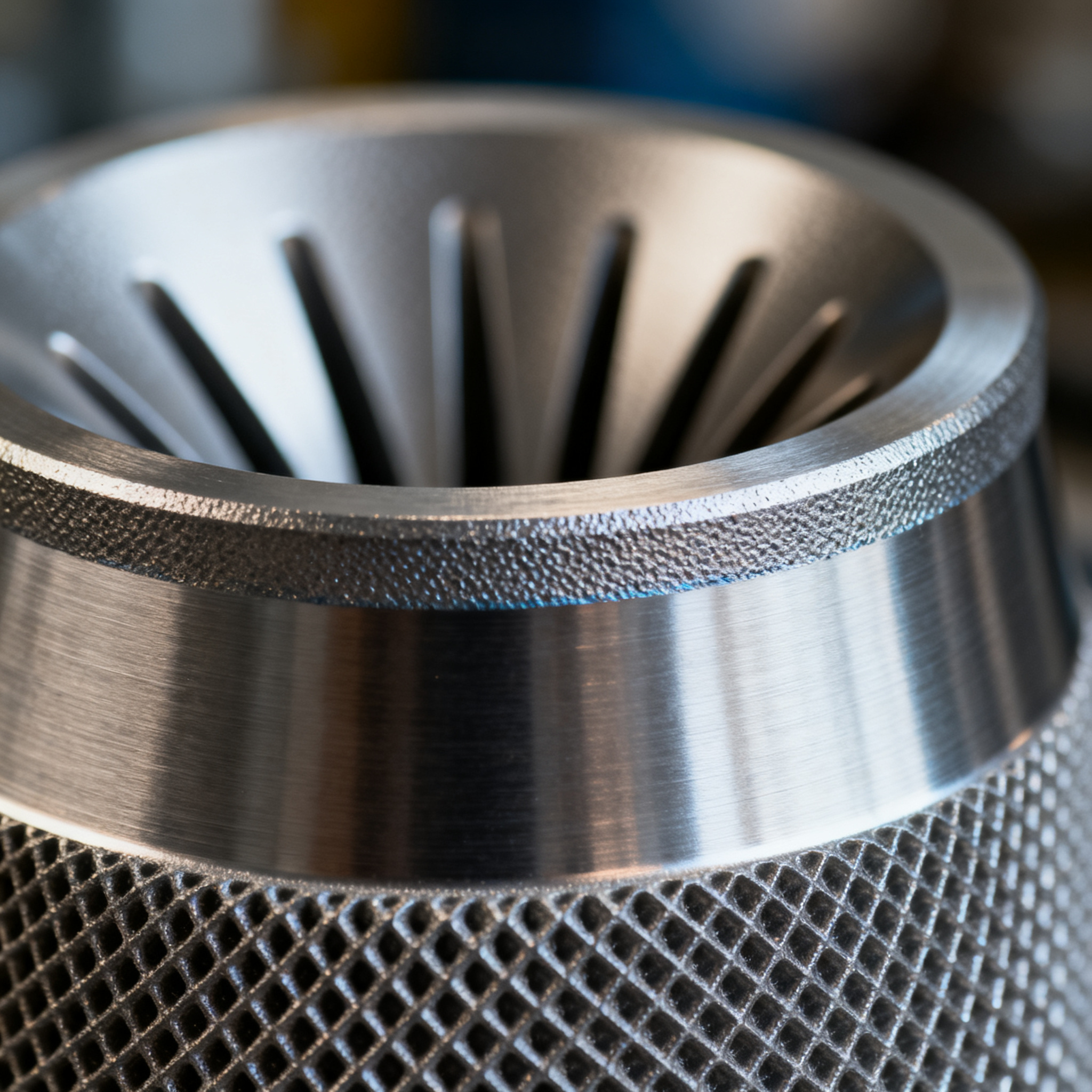
Nozzles that challenge hydrogen?
Gas turbine nozzles are becoming smarter and more resistant, thanks to complex geometries and hybrid materials designed to handle extreme conditions like hydrogen embrittlement. Two recent patents show how additive manufacturing can transform critical components into jointless, more durable and reliable solutions.
- HYDROGEN NOZZLE WITH MULTIPLE FLOW CIRCUITS — 22 April 2026
- BIMETALLIC HYDROGEN FUEL NOZZLE WITH MULTIPLE FLOW CIRCUITS — 29 April 2026
Smart nozzles for extreme environments
Recent patents show how complex internal geometries and controlled finishes can drastically improve the durability of nozzles exposed to high-pressure hydrogen.
Hydrogen is a promising fuel for aviation and energy, but it brings significant technical challenges. One of the most insidious is embrittlement: hydrogen penetrates metals, makes them brittle and can cause sudden failures. Traditional joints worsen the problem, multiplying weak points.
The patent “HYDROGEN NOZZLE WITH MULTIPLE FLOW CIRCUITS” proposes a radical solution: eliminating joints. Thanks to additive manufacturing, the nozzle is printed as a single piece with complex internal geometries, impossible to achieve with traditional techniques. This drastically reduces the risk of leaks and failures.
But the real innovation lies in the surface finish. The patent specifies that internal surfaces in contact with hydrogen must have an average roughness below 20 µm, ideally under 5 µm. This is achieved with a post-print chemical milling process, which smooths the internal walls and limits hydrogen penetration into the material.
- Single-piece printed nozzle, without welded joints
- Internal surface roughness below 5 µm to limit embrittlement
- Complex internal geometries to optimize hydrogen flow
The result? Longer-lasting components and reduced machine downtime. In a gas turbine production plant, this translates to fewer extraordinary maintenance events and greater operational reliability.
Bimetallic and hybrid: the winning compromise
The combined use of different materials in the same component allows for balancing costs and performance in critical applications.
Not all hydrogen-resistant materials are suitable for extreme temperatures. And not all high-temperature materials withstand hydrogen. The patent “BIMETALLIC HYDROGEN FUEL NOZZLE WITH MULTIPLE FLOW CIRCUITS” addresses this dilemma with a hybrid approach.
The bimetallic nozzle combines two different materials in the same component. The zones exposed to hydrogen are made from compatible alloys such as Inconel 600 or Inconel 625. The unexposed zones, which must withstand heat, use conventional high-temperature alloys such as MAR-M200 or Waspaloy.
This solution optimizes costs. Hydrogen-compatible materials are more expensive, so using them only where needed reduces the overall investment. The patent describes combined AM techniques: laser powder bed fusion (PBF-LB) for precision parts, directed energy deposition (DED-AW) for larger sections.
| Nozzle zone | Material | AM Technique |
|---|---|---|
| Exposed to hydrogen | Inconel 625 | PBF-LB |
| Not exposed | MAR-M200 | DED-AW |
An aerospace component factory could print bimetallic nozzles to achieve high performance without compromise. The challenge lies in managing hybrid processes: it is necessary to coordinate two different technologies and guarantee the quality of the interface between the materials.
Trade-offs and limitations
Despite the advantages, the adoption of these technologies requires rigorous controls and investments in special materials.
Both patents highlight that 3D printing solves many problems but introduces new ones. Materials compatible with hydrogen cost more. Alloys such as Inconel 625 or NASA HR-1 are not economical, and their use increases the unit cost of the component.
Post-production quality controls are critical. The patent “HYDROGEN NOZZLE WITH MULTIPLE FLOW CIRCUITS” requires the removal of internal support structures and chemical milling to achieve the desired surface finish. These steps add time and complexity to the process.
The bimetallic patent introduces another challenge: managing the interface between the two materials. If the transition is not performed correctly, defects can form that compromise mechanical strength. The recycling and repair of bimetallic components are more complex than those of monolithic components.
Bimetallic nozzles are difficult to recycle: separating the materials after use requires expensive processes that are not always economically sustainable.
These limitations do not make the technologies impractical, but they require investment in skills and equipment. Companies must evaluate whether the benefits in terms of durability and reliability justify the additional costs.
Reality check: when will they really arrive?
The described technologies are already plausible, but industrial integration will require time and standardization.
Both patents are based on established AM techniques. Laser powder bed fusion and directed energy deposition are already used in high-tech sectors such as aerospace and energy. The cited materials, such as Inconel 625 and MAR-M200, are available on the market.
This makes the proposed solutions plausible in the short to medium term. These are not speculative technologies, but engineering applications of already existing tools. The adoption horizon indicated in the patents is 2-5 years, a realistic interval for critical components that require rigorous certifications.
The real challenge is standardization. Chemical milling processes, hybrid AM techniques, and quality controls must be codified into repeatable procedures. Companies will need to develop internal skills or collaborate with specialized suppliers.
Path to adoption
- Validation: Prototype testing to verify resistance and durability.
- Certification: Approval from regulatory bodies for critical applications.
- Scaling: Integration into existing production processes.
The sectors most ready to adopt these technologies are those where reliability and precision are non-negotiable: aerospace, energy, and defense. In these contexts, the benefits in terms of reduced machine downtime and greater durability justify the initial investments.
Future nozzles will not only be more resistant but also smarter. Complex geometries, hybrid materials, and controlled surface finishes will transform critical components into more reliable and durable solutions. Their impact will be felt especially in sectors where reliability and precision are non-negotiable.
Keep an eye on the next 24 months: the first industrial applications could arrive faster than you think.
article written with the help of artificial intelligence systems
Q&A
What is the main problem with hydrogen in traditional nozzles and how is it addressed in the new patents?
Hydrogen causes embrittlement in metals, making them brittle and prone to sudden fractures. The new patents address this problem with nozzles printed in a single piece via additive manufacturing, eliminating welded joints that act as weak points. Furthermore, they provide for an internal surface finish below 5 microns to limit hydrogen penetration into the material.
What makes the 'Hydrogen Nozzle with Multiple Flow Circuits' patent innovative?
It proposes a monolithic nozzle without joints, made with additive manufacturing to incorporate complex internal geometries impossible with traditional methods. The real innovation lies in the internal surface finish obtained with post-print chemical milling, which keeps roughness below 5 microns to counteract embrittlement.
How is the bimetallic nozzle structured and why is this solution chosen?
The bimetallic nozzle combines hydrogen-compatible alloys, such as Inconel 625, in areas in contact with the fuel, and conventional high-temperature alloys, such as MAR-M200, in non-exposed areas. This approach balances performance and costs, using special and more expensive materials only where strictly necessary.
Which additive manufacturing techniques are employed for the production of the bimetallic nozzle?
Hybrid techniques are used: laser powder bed fusion (PBF-LB) for precision parts exposed to hydrogen and directed energy deposition (DED-AW) for larger non-exposed sections. The challenge lies in coordinating these two different processes while ensuring the quality of the interface between materials.
What are the main limitations in the adoption of these advanced nozzles?
Hydrogen-compatible materials have high costs and post-production quality controls, such as support removal and chemical milling, add complexity. Furthermore, bimetallic components present difficulties in managing the interface between materials and are problematic to recycle economically.
When is industrial adoption of these technologies expected and in which sectors?
The indicated adoption horizon is 2-5 years, a realistic period to obtain the necessary certifications. The sectors most ready are aerospace, energy, and defense, where reliability is a priority and the benefits in durability and maintenance justify the initial investments.