High-temperature ceramics: which AM process to choose?
Additive manufacturing of ceramic components withstands extreme temperatures, but each method presents critical trade-offs between cost, strength, and complexity. Choosing the wrong technology can compromise the part's reliability or significantly increase process costs.
Production methods compared
The main techniques for high-temperature composite ceramics present specific advantages but also economic and operational limits that condition their industrial applicability.
Ceramic matrix composites (CMCs) are mainly produced with three chemical processes. Melt-infiltration uses molten silicon or silicon alloys to fill the pores of the cured preform. The process is relatively fast but requires high temperatures and precise control of the final composition.
Chemical vapor infiltration (CVI) employs a gaseous source of silicon, silicon carbide, or alloys to infiltrate the porous material. It offers superior composite control but involves very long process times, with a direct impact on operating costs.
| Process | Speed | Composition control | Complexity |
|---|---|---|---|
| Melt-infiltration | High | Medium | Medium |
| CVI | Low | High | High |
| PIP | Medium | Medium-High | Medium-High |
Polymer infiltration and pyrolysis (PIP) represents a compromise: it infiltrates the preform with polymers which are then pyrolyzed to obtain the ceramic residue. It requires multiple cycles but allows complex geometries with intermediate costs.
Internal structures: lightness vs integrity
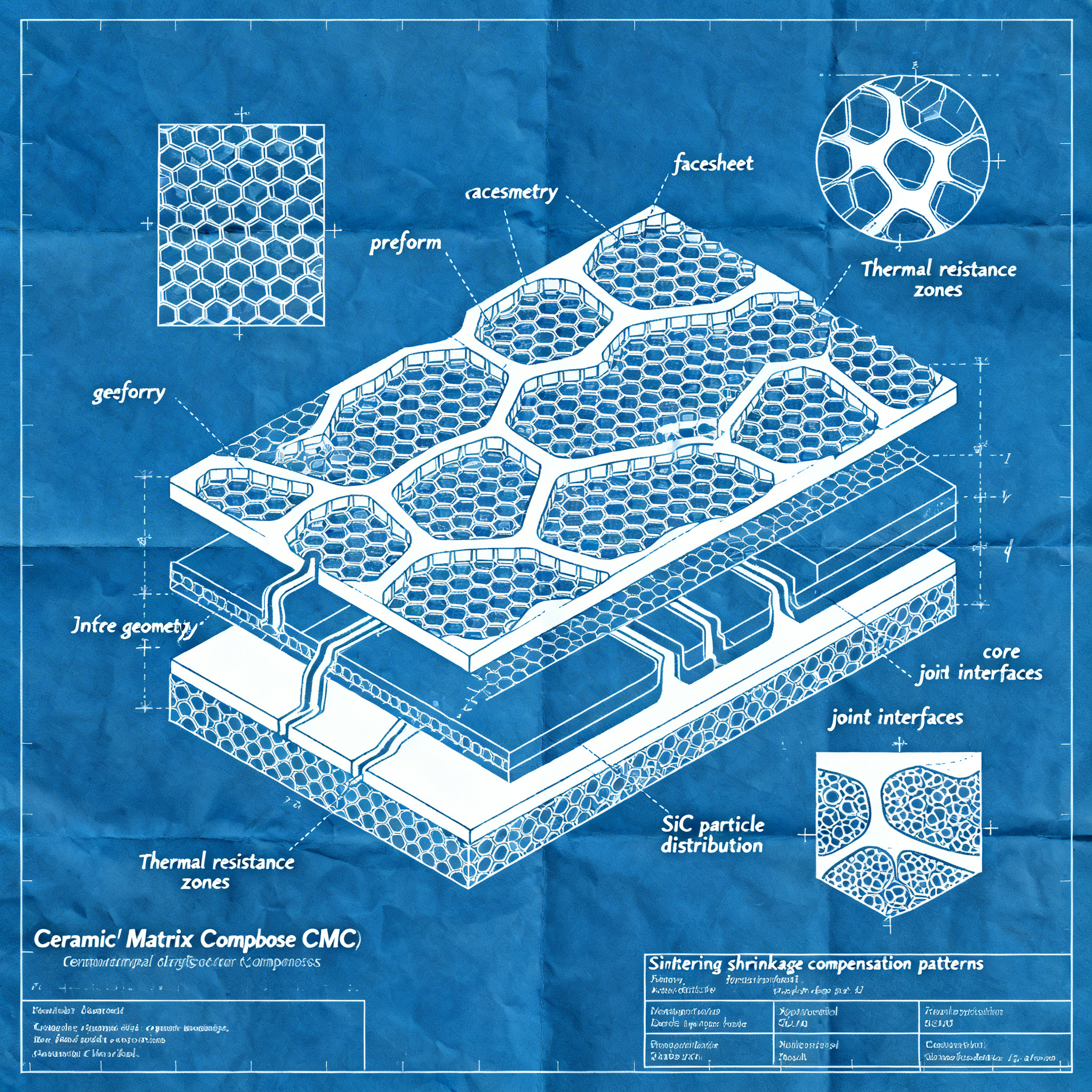
The use of cellular geometries such as honeycomb reduces weight and material consumption, but introduces structural risks related to limited joint areas.
Panels with internal cellular structures offer properties similar to solid components, drastically reducing weight and the amount of CMC material used. Honeycomb configurations can be hexagonal, triangular, square, or combinations of these shapes.
The critical problem lies in the relatively thin walls of the honeycomb structure. These provide a limited bonding area to connect the core with the external facesheets, compromising the overall structural integrity of the panel.
Cellular structures reduce the required CMC material, but thin walls limit the strength of the joints with the facesheets, creating potential structural failure points.
Facesheets include one or more layers of fabric or reinforcing fibers, typically CMC plies, cured to provide strength and rigidity. They are thin compared to the cellular structure but must ensure the mechanical integrity of the entire component.
Advanced ceramic materials: power and complexity
Silicon carbide and multi-oxide composites guarantee excellent thermal stability but require expensive chemical processes and rigorous microstructural control.
Silicon carbide (SiC) offers superior chemical resistance and stability at high temperatures. Processes like Micro Particle Jetting allow printing SiC with high-water-percentage aqueous suspensions, which after drying leave pathways for complete debinding before sintering.
Shrinkage during sintering reaches approximately 17%, requiring precise design compensations. Particle size reaches up to 62 microns, influencing the final density and mechanical properties of the component.
- SiC: excellent chemical resistance, 17% shrinkage in sintering
- Al₂O₃-YSZ-YAG composites: high mechanical resistance and thermal stability
- Processes require rigorous control of temperature and atmosphere
Multiphase composites such as alumina-stabilized zirconia-YAG combine mechanical resistance and thermal stability. YSZ efficiently absorbs microwaves, acting as an internal volumetric heater and allowing more uniform thermal distributions compared to laser alone.
Raw materials and processing techniques for high-performance ceramics remain expensive. Structures capable of withstanding extreme operating conditions are often heavy, expensive, or have limited life cycles, pushing towards lighter and more economical solutions.
Conclusion
Choosing the right process for high-temperature ceramics means balancing thermal performance, operational costs, and structural reliability. Each technology has a different breaking point: melt-infiltration prioritizes speed, CVI composite control, and PIP geometric flexibility.
Cellular structures reduce weight and material but introduce criticalities in the joints. Advanced materials such as SiC and multi-oxide composites guarantee extreme performance but require significant investments in process and quality control.
Carefully evaluate the requirements of your project: each technology has a different breaking point. The choice depends on operating temperature, mechanical stresses, production volumes, and the available budget for process and materials.
article written with the help of artificial intelligence systems
Q&A
What are the three main chemical processes for producing ceramic matrix composites (CMCs)?
The three main processes are melt-infiltration, chemical vapor infiltration (CVI), and polymer infiltration and pyrolysis (PIP). Each has advantages and disadvantages in terms of speed, compositional control, and complexity.
What are the advantages and disadvantages of chemical vapor infiltration (CVI)?
CVI offers excellent control over material composition, but requires very long processing times, increasing operational costs. It is particularly suitable when compositional precision is a priority.
How do internal cellular structures affect the design of ceramic components?
Cellular structures reduce weight and material consumption, but introduce structural criticalities due to thin walls that limit bonding area with the facesheet. This can compromise the overall integrity of the component.
Why is silicon carbide (SiC) considered an advanced material for high-temperature applications?
SiC provides excellent chemical resistance and thermal stability. However, during sintering, a 17% shrinkage occurs, requiring precise design compensations to maintain dimensional tolerances.
What is the main trade-off in choosing the production process for high-temperature ceramics?
The choice of process involves balancing thermal performance, operational costs, and structural reliability. For example, melt-infiltration is fast but less precise, while CVI is precise but slow and expensive.