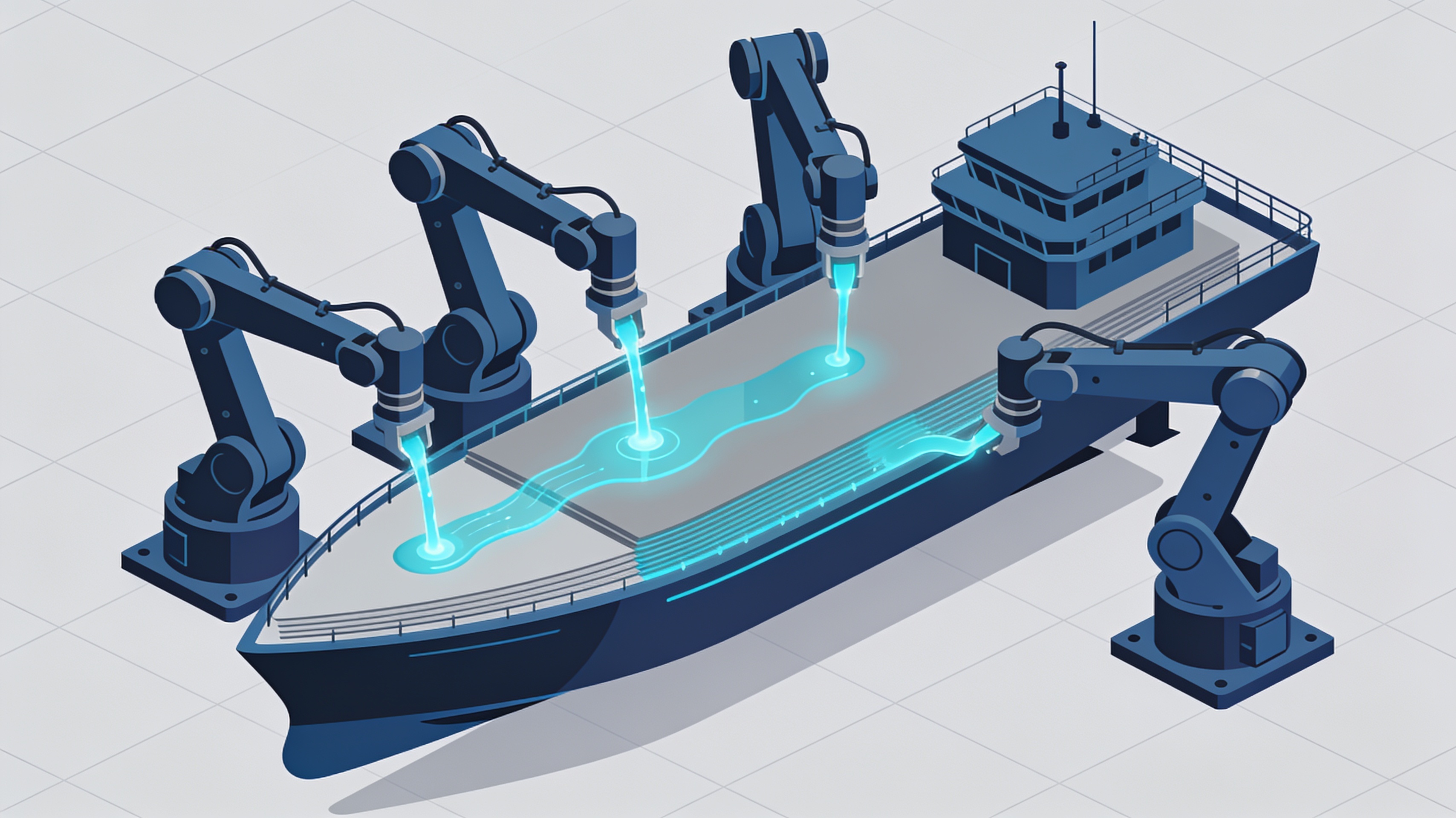
Haddy 3D prints the TF-179 drone boat with robotic arms
Large-format additive manufacturing enters shipbuilding: an unmanned vessel built entirely with robotic systems in Florida.
Haddy, a US company specializing in large-format additive manufacturing, has completed production of the TF-179 Drone Boat in St. Petersburg, Florida. The unmanned vessel represents a concrete application of robotic 3D printing in the naval sector, where component sizes and the need for rapid design changes are critical factors.
The company has not revealed the identity of the client nor the specific mission of the TF-179. Although the project fits into the naval defense applications market, public information about its precise operational role is lacking.
The robotic production process
The TF-179 was built directly from the digital model using robotic arms equipped with extrusion systems, eliminating the need for traditional molds.
Haddy used robotic arms equipped with extruders to build the vessel's large structures directly from three-dimensional data. The principle is the same as extrusion 3D printing, but applied on an industrial scale completely different from desktop machines.
In Large Format Additive Manufacturing (LFAM), the component is digitally divided into layers. The material is deposited progressively along trajectories calculated by the software.
- Multi-axis robotic arms replace traditional Cartesian structures
- Deposition of thermoplastic material along programmed trajectories
- Direct construction from digital model without physical molds
- Extended production volumes over several meters when the robot is mounted on a linear axis
Advantages for naval platforms
The flexibility of the digital process allows rapid modifications without rebuilding molds, a crucial advantage for vehicles that require different configurations and small series.
When the process is entrusted to a multi-axis industrial robot, the extruder is not constrained to the Cartesian structure typical of 3D printers. The arm can move along extended trajectories and cover production volumes several meters long.
For objects such as hulls or large boat structures, this feature changes the organization of production. The three-dimensional model becomes the starting point of the entire process.
Design changes can be made digitally and transferred to the production system. There is no need to build a new mold every time the geometry changes.
These platforms often require different configurations and small production runs. Robotic 3D printing eliminates mold costs and accelerates design iterations, key factors for this emerging market.
The technological and industrial context
Haddy uses Flexbot systems developed by the Dutch company CEAD and collaborates with partners specialized in autonomous naval systems.
The company, founded by Jay Rogers in 2022, employs Flexbot robotic systems developed by the Dutch company CEAD. Partners include HavocAI for the production of unmanned surface vehicles and Blue Ops, a division of Red Cat Holdings dedicated to autonomous naval systems.
The TF-179 demonstrates how large-format additive manufacturing is emerging from the experimental phase. The technology finds application where reduced development times and customization are operational requirements, not just theoretical advantages.
article written with the help of artificial intelligence systems
Q&A
Who produced the TF-179 drone boat and where?
The TF-179 was produced by Haddy, a US company specializing in large-format additive manufacturing. Construction took place in St. Petersburg, Florida.
What technology was used to build the TF-179 hull?
Multi-axis robotic arms equipped with extrusion systems for thermoplastic material deposition were employed. This process eliminates the need for traditional molds.
What are the main advantages of using robots for shipbuilding?
Using robots allows rapid design modifications directly from the digital model without rebuilding physical molds. Additionally, it enables covering production volumes spanning several meters.
Is the client or specific mission of the TF-179 drone boat known?
Haddy has not revealed the client's identity nor the vehicle's specific operational mission. Although it falls within the defense sector, public details on its role are lacking.
How does Haddy's LFAM process differ from desktop 3D printers?
The LFAM process uses industrial robotic arms instead of fixed Cartesian structures, allowing large-scale components to be printed industrially. Material is deposited along trajectories calculated over extended volumes.