
Functional and Adaptive Filaments: Mechanisms of Fracture and Thermomechanical Stability
Introduction to Functional and Adaptive Filaments
Composite filaments for FDM printing represent a rapidly expanding category, characterized by the integration of additives such as carbon fibers, glass fibers, and ceramic particles that profoundly modify the mechanical and thermal behavior of the base material.
Functional and adaptive filaments today constitute one of the most promising frontiers in fused deposition modeling (FDM) 3D printing. Unlike pure polymers such as PLA or ABS, these materials incorporate specific additives – mainly carbon fibers (CF), glass fibers (GF), activated carbon, and magnesium oxide (MgO) – with the aim of improving mechanical, thermal, or functional properties. However, the integration of these additives introduces significant technical challenges that go beyond simple marketing promises.
Recent research has highlighted that the addition of short fibers to thermoplastics does not automatically guarantee performance improvements. On the contrary, in many cases the presence of these additives can compromise the structural integrity of the filament itself, making it brittle and subject to sudden breakage during the printing process. This phenomenon is particularly critical in filaments loaded with CF and GF, where mechanical brittleness can also manifest inside the PTFE tube that guides the material toward the extruder.
Breakage Mechanisms in Reinforced Filaments
The brittleness of composite filaments derives mainly from poor interfacial integration between the reinforcing fibers and the polymer matrix, which creates structural discontinuities and localized stress concentrations.
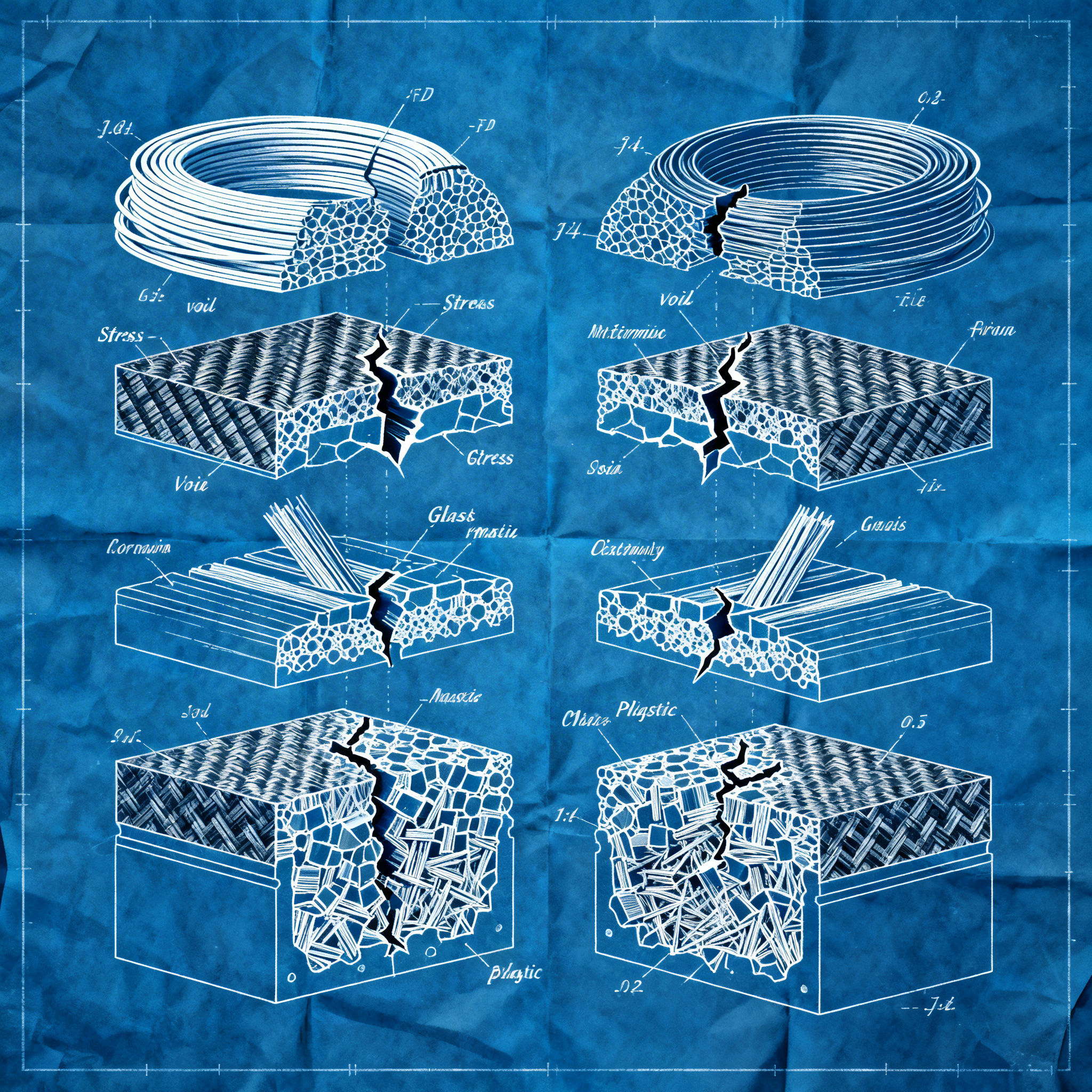
The physical mechanisms underlying the breakage of reinforced filaments are complex and multifactorial. At the microscopic level, scanning electron microscopy (SEM) analyses have revealed that chopped carbon fibers (chopped CF) do not integrate effectively into the thermoplastic polymer matrix. Unlike thermosetting composites, where chemical reactions during curing allow the formation of covalent bonds between resin and fibers, in thermoplastics adhesion relies exclusively on weak Van der Waals interactions, π-π interactions, and hydrogen bonds.
This poor integration generates voids and discontinuities around the fibers, effectively turning the additives into “contaminants” that weaken the structure rather than reinforce it. Micro-computed tomography (Micro CT) images have documented the systematic presence of air bubbles associated with each individual carbon filament, probably caused by thermal decoupling between the solid fiber and the still-molten polymer during cooling.
In filaments with glass fibers (such as PET-GF and PAHT-GF), the problem persists in similar ways, compromising both the mechanical strength and the ductility of the material. The presence of these structural discontinuities makes the filament particularly vulnerable to bending stresses that occur along the path from the spool to the extruder.
Thermomechanical Tests: Comparison between Standard Conditions and Heated Chamber
A controlled experiment on five composite filaments demonstrated that heating the chamber to 65°C not only does not reduce brittleness, but in some cases can even worsen it.
To verify the effectiveness of heated chambers in reducing the brittleness of composite filaments, a systematic test was conducted using a calibrated bending device. The experiment involved five different filaments from three manufacturers (Polymaker, Qidi, and YXPolymer), including both carbon fiber and glass fiber variants (Qidi's PET-GF and PAHT-GF).
The experimental protocol involved preheating the samples to 65°C for five minutes – a time longer than the 2.5 minutes estimated for the actual transit of the filament through a 500 mm PTFE tube under real operating conditions. This methodological choice ensured the most favorable possible conditions for observing any beneficial effects of heating.
The results categorically refuted the initial hypothesis: even taking standard deviation into account, the data showed that heating tends to make the filaments even more brittle than under ambient conditions. This counterintuitive behavior suggests that the thermomechanical mechanisms involved are more complex than assumed by the user community, and that empirical solutions based on subjective perceptions can prove ineffective or even counterproductive.
Role of Temperature and Exposure Time
Prolonged thermal exposure modifies the viscoelastic properties of the polymer and can alter internal stress balances, but it does not improve interfacial adhesion between fibers and matrix.
Temperature plays a critical role in the behavior of thermoplastic composite materials, but its effects are not unambiguous. When a fiber-filled filament is heated, the polymer undergoes thermal transitions that modify its mechanical properties: the glass transition temperature (Tg) represents a critical threshold above which the material becomes more ductile but also less rigid.
In the specific case of the tests at 65°C, this temperature falls in an intermediate zone for many engineering polymers, insufficient to significantly soften the matrix but sufficient to alter internal stress balances. The five-minute exposure time used in the experiments represents a compromise between real operating conditions and the need to ensure uniform heating of the sample.
However, heating cannot compensate for the fundamental problem: the absence of strong chemical bonds between fibers and polymer. Ceramic additives such as magnesium oxide (MgO) can act as nucleating agents and thermal stabilizers, improving crystallinity and oxidation resistance, but they do not solve the problem of interfacial integration. Activated carbon, while offering interesting functional properties (absorption, thermal conductivity), can even increase the porosity of the material if not properly processed.
Filament Path Geometry and Concentrated Stresses
The mechanical configuration of the feed system, with curves, angles, and contact points, generates stress concentrations that exploit the intrinsic structural discontinuities of composite filaments.
The geometry of the path that the filament must travel from the spool to the extruder represents a critical variable that is often underestimated. Every curve, every deflection angle, and every contact point with guides or PTFE tubes introduces localized bending stresses. In a homogeneous and ductile filament, these stresses are distributed uniformly and absorbed elastically. In composite filaments, however, the interfacial discontinuities between fibers and matrix act as stress concentrators.
When the filament is flexed, the rigid fibers cannot deform like the surrounding polymer matrix. This mechanical decoupling generates shear stresses at the interface, which propagate through the voids and poorly bonded areas already present in the material. The result is a brittle fracture that can occur even at relatively modest bending angles.
Fiber length plays an important role: longer fibers (0.3–0.5 mm in co-extruded filaments) reduce the presence of reinforcements between print layers, improving interlaminar adhesion, but they do not eliminate the problem of poor integration into the matrix. Even innovative solutions such as co-extrusion, where a continuous carbon fiber core is surrounded by polymer, do not completely solve the problem: SEM analyses show that the PLA still detaches from the fibers, leaving evident voids.
Technological Limitations of Heated Chambers
Heated chambers represent an effective technological solution for managing warping and improving layer adhesion, but they cannot correct intrinsic structural defects of poorly formulated composite materials.
The adoption of heated chambers in FDM 3D printing is mainly motivated by the need to control the thermal gradient during deposition, reducing warping and improving adhesion between layers. These benefits are real and documented for many high-temperature engineering polymers such as PEEK, PEI, and nylon.
However, the idea that a heated chamber can “soften” the filament during its transit to the extruder, making it less brittle, has proven unfounded. Experimental tests have shown that heating to 65°C not only does not reduce the brittleness of CF and GF filaments, but can even increase it. This behavior suggests that mechanisms of thermal degradation or internal stress relaxation may prevail over any plasticizing effects.
The fundamental question remains unresolved: if the interfacial integration between fibers and matrix is inadequate, no environmental condition can compensate for this structural deficiency. Heated chambers remain valuable tools for optimizing the printing process, but they cannot transform a poorly formulated material into a high-performance composite.
Conclusion
Functional and adaptive filaments represent a promising but technically complex area of development. Available experimental evidence demonstrates that adding short fibers to thermoplastics does not automatically guarantee performance improvements and may even introduce critical brittleness. Fracture mechanisms are rooted in poor interfacial integration between reinforcements and polymer matrix, a problem that requires targeted engineering solutions – such as fiber surface treatments or chemical modifications of the matrix – rather than empirical adjustments of operating conditions.
Heated chambers, although valid tools for other purposes, do not represent an effective solution for the brittleness of composite filaments. The choice of these materials must be based on a critical evaluation of real operating conditions, documented mechanical properties, and application specifications, avoiding relying exclusively on marketing claims or generic solutions.
Choose the filament based on real operating conditions and not only on the manufacturer's claims. Only a rigorous engineering approach, supported by verifiable experimental data, can guarantee reliable results in 3D printing with advanced composite materials.
article written with the help of artificial intelligence systems
Q&A
What are the main additives used in functional and adaptive filaments for FDM 3D printing?
The main additives are carbon fibers (CF), glass fibers (GF), activated carbon, and magnesium oxide (MgO). These materials are integrated into base polymers to enhance the mechanical, thermal, or functional properties of the filament.
Why can fiber-reinforced filaments with short fibers become brittle during printing?
Brittleness arises from poor interfacial integration between the fibers and the polymer matrix, creating structural discontinuities and stress concentrations. Short fibers do not form stable covalent bonds with thermoplastics, relying only on weak interactions such as Van der Waals forces and hydrogen bonding.
How does heating the print chamber affect the brittleness of composite filaments?
According to conducted experiments, heating to 65°C does not reduce the brittleness of composite filaments and may even worsen it. This occurs because intermediate temperatures disrupt internal stress balances without addressing the fundamental issue of interfacial adhesion.
What structural issues emerge from electron microscope (SEM) analyses on carbon fiber filaments?
SEM analyses reveal the presence of voids and air bubbles around carbon fibers, caused by thermal decoupling between the fiber and polymer during cooling. These discontinuities turn fibers into potential fracture points rather than reinforcement elements.
How does filament path geometry affect its structural integrity?
Curves, angles, and contact points generate localized bending stresses that concentrate on the material's interfacial discontinuities. Rigid fibers do not follow the elastic deformation of the polymer matrix, causing brittle fractures even at low bending angles.


