Fiber optic sensors integrated in large-format 3D printing: ERDC research
Researchers at the U.S. Army ERDC have demonstrated that it is possible to embed fiber optic strain sensors during large-format additive manufacturing without modifying the basic printing process. The technology promises to revolutionize structural monitoring of civil infrastructure in polymer.
Integrated monitoring for large components
The research explores how to integrate sensors directly during LFAM printing, eliminating the need for periodic inspections or subsequent installations.
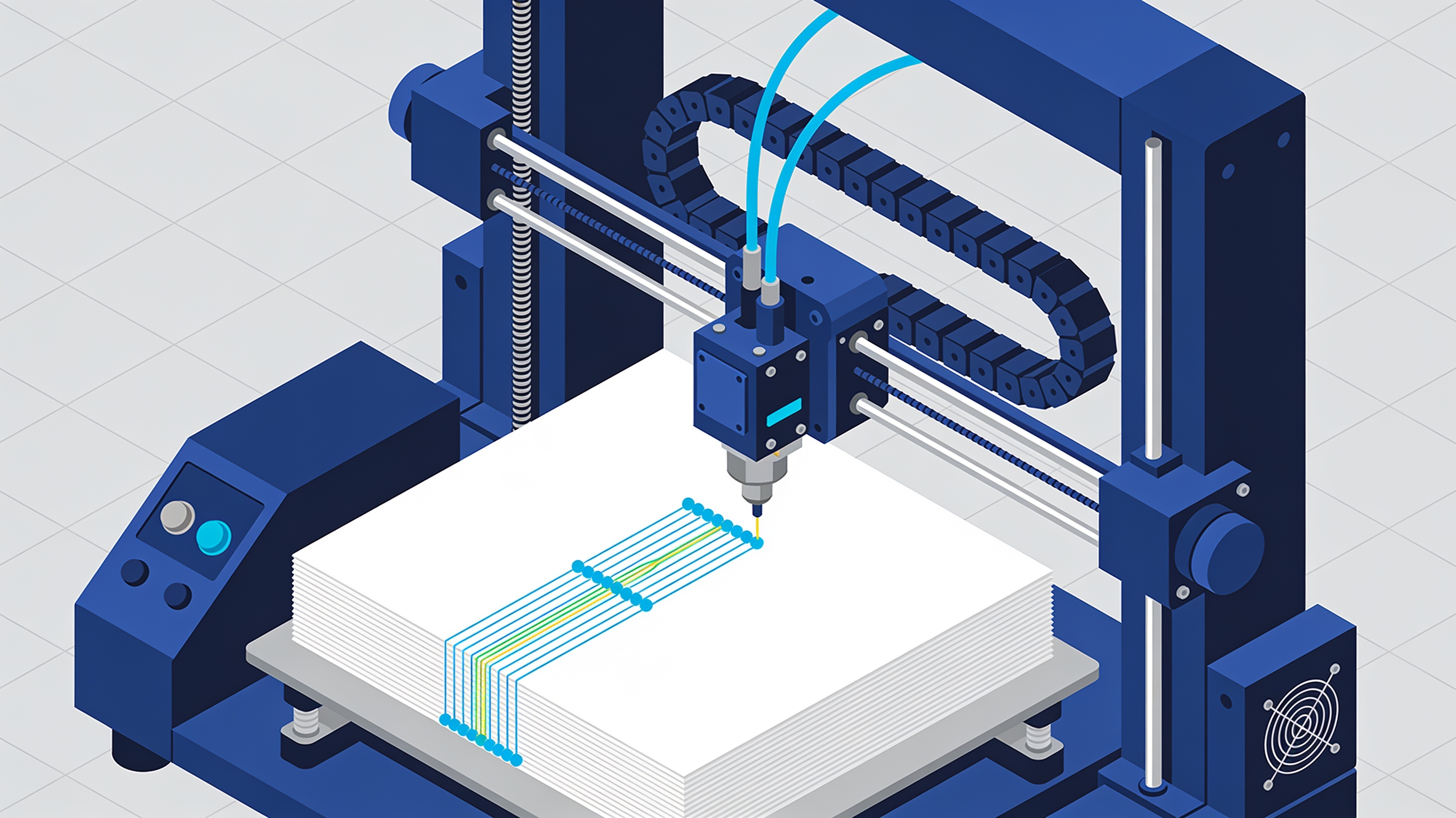
The approach developed by ERDC focuses on structural health monitoring for large polymer components intended for civil infrastructure. Instead of periodically inspecting a structure or applying sensors after production, the sensor path is printed directly inside the component.
This solution naturally adapts to Large Format Additive Manufacturing (LFAM), where a large extrusion bead is deposited layer by layer.
- 155-micrometer fiber optic sensors embedded during LFAM printing
- Continuous strain monitoring with 0.65 mm resolution
- Polymer application for civil infrastructure
- No modification to the standard printing process required
The experimental protocol
The team tested the integration on reinforced PLA specimens, manually placing the sensors between the printing layers.
The researchers used a containerized LFAM system equipped with a Strangpress 19 extruder. They printed 20 short test bars using 3DXTech carbon fiber reinforced PLA.
Each bar was made with three passes of the extruder, 15 mm wide and 5 mm high, producing specimens of 15 x 45 x 160 mm. In the instrumented versions, operators manually laid a Luna fiber optic sensor with a diameter of 155 micrometers along the central bead after the first layer.
The second layer was then printed over the sensor at 200°C.
Distributed strain measurement
The interrogation system used allows continuous measurement of strain along the entire fiber, not just at discrete points.
The sensor was connected to a Luna ODiSI 7100 interrogator, which uses Rayleigh backscatter to measure strain continuously along the fiber. The researchers configured it with a resolution of 0.65 mm and a sampling frequency of 31.25 Hz per channel.
A sufficiently long embedded fiber could potentially reveal where a strain concentration develops within a large printed structure. This is much more useful than simply confirming the loading of an entire beam or panel.
| Parameter | Value |
|---|---|
| Optical fiber diameter | 155 micrometers |
| Measurement resolution | 0.65 mm |
| Sampling frequency | 31.25 Hz |
| Printing temperature | 200°C |
Fatigue test results
During ten displacement-controlled fatigue cycles, the fiber signals accurately tracked the stress trend measured by the load cell.
Peaks, valleys, and transitions appeared at the correct points on all three usable specimens. For monitoring load events and accumulated usage, these qualitative data are quite encouraging.
The sensor also recorded high apparent strain values immediately after being encapsulated by the hot material. These exceeded roughly 15,000 microstrain, the instrument limit, and were attributed to thermal expansion and refractive index changes during cooling.
Although this response was not used as a quantitative strain measurement, it suggests that the same setup could observe cooling behavior during manufacturing in addition to subsequent in-service load.
The challenge of adhesion quality
X-ray computed tomography revealed a critical issue: only 58.2% of the fiber surface is in contact with the polymer.
X-ray computed tomography on a specimen with an embedded sensor detected only 58.2% polymer contact around the fiber surface. This gap in adhesion represents the immediate challenge to be addressed for system reliability.
This data highlights that, despite the promising results on strain tracking, there is still work to be done to optimize the physical integration between sensor and printed material. The quality of adhesion directly affects the sensor's ability to accurately detect structural strains.
Perspectives for infrastructure
ERDC's research opens concrete perspectives for the continuous monitoring of 3D-printed structural components. The ability to detect strain concentrations within large structures could significantly improve predictive maintenance of civil infrastructure.
The next step will be to improve the quality of adhesion between fiber and material to ensure more reliable and long-lasting measurements over time.
article written with the help of artificial intelligence systems
Q&A
What is the main objective of ERDC's research on LFAM printing?
The goal is to integrate fiber optic strain sensors directly during large-format additive manufacturing. This enables continuous structural monitoring of polymer civil infrastructures without the need for periodic inspections or post-installation.
How are fiber optic sensors incorporated into the printing process?
The 155-micrometer sensors are manually placed along the central bead after the first layer is deposited. Subsequently, the second layer is printed over the sensor at 200°C without modifying the standard printing process.
Which material and extrusion system were used in the experimental tests?
Researchers used an LFAM system with a Strangpress 19 extruder to print specimens made of 3DXTech carbon fiber-reinforced PLA. Twenty test bars with specific dimensions were produced to validate sensor integration.
What type of data does the Luna ODiSI 7100 interrogation system collect?
The system uses Rayleigh backscatter to measure strain continuously along the entire optical fiber, not just at discrete points. It is configured to offer a resolution of 0.65 mm and a sampling frequency of 31.25 Hz.
For which applications is this integrated sensor technology particularly suitable?
The solution is specifically targeted at structural health monitoring of large-scale polymer components intended for civil infrastructure. The technology eliminates the need to apply sensors externally after component production.