
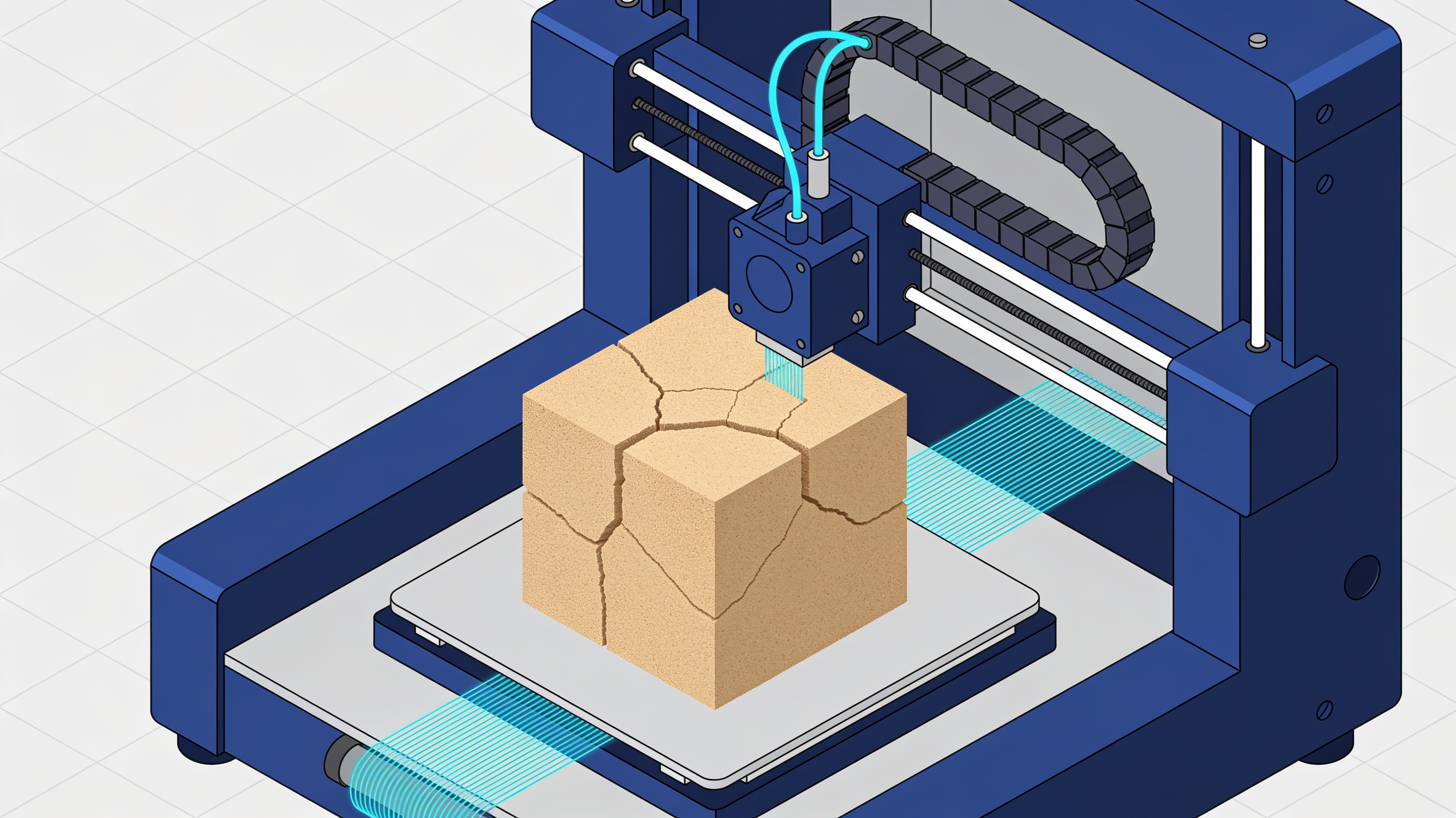
ETH Zurich 3D-prints artificial stones to study the degradation of historic buildings
Researchers at ETH Zurich will use binder jetting to manufacture stone samples with controlled defects, reproducing in the laboratory the mechanisms that cause the deterioration of sandstones in Swiss monuments.
Two research groups at ETH Zurich have won an ETH Collaborative Grant 2026 for a project that applies 3D printing to the study of architectural conservation. The announcement came on October 8, 2026.
The project, titled “Spatially graded 3D printing to elucidate contour scaling of building stones”, combines additive manufacturing and materials science. The goal is to understand why stones in historic buildings degrade and progressively lose portions of their surface.
The problem of contour scaling
The phenomenon of contour scaling causes the detachment of entire portions of the stone's outer layer. It is particularly common in the Molasse sandstones used in the Swiss Plateau.
Contour scaling manifests as the formation of internal fractures parallel to the exposed surface. These fractures grow until they cause the detachment of surface layers.
Numerous Swiss monumental buildings are built with Molasse sandstones. These sedimentary rocks have variable compositions depending on their origin, making it difficult to predict their behavior over time.
- Technology: binder jetting to produce artificial stones with controlled defects
- Application: accelerated study of deterioration under laboratory conditions
- Outlook: development of compatible replacement elements for restoration
Interdisciplinary collaboration
Two ETH professorships combine complementary expertise: physical chemistry of building materials and digital technologies for architecture.
The program involves the Chair of Physical Chemistry of Building Materials, led by Robert J. Flatt in the Department of Civil, Environmental and Geomatic Engineering. The second group is the Chair of Digital Building Technologies, led by Benjamin Dillenburger in the Department of Architecture.
The printing platform derives from a large-format system developed by Pietro Odaglia, a researcher in Dillenburger's group.
Binder jetting for experimental samples
Additive manufacturing makes it possible to introduce defects and variations in properties at precise positions, which cannot be controlled with natural stones.
The first application does not concern the construction of 3D-printed facades or monuments. The researchers will produce experimental samples with controlled compositions, porosity, and weak zones.
These samples will be subjected to accelerated environmental conditions. Precise control of the internal characteristics will make it possible to isolate the mechanisms responsible for deterioration.
Binder jetting deposits layers of powder selectively bound by a liquid binding agent. The technique makes it possible to vary composition and porosity during printing, creating materials with spatially graded properties.
From research to restoration
The second direction of the project involves the development of 3D-printed replacement elements, designed to be compatible with the original stones.
The replacement elements must have mechanical and chemical characteristics compatible with historic sandstones. Compatibility is essential to prevent the new stones from accelerating the degradation of the original ones.
3D printing offers the possibility of replicating not only the composition but also the internal porous structure. This level of control is impossible with traditional stone-working techniques.
Prospects for conservation
The project represents an innovative approach to the conservation of architectural heritage. The possibility of studying deterioration under controlled conditions will accelerate understanding of the mechanisms involved.
The results could apply not only to Swiss sandstones but also to other stone materials used in historic buildings. The methodology based on 3D-printed samples with controlled defects is transferable to different types of stone.
The combination of additive manufacturing and conservation science opens new possibilities for restoration based on experimental evidence. The ETH Collaborative Grant 2026 funds this direction of interdisciplinary research.
article written with the help of artificial intelligence systems
Q&A
Which 3D printing technology does the ETH Zurich project use?
The project is based on binder jetting, an additive manufacturing technology that makes it possible to produce stone samples with controlled compositions, porosity, and weak zones. This allows defects that are difficult to control in natural stones to be reproduced in the laboratory.
What does the project on contour scaling of building stones study?
The project investigates contour scaling, a phenomenon that causes internal fractures parallel to the surface and the detachment of outer layers of the stone. The goal is to understand the deterioration mechanisms that particularly affect the Molasse sandstones used in Swiss historic buildings.
Which ETH Zurich research groups are participating in the project?
Two chairs are involved: Physical Chemistry of Building Materials, led by Robert J. Flatt, in the Department of Civil, Environmental and Geomatic Engineering, and Digital Building Technologies, led by Benjamin Dillenburger, in the Department of Architecture.
Does the project plan to 3D print entire monuments or facades?
No, the first application does not involve the construction of 3D-printed facades or monuments. The researchers will produce experimental samples to be subjected to testing, with the aim of studying degradation and, in perspective, developing compatible replacement elements for restoration.
From which system does the printing platform used in the project derive?
The printing platform derives from a large-format system developed by Pietro Odaglia, a researcher in Benjamin Dillenburger's group. The project thus combines additive manufacturing and materials science for the study of architectural conservation.


