
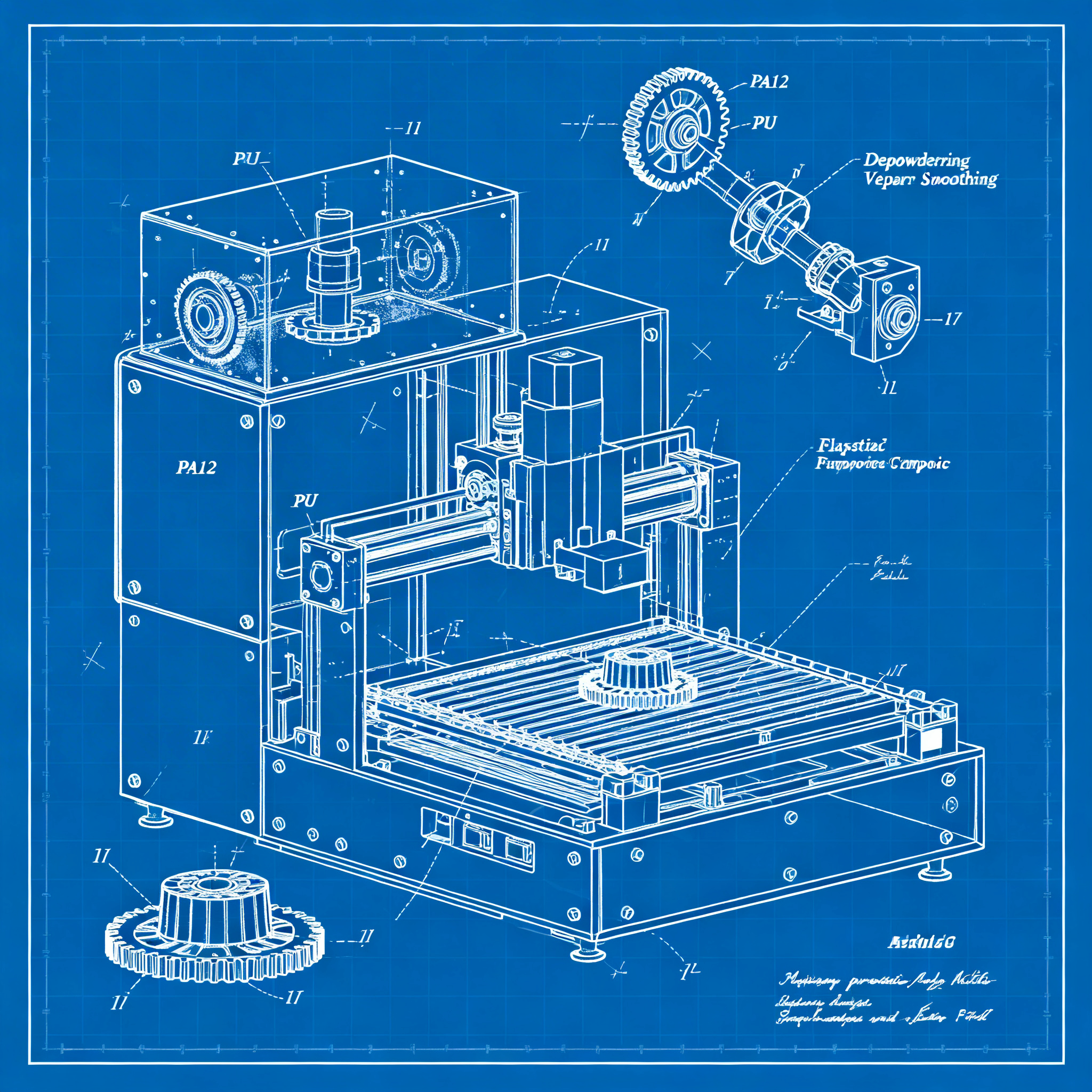
Direct Production of Functional Parts Without Post-Processing: Mechanisms and Advanced Technologies
Definition and Context of Direct Production of Functional Parts
The concept of direct production without post-processing represents the evolution of additive manufacturing toward immediately usable components, clearly distinguishing itself from traditional prototyping, which requires multiple subsequent processing stages.
Additive manufacturing is finally overcoming the gap between prototyping and serial production thanks to technologies that eliminate dependence on post-processing operations. Traditionally, up to 60% of the cost of a 3D printed part is attributable to post-printing operations: support removal, cleaning, surface smoothing, chemical and thermal treatments. This represents the main bottleneck for the industrial scalability of additive manufacturing.
Direct production aims to overcome this limit through the integration of finishing capabilities directly into the layer-by-layer build process, making it possible to obtain parts with mechanical properties and surface finishes suitable for end use without further manual or automated interventions external to the printing machine.
Enabling Technologies: Printers and In-Situ Processes
Advanced printing technologies integrate consolidation, finishing, and quality control capabilities directly during the build phase, eliminating the need for dedicated post-processing stations.
The technologies that come closest to the concept of direct production include processes that drastically minimize post-printing operations. In the context of powder technologies (SLS, MJF), some systems integrate automated depowdering and surface blasting cycles that reduce cleaning times to less than 10 minutes per cycle, with material waste reductions of up to 75% compared to manual methods.
For FDM (Fused Deposition Modeling) technologies, the elimination of post-processing focuses on reducing the need for supports or on the use of soluble support materials that do not require manual intervention. Unlike SLA and SLS technologies, FDM parts do not require chemical treatments or post-print curing to achieve final mechanical properties, approaching the concept of direct production for specific applications.
Automated vapour smoothing technologies represent a bridge between traditional post-processing and direct production: systems such as chemical vapour smoothing units can be integrated into the production workflow with chambers up to 96 liters, processing thermoplastic parts with dimensional variations of less than 0,4% and improving elongation at break without loss of tensile strength.
Specialized Materials for Immediate Properties
Material selection is the determining factor for achieving mechanical and surface characteristics usable directly from the machine, without the need for subsequent thermal or chemical treatments.
Materials compatible with direct production approaches include advanced thermoplastics such as PA6, PA11, PA12, ABS, PC, PP, TPU, TPE, PEBA, and composites with glass, carbon, or mineral fillers. These materials are designed to achieve target mechanical properties directly at the end of the printing cycle, eliminating the need for post-process thermal treatments.
For resin technologies (SLA), the requirement for washing in isopropyl alcohol (IPA) or tripropylene glycol monomethyl ether (TPM) and for post-curing to optimize mechanical properties represents an intrinsic limit to direct production. Some functional resins mandatorily require post-curing, while standard resins can be used without this step, although maintaining limitations in final mechanical properties.
Material-process compatibility is fundamental: depowdering and shot blasting systems operate with different media (glass beads, polybeads, corundum, ceramics, nut shells, plastics, stainless steel) depending on the part material, influencing the surface finish achievable without further processing.
Simplified Production Workflow
The elimination of post-process phases radically transforms the production flow, reducing lead times, labor costs, and batch-to-batch variability, with measurable impacts on total cost of ownership.
The traditional additive manufacturing workflow involves complex sequences: printing → removal from the build platform → depowdering/cleaning → support removal → surface treatments → thermal treatments → quality control. Each phase introduces variability, requires specialized labor, and dedicated equipment.
The automation of post-processing through integrated systems has demonstrated reductions of 30-50% in return on investment (ROI) in industrial production contexts. The elimination of manual labor significantly reduces the time required to complete post-printing operations, directly impacting total cost of ownership (TCO).
The standardization of processes through software-driven validated “recipes” guarantees part-to-part repeatability, eliminating variability introduced by human operators. This aspect is critical for the transition from prototype use cases to serial production, where qualitative consistency is a fundamental requirement.
The reduction of production steps also impacts safety: exposure to flammable chemicals and solvents is minimized through automated closed systems, reducing risks for operators and ventilation requirements of production environments.
Industrial Cases: Aerospace and Automotive
High-criticality sectors such as aerospace and automotive are implementing direct production solutions with quantifiable benefits in terms of lead time, quality, and component certifiability.
In the aerospace sector, the qualification of additive parts follows rigorous frameworks that include Machine Qualification (Factory Acceptance Testing, Installation Qualification, Operational Qualification) and Part/Performance Qualification. The integration of processes that reduce post-processing simplifies these qualification paths, reducing the variables to be controlled and validated.
Documented applications include the use of vapour smoothing systems for 3D-printed aerospace tooling, where surface finish and sealing (water-tight and air-tight) are obtained directly from the automated process, eliminating subsequent manual operations. The ability to process complex geometries and internal cavities without degrading mechanical properties is particularly relevant for aerospace components with cooling channels or structural lightening.
In the automotive and motorsport sector, documented application cases show the use of automated post-processing for engine components in Formula Student, where the repeatability of mechanical performance and the speed of design iteration are determining competitive factors.
The production of spare parts through reverse engineering (3D imaging of physical components, comparison with PLM databases, identification of reference part, and modification for additive manufacturing) represents an emerging application where the reduction of post-processing significantly accelerates component availability times for legacy systems.
Technological Limits and Current Challenges
Despite progress, direct production without post-processing remains constrained to specific material-technology-geometry combinations, with limitations that restrict its applicability to advanced industrial niches.
The main limitation concerns technological compatibility: not all additive technologies can completely eliminate post-processing. SLA technologies intrinsically require washing and often curing; powder technologies always require depowdering, even if automatable; FDM technologies with complex supports require manual or chemical removal.
The surface finish obtainable directly from printing, even with advanced technologies, does not always meet stringent aesthetic or functional requirements. Vapour smoothing systems, although automated, still represent an additional step compared with true direct production.
The “as-built” mechanical properties (as built) may not reach the values obtainable with post-process heat treatments, limiting applicability to critical structural components. Aerospace qualification requires extensive testing (compositional, microstructural, mechanical, NDT, CT) that can reveal the need for additional treatments.
Investment in integrated automated post-processing systems (with costs ranging from a few thousand to tens of thousands of euros per unit) represents an economic barrier for small and medium-sized enterprises, limiting adoption to medium-to-high production contexts.
The standardization of processes and the creation of validated “recipes” require specific expertise and experimental iterations, slowing adoption for new material-geometry-application combinations.
Conclusion
The direct production of functional parts without post-processing represents a significant change in the additive manufacturing landscape, while remaining tied to advanced technological niches. The integration of automated systems and material optimization are progressively reducing the gap between printing and the finished part, with measurable benefits in terms of costs, times, and repeatability for critical industrial sectors.
Explore the key technologies and assess their applicability in your industrial sector: analyze the material-process combinations compatible with your functional requirements and consider investment in post-processing automation as a first step toward more efficient and scalable production workflows.
article written with the help of artificial intelligence systems
Q&A
What distinguishes direct production of functional parts from traditional prototyping?
Direct production allows obtaining parts immediately ready for use, avoiding post-processing steps such as cleaning, smoothing, and chemical treatments. Unlike traditional prototyping, it aims to eliminate up to 60% of the costs associated with subsequent machining.
Which technologies enable a reduction in post-processing in 3D printing?
Technologies such as SLS, MJF, and advanced FDM integrate automated cycles of depowdering, surface blasting, and use of soluble supports. Some FDM systems do not even require post-printing chemical or thermal treatments.
Which materials are most suitable for direct production without post-processing?
Materials such as PA6, PA11, PA12, ABS, PC, TPU, and composites with fillers allow achieving final mechanical properties directly from printing. SLA resins, however, often still require washing and curing.
How does the production workflow change with the adoption of direct production?
The workflow is simplified by eliminating manual steps such as support removal and chemical treatments. This results in lower costs, greater repeatability, and reduced safety risks thanks to automation.
In which industrial sectors is direct production most commonly applied?
Sectors such as aerospace and automotive use this technology to reduce lead times and ensure quality and certifiability. Examples include tooling with automated surface finishing and engine components in Formula Student.
What are the main limitations of direct production without post-processing?
Limitations include the still-present need in some technologies (e.g., SLA) for washing and curing, surface finishes that are not always optimal, and lower mechanical properties compared to heat-treated parts. Additionally, investment in automated systems can be high for SMEs.


