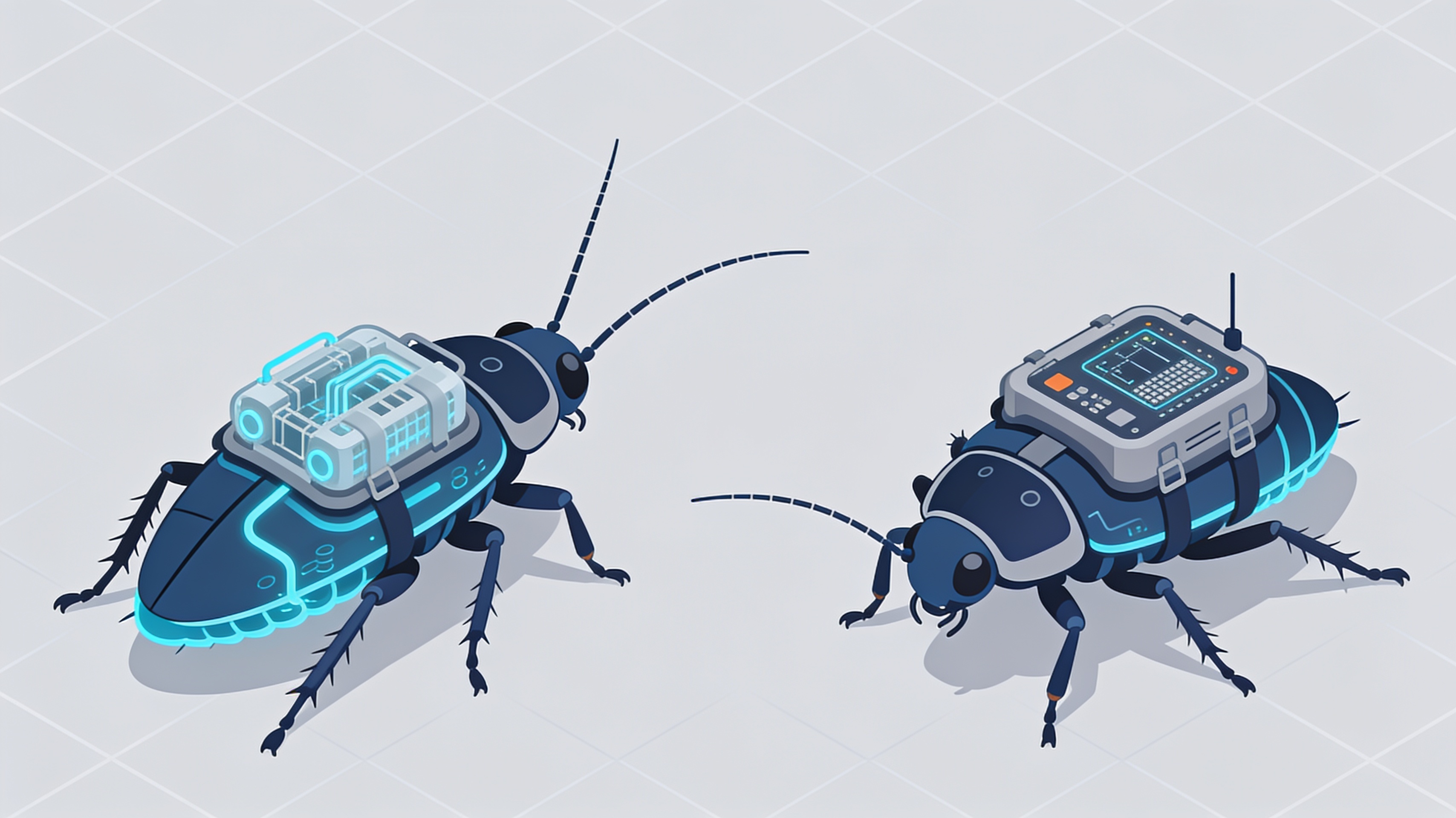
Cyborg cockroaches with 3D-printed suit for underwater operations
Researchers from Nanyang Technological University and Waseda University have developed a 3D-printed underwater suit that allows cyborg cockroaches to operate underwater for hours. The system, published in Nature Communications, transforms living insects into tools for rescue operations in flooded environments and confined spaces.
Insects equipped with this gear can move both on land and underwater. They remain active for up to three hours submerged, surpassing the natural physiological limits of cockroaches.
- 3D-printed suit allows cockroaches to breathe underwater for three hours
- Hybrid system combines living insects with radio-controlled electronic components
- Applications planned for rescue operations in extreme environments
Cyborg insects: nature and technology integrated
The researchers chose to enhance living insects rather than build robots, leveraging natural abilities that are difficult to replicate artificially.
The team used Madagascar hissing cockroaches as a biological base. These insects were equipped with a pre-existing electronic control backpack and a new 3D-printed respiratory system.
The approach represents a paradigm shift: instead of imitating the capabilities of cockroaches with complex robots, researchers integrate technological components into the living animal. This creates hybrid systems that combine biological efficiency with electronic control.
Why cockroaches are ideal for this application
The natural capabilities of cockroaches surpass those of small robots in terms of mobility and endurance.
Cockroaches squeeze into gaps of a few millimeters. They climb over debris and uneven surfaces with ease.
They straighten up quickly when they are overturned. They continue moving for hours with minimal energy consumption.
Engineers have been working for years to replicate these capabilities in robots. The results remain inferior to the natural performance of insects.
Cockroaches breathe through spiracles, small lateral openings. Underwater these spiracles do not work and the insect cannot absorb oxygen. The 3D-printed suit solves this physiological limitation.
The solution: a miniature diving suit
The flexible 3D-printed shell wraps around the insect's abdomen and operates separately from the electronic control system.
The suit is made with a combination of materials. The oxygen tank uses PMMA, a transparent resin based on polymethyl methacrylate. Other components use silicone to ensure flexibility.
The system works like real diving equipment. It provides oxygen to the insect's spiracles while it is submerged.
The equipment does not interfere with the electronic backpack. The two systems operate independently, one for breathing and one for movement control.
Performance and operational autonomy
The equipped insects remain active underwater for up to three hours, a result impossible for unmodified cockroaches.
Without the 3D-printed suit, cockroaches quickly lose functionality when submerged. The artificial respiratory system drastically extends their operational capability.
The three-hour duration provides a sufficient margin for search operations in flooded environments. The insects maintain mobility and reactivity throughout the period.
Applications in rescue operations
Cyborg cockroaches are designed to operate in extreme conditions where humans and conventional robots encounter difficulties.
The system is designed for confined spaces and flooded environments. These are typical conditions of buildings collapsed after natural disasters.
Insects can explore areas inaccessible to rescuers. Their ability to move through millimeter-sized cracks and over irregular debris makes them potentially effective search tools.
The research is led by Hirotaka Sato from the School of Mechanical and Aerospace Engineering at NTU Singapore. The study represents a significant advancement in the integration of biology and technology for practical applications.
article written with the help of artificial intelligence systems
Q&A
How long can cyborg cockroaches stay underwater?
Thanks to the 3D-printed suit, cockroaches can operate submerged for up to three hours. This surpasses their natural physiological limits that would prevent underwater breathing.
Which insect species was used for this project?
Researchers chose the Madagascar hissing cockroach as the biological basis. These insects offer superior natural mobility and endurance compared to small-scale robots.
How does the respiratory system of the 3D suit work?
The suit solves the problem of spiracles, the side openings that do not function underwater. The flexible shell wraps around the abdomen and includes an oxygen tank made of PMMA.
What are the advantages of cockroaches over traditional robots?
Cockroaches slip into cracks just a few millimeters wide and climb over debris with ease. Furthermore, they consume minimal energy and quickly right themselves if overturned.
Who developed this technology for underwater rescue?
The system was developed by researchers from Nanyang Technological University and Waseda University. The study was published in the journal Nature Communications.