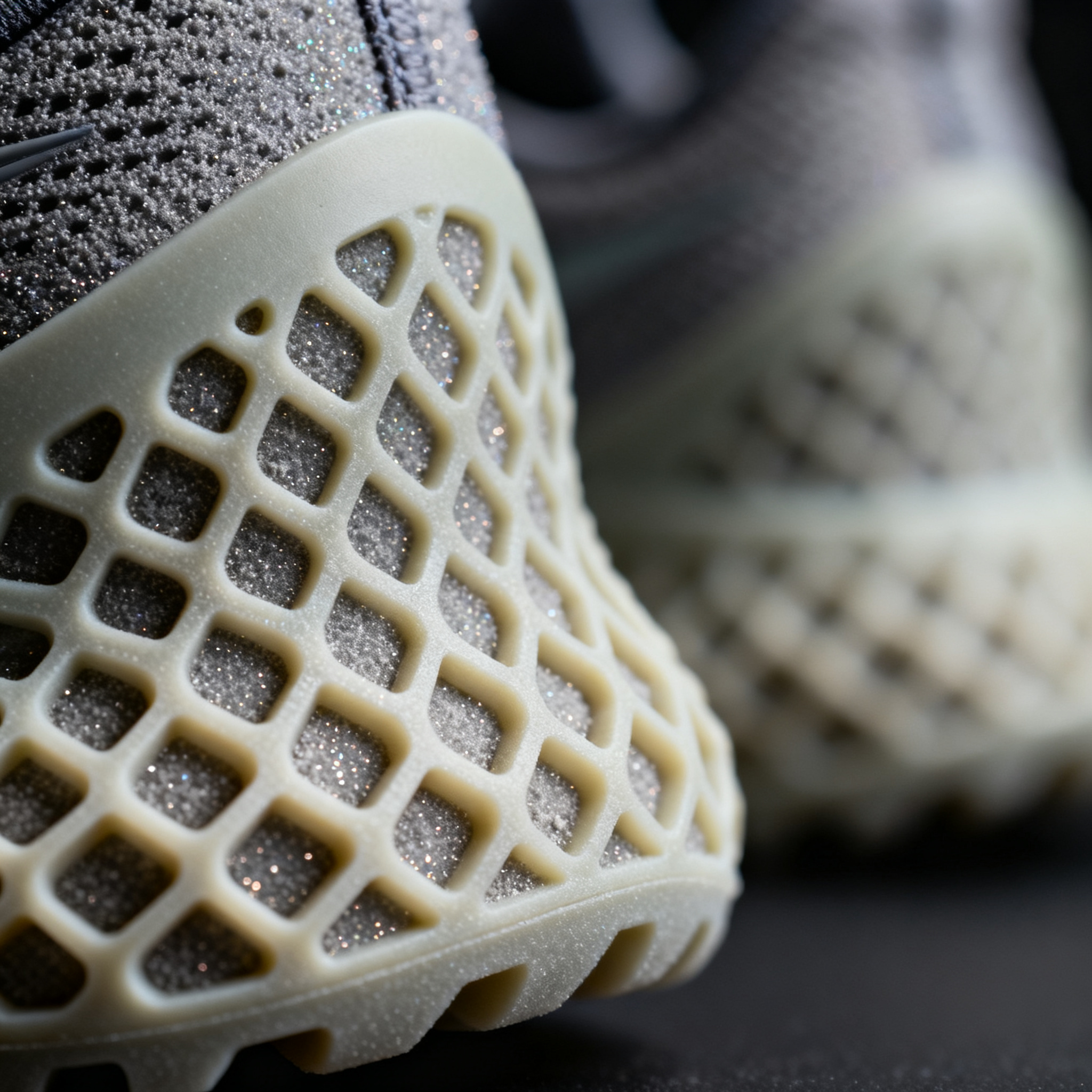
Custom shoes in 24 hours? Here's how it's done
L’integration between 3D foot scanning and additive manufacturing is transforming industrial footwear from a standard-size model to a scalable customization system. It’s no longer prototyping: it’s real production.
Incorrect fit is the leading cause of returns in the online footwear sector. Many customers order multiple sizes of the same model, try them at home, and return what doesn’t fit. This generates logistics costs, waste, and margin loss for retailers.
3D foot scanning, combined with additive printing, can drastically reduce this uncertainty. However, a complete rethinking of the production flow is needed.
3D Scanning: the new front-end of footwear e-commerce
Mobile scanning systems are entering the online purchase flow, enabling more precise recommendations and reducing returns.
Zellerfeld introduced a process where the customer scans their feet after purchase using a smartphone. Volumental’s acquisition strengthens this part, bringing tools already tested in stores and international retail chains such as Fleet Feet, New Balance, Red Wing Shoes, and Intersport.
The difference is substantial: it goes from a scan designed to choose among existing models to a scan that contributes to the production of a customized model. Volumental reports over 66 million feet scanned and more than 3,000 stores served.
- Over 66 million feet scanned by Volumental
- More than 3,000 stores served globally
- Mobile scanning available via smartphone for direct orders
- Complete 3D foot profile, not just length and width
The data is not only for choosing the size. It can influence the shape of the upper, the width of the forefoot, the support in the arch area, and the distribution of printed structures. In a shoe produced with additive manufacturing, even densities and internal geometries can be adapted with greater freedom.
Additive manufacturing: from artisanal to volume
3D printing is no longer just prototyping: new materials and production layouts are making the production of customized footwear scalable.
Zellerfeld follows a different path from the big brands: producing entire 3D-printed shoes, without complex traditional assemblies, with models uploaded by designers and made on demand. The collaboration with Fraunhofer IAPT indicates that the company is working on the industrial side: factory layout, safety, production capacity, and the transition from hundreds to thousands of printers.
Scalability is the critical point. Printing one shoe is one thing. Printing thousands or millions of pairs with consistent quality, acceptable times, and sustainable costs is another problem.
TPM3D has achieved industrial production with SLS and high-performance PEBA elastomers, offering superior fatigue resistance and energy return compared to DLP/SLA resins commonly used in printed footwear.
FITASY Inc. has made commercially viable the sale of individual shoes (not pairs) at half price, using mobile scanning and 3D printing. The process starts with a smartphone scan that creates a 360° biometric profile, then the shoe is printed on the exact morphology of the foot without specialized equipment or inventory.
Layout and supply chain: how they are reconfigured
The entry of large-scale customization requires a redesign of production centers and logistics.
Zellerfeld works on a platform where designers and brands can propose models, upload them to the system, verify their printability, and sell them without managing factories, molds, inventory, and traditional distribution channels. The shoe becomes a file, a process, and a physical object only at the moment of demand.
This model touches structural problems of footwear: overproduction, unsold stock, long development times, sampling costs, size complexity. 3D printing does not eliminate all these problems, but allows addressing some of them differently.
| Appearance | Traditional production | Additive manufacturing |
|---|---|---|
| Inventory | Stock by size and model | On-demand production |
| Development times | Months (molds, samples) | Weeks (digital file) |
| Customization | Limited to standard sizes | Geometry adapted to the foot |
| Minimum lot | Thousands of units | Single pair |
L’acquisition of Volumental by Zellerfeld also makes sense from an operational standpoint: on-demand production must be fueled by clean, fast, and usable data. The system combines scans, recommendations, and business results.
Startups and institutes: the pairing that scales l’innovation
Collaborations between entrepreneurial realities and research centers are accelerating l’industrial adoption of new technologies.
Vivobarefoot launched the Tabi Gen 02 sandal through the VivoBiome platform, in collaboration with Carbon for printing technology, Oechsler as production partner, Volumental for scanning, and ShapeDiver for computational visualization. Every pair is different, and this means that production must handle continuous variability.
3D printing alone is not enough: an infrastructure capable of transforming individual data into repeatable, controlled, and deliverable products is needed. The collaboration between Zellerfeld and Fraunhofer IAPT focuses precisely on this: factory layout, safety, production capacity, flow management.
Scan-to-print workflow
- Acquisition: 3D foot scanning in-store or via smartphone, with recording of biometric data and product preferences.
- Processing: Homologation modeling and computational generation of design adapted to foot morphology.
- Production: 3D printing of the specific pair with high-performance materials (PEBA, Carbon resins) without dedicated equipment.
- Delivery: Direct shipment to the customer without central warehouse steps.
For the additive sector, this is an important lesson. 3D printing becomes strong when it solves a specific problem: the anatomical variability of the foot, the difference between right and left, the need for personalized support, and the difficulty of keeping infinite variants in stock.
The integration of 3D scanning and additive manufacturing is redefining the future of industrial footwear. It is no longer about experiments or prototypes, but about scalable production models that reduce returns, eliminate inventory, and respond to real demand.
Explore the case studies of companies that have already adopted this synergy and discover how to replicate its success in your production context.
article written with the help of artificial intelligence systems
Q&A
Why is incorrect fit such a significant problem for footwear e-commerce?
It is the leading cause of returns in the sector. Many customers order multiple sizes of the same model, try them on at home, and return those that don't fit, generating high logistics costs, waste, and significant margin loss for retailers.
What is the difference between a 3D scan for size selection and one for custom production?
Traditional scanning is used to select an existing model among standard sizes. In the new approach, the complete 3D profile of the foot directly influences production, adapting the upper shape, forefoot width, arch support, and internal geometries to the individual morphology.
In what sense is 3D printing in the footwear sector no longer just prototyping?
Thanks to new materials such as PEBA elastomers and industrial production layouts, the technology has moved to real and scalable production. Companies like Zellerfeld produce whole shoes on demand, tackling the challenge of ensuring consistent quality even at increasing volumes.
How is the supply chain reconfigured with the on-demand production model?
The shoe becomes a digital file that materializes only at the time of order, eliminating the need for molds, size-specific stock, and central warehouses. This reduces overproduction and unsold inventory, shortening development times from months to weeks.
What is the role of collaborations between startups and research institutes in this scenario?
They accelerate industrial adoption by integrating diverse competencies: startups provide platforms and scan data (Zellerfeld, Volumental), while institutes and industrial partners (Fraunhofer IAPT, Carbon, Oechsler) develop factory layouts, high-performance materials, and production flow management to make individual variability scalable.