How Lightweight Reticular and Foamed Structures Work: A Technical Approach to Advanced Composite Materials
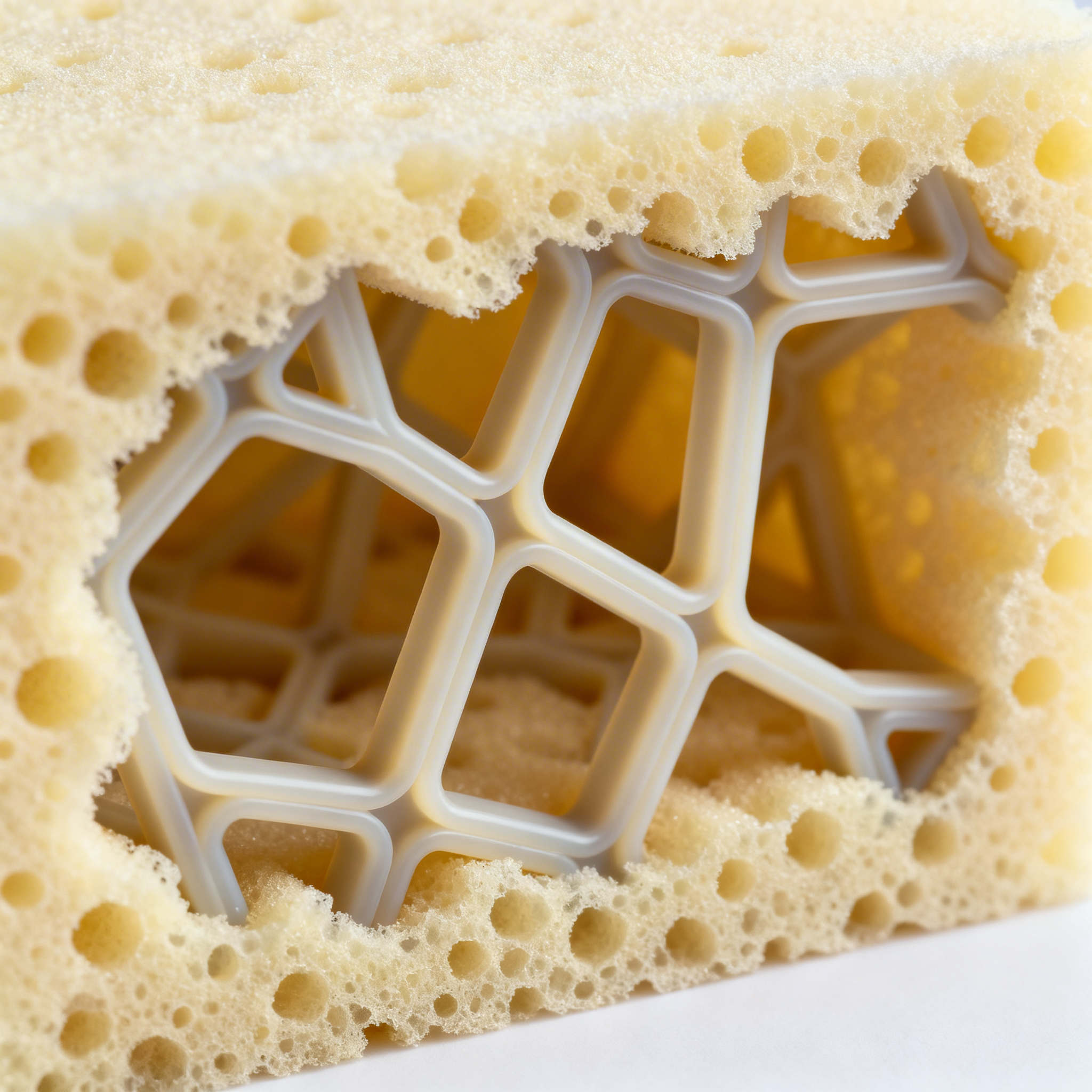
A new production technique combines conventional foam and 3D-printed polymer structures to create advanced composites with superior mechanical properties. Researchers from Texas A&M University and the DEVCOM Army Research Laboratory have developed a composite material capable of absorbing up to ten times more energy than conventional padding, combining a 3D-printed elastomeric skeleton with ordinary open-cell foam. The result is a lightweight, economical material with exceptional performance, with implications extending beyond personal protection to the defense, automotive, aerospace, and consumer sectors.
Fundamentals of Reticular Structures and Foamed Materials
3D-printed reticular structures and polymer foams present complementary mechanical characteristics but, when used individually, show significant limitations in terms of structural stability and load distribution.
Open-cell polymer foams are lightweight materials traditionally used for energy absorption, but their ability to handle high loads is limited by the random cellular structure and the tendency to premature collapse under compression. 3D-printed reticular structures, on the other hand, offer precise geometric control and can be designed to meet specific mechanical requirements. However, when subjected to compression, individual struts tend to become unstable and bend prematurely, reducing the overall effectiveness of the structure.
The research published in Composite Structures demonstrates that these two materials, if integrated correctly, can overcome their respective individual limits. The foam provides continuous lateral constraint that prevents instability of the printed struts, while the reticular structure redistributes the load more uniformly through the surrounding foam, creating a mutual load-sharing system.
The IFAM Process: Innovative Integration
The In-Foam Additive Manufacturing (IFAM) process represents a radically different approach compared to traditional techniques, depositing an elastomeric rod network directly inside an existing foam block.
Unlike conventional methods that fabricate the structure and foam separately and then combine them, IFAM integrates the two materials during production itself. The process uses computer-controlled parameters to regulate geometry, diameter, angular orientation, and spacing of the rods, enabling the targeting of specific mechanical outcomes. This geometric customization allows the composite material to be adapted for different applications without modifying the base materials.
As highlighted by Dr. Eric Wetzel, team leader for Strategic Polymers Additive Manufacturing at ARL, «the IFAM process combines the best of both worlds, providing a customizable, high-performance, low-cost composite energy absorber.» The ability to deposit the polymeric structure directly into the foam makes the two materials mechanically inseparable rather than simply adjacent, distinguishing IFAM from other approaches that print around or on top of the foam.
Mechanical Interaction between Polymer and Foam
The physical interaction between the elastomeric rods and the surrounding foam generates a mechanical behavior that exceeds the sum of the individual components' performance, through a mechanism of mutual load sharing.
During the initial compression phase, the surrounding foam constrains the printed rods, preventing them from becoming unstable prematurely. This lateral constraint is crucial for maintaining the structural integrity of the rods under load. As pressure increases, the rods redirect force laterally into the adjacent foam, distributing stress over a wider area. This load redistribution continues as compression deepens, allowing the composite to sustain higher forces for longer periods.
The mutual load-sharing mechanism is what enables the material to absorb up to ten times more energy than conventional padding. The foam not only stabilizes the lattice structure but also benefits from the presence of the rods, which prevent localized collapse and maintain a more uniform mechanical response throughout the material's volume.
Performance Advantages and Technical Limits
The foam-polymer hybrid system demonstrates quantifiable improvements over traditional solutions while maintaining lightweight characteristics and production scalability.
Tests conducted by researchers have documented an increase in energy absorption up to ten times greater than conventional padding. This result is achieved without sacrificing durability or performance, keeping the material lightweight and producible at contained costs. The ability to adjust the geometric parameters of the lattice structure through computerized control allows for the optimization of mechanical behavior for specific applications.
The IFAM process also stands out for its scalability. Unlike other techniques that require complex assembly processes or expensive materials, IFAM uses ordinary open-cell foam and standard elastomeric polymers, making the system economically advantageous for large-scale production. This combination of high performance and contained costs positions the technology as a practical solution for real industrial applications.
Specific Technical Applications
The unique properties of the IFAM composite make it particularly suitable for applications where energy absorption, weight reduction, and scalable production requirements converge.
The first application objective, funded by the U.S. military, concerns military helmets. These devices must simultaneously stop ballistic projectiles and absorb contusive impacts during falls, two requirements that current padding handles inadequately. As highlighted in research, head and brain injuries remain a significant concern for the military, and any material innovation that allows for greater protection represents a critical advancement.
Beyond military applications, the material presents unequivocal technical advantages in sectors such as automotive, where impact absorption and weight reduction are priorities, and aerospace, where every gram saved translates into operational efficiency. Even consumer applications, such as sports protection or high-performance packaging, could benefit from the superior properties of the IFAM composite.
Conclusion
Hybrid foam-polymer structures represent a qualitative leap in the design of lightweight and high-performance materials. The IFAM process demonstrates how the deep integration between 3D printing and conventional materials can generate superior mechanical properties through controlled physical interaction between components. With energy absorption up to ten times higher, contained costs, and productive scalability, this technology positions itself as a concrete solution for advanced engineering applications.
Exploring further developments of the IFAM process could open new frontiers in the design of advanced components for high-tech sectors, from defense to aerospace, where performance-to-weight ratio optimization represents a decisive competitive advantage.
article written with the help of artificial intelligence systems
Q&A
- What is the fundamental principle of the IFAM process?
- The IFAM process (In-Foam Additive Manufacturing) consists of directly depositing a 3D-printed elastomeric structure inside an open-cell foam block. This approach integrates the two materials during production, making them mechanically inseparable and creating a composite with superior properties.
- What advantages does the IFAM composite offer compared to traditional materials?
- The IFAM composite can absorb up to ten times more energy than conventional fillings, while maintaining lightness and contained costs. Furthermore, thanks to the load sharing between the foam and the lattice structure, it improves both the resistance to collapse and the stress distribution.
- How do the foam and the 3D printed structure mechanically interact in the composite?
- The foam provides a lateral constraint that prevents the early instability of the printed rods, while the latter redistribute the load in the surrounding foam. This mechanism of mutual load sharing allows the material to sustain greater forces for longer times.
- Which sectors can benefit from the use of the IFAM composite?
- The main sectors include defense (e.g. military helmets), automotive, aerospace, and consumer goods. In all these areas, the IFAM composite offers high energy absorption capacity, weight reduction, and productive scalability at contained costs.
- Why is the IFAM process considered economically advantageous?
- IFAM uses standard materials such as open-cell foam and common elastomeric polymers, avoiding additional costs related to specialized materials or complex assembly processes. This makes it easily scalable and suitable for industrial production.