Fixing on the fly: how patents promise to revolutionize 3D printing
Imagine if your 3D printer could correct errors while printing, without having to redo everything from scratch. That is exactly what a new generation of quality control systems integrated into the production process promises, capable of detecting deviations and adjusting parameters before a defect becomes irreversible.
Patents cited
What problem does it solve
One of the main obstacles of industrial 3D printing is the lack of control during the process, which leads to high waste and uncertain reproducibility.
In traditional additive manufacturing, defects are discovered only after production is completed. The part is printed, then inspected with non-destructive techniques such as X-rays or computed tomography, and only then do you understand if something went wrong. If a cooling hole in a combustor head is obstructed or deformed, the only option is to throw away the component and start over, perhaps after adjusting the printing parameters during prototyping.
The problem is particularly critical for complex geometries: small cavities, internal channels, lattice structures. These elements are sensitive to minimal variations in temperature, laser speed, distance between passes. And when something goes wrong, it is often discovered too late. The result? Scrap rates that can exceed 50% of the cost of a qualified metal component, according to reports from aerospace industry operators.
The idea in 60 seconds
The patent introduces a system that integrates calibration elements into the CAD model and uses optical and thermal sensors to correct printing parameters in real time.
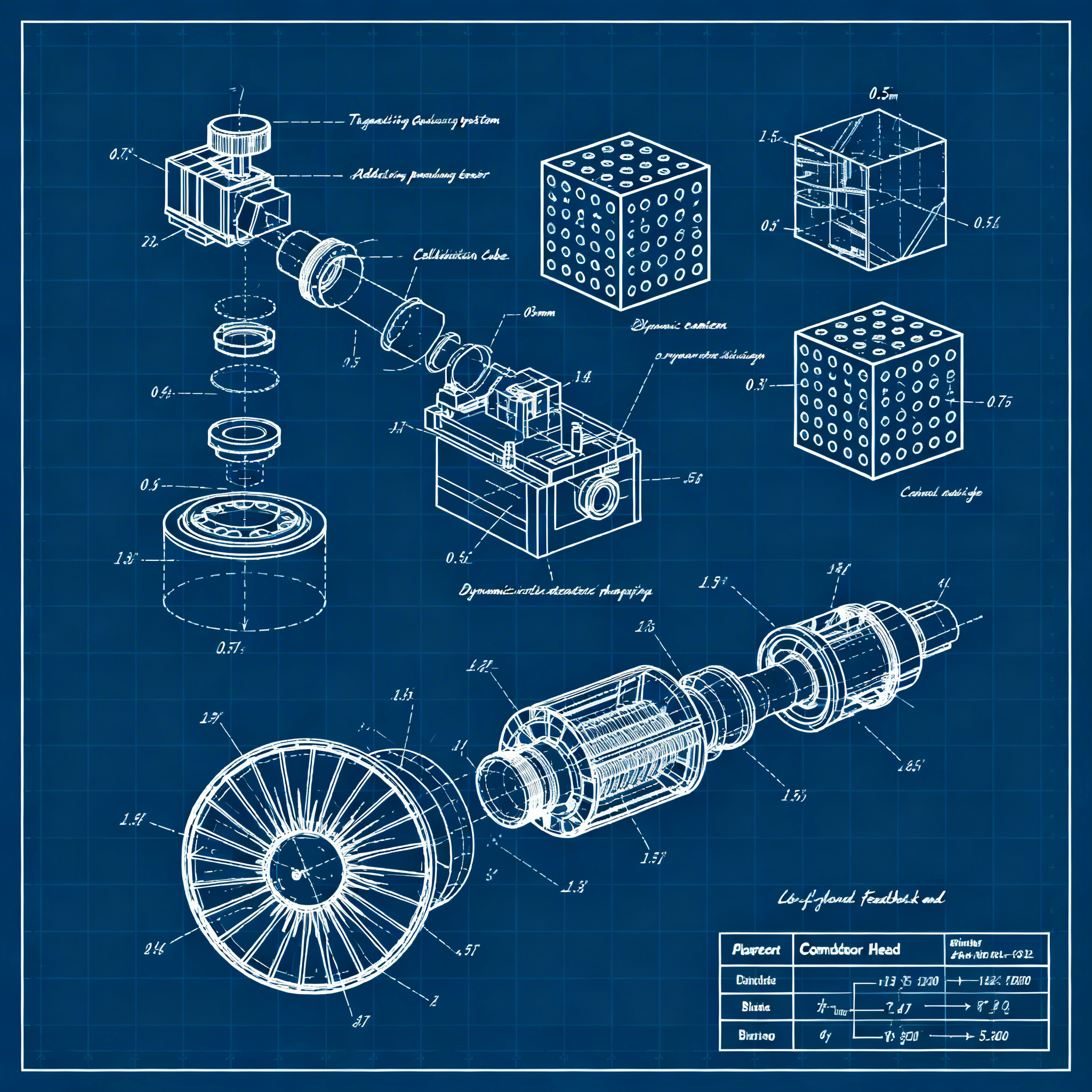
The approach is ingenious: instead of printing only the final part, the system automatically places calibration elements in the free spaces around the component. These elements replicate the critical characteristics of the actual part — for example, if you need to print a turbine with 0.5 mm cooling holes, the system creates test cubes with identical holes.
The difference is that these calibration elements are produced first, layer by layer, leveraging the fact that 3D printing builds from the bottom up. While the system prints the test cubes, optical and thermal sensors continuously monitor what happens: if a hole partially closes, if the local temperature is too high, if the molten material presents anomalies.
The collected data are compared in real time with a historical database of previous successful production runs. When the system detects a deviation — for example, an anomalous temperature or an out-of-tolerance geometry — it can intervene immediately, modifying parameters such as laser power, printing speed, beam offset, or distance between passes. And all this happens before the printer reaches the critical portion of the final component.
The patent also provides for the possibility of printing multiple identical calibration elements in sequence, allowing an iterative adjustment process until the parameters are optimized or until deviations fall below an acceptable threshold.
What really changes (tangible improvements)
On-the-fly corrections make it possible to reduce scrap and improve geometric precision, especially in complex components such as aerospace ones.
The main advantage is the reduction of scrap. Instead of discovering a defect after 20 hours of printing and having to throw away a part worth thousands of euros, the system catches it in the first layers and corrects course. For aerospace components with complex geometries, this can make the difference between a success rate of 60% and one above 90%.
Quality improves especially on features that are difficult to control: small-diameter cooling holes, internal cavities, thin walls. The patent explicitly mentions components such as combustor heads and turbine blades, where even minimal deviations can compromise performance or safety.
There is also a long-term benefit: the parameters optimized during a production run are recorded in the machine's database and can be reused for subsequent batches. This means that each print contributes to improving the process, reducing setup times and increasing consistency between different production runs.
The system also offers flexibility in monitoring: you can choose to check every single layer, set predefined time intervals, or record continuous video. The data are saved and tagged with reference to the specific sample and the parameters used, creating complete traceability.
Esempio in azienda / sul mercato
During the printing of a combustor head, the system detected a thermal deviation and modified the parameters before the defect became critical.
The patent describes a concrete scenario in an aerospace department. During the production of a combustor head, the system first prints some calibration elements that replicate the critical cooling holes of the final component. While these elements are being built, thermal sensors detect a slight temperature deviation on one of the holes.
The system compares the data with previous successful production runs and identifies that this deviation, if not corrected, would lead to a partially obstructed hole. At that point it intervenes automatically, reducing the printing speed and slightly modifying the laser power. In the subsequent calibration elements, the system verifies that the correction worked.
When the printer finally gets to producing the cooling holes on the actual component, the parameters have already been optimized. The result is a part that conforms to specifications, with no need for rework or scrap.
This type of intervention is particularly valuable for geometries that require extreme precision. A clogged cooling hole in a turbine is not just a cosmetic defect: it can cause localized overheating, reduce engine efficiency, or, in the worst case, lead to catastrophic failures.
Trade-offs and limitations
Continuous corrections can lengthen cycle times; moreover, the system requires highly reliable predictive models to avoid false positives.
The first trade-off is time. Every correction requires a momentary interruption or a slowdown of the process. If the system detects frequent deviations, the total printing time can increase significantly. The patent does not specify by how much, but it is reasonable to expect that for particularly complex components the overhead could reach 10-20% of the cycle time.
There is also the question of the reliability of the feedback loop. The system relies on comparisons with historical data and on predictive models to decide when to intervene. If these models are not accurate, there is a risk of making unnecessary corrections (false positives) or, worse, of failing to intervene when it would be necessary (false negatives). The patent implicitly acknowledges this limitation when it mentions the need for “extensive validations.”.
Another critical aspect is the complexity of the setup. Integrating optical and thermal sensors, configuring the historical database, defining intervention thresholds: all of this requires expertise and time. For small productions or simple components, the game may not be worth the candle.
Finally, the system does not completely eliminate the need for post-production inspections. Even with real-time corrections, some defects could escape detection or only appear in the final stages of printing. Final inspections remain necessary, although probably less frequent and less burdensome.
Reality check: what is needed to reach production
The feedback loop must be extensively validated in real operating environments, and the sensors must be integrated without increasing the complexity of the setup too much.
Moving from patent to production requires several validations. First of all, it must be demonstrated that the system works reliably across a wide range of materials, geometries, and machines. Laboratory tests are one thing, but in a real production environment there are many more variables: vibrations, environmental variations, differences between batches of metal powder.
A robust historical database is also needed. The system relies on comparison with previous successful productions, but at the beginning this database does not exist. It must be built gradually, and during this initial phase the system's effectiveness will be limited. It is a classic chicken-and-egg problem.
Integration with existing systems is another obstacle. Most industrial printers already have proprietary control systems. Adding external sensors and feedback logic requires hardware and software modifications that could void warranties or certifications.
From a regulatory standpoint, sectors such as aerospace require rigorous qualifications for any change to the production process. Even if the system objectively improves quality, years of testing and documentation will be needed before it is accepted for critical components.
Finally, there is the issue of costs. High-quality sensors, real-time analysis software, storage for historical data: all of this has a price. To justify the investment, the system must demonstrate a clear economic return, typically through a significant reduction in scrap or an increase in qualification speed.
This technology represents a step forward toward truly intelligent additive manufacturing, capable of self-correcting and continuously improving. But the road from proof of principle to large-scale industrial adoption is still long and requires rigorous validations, significant investments, and a change in mindset in production departments.
Follow the first pilot tests in high-precision sectors: they could anticipate widespread adoption. Aerospace companies and turbine manufacturers are the natural candidates to experiment with this technology first, where the cost of scrap amply justifies investment in advanced control systems.
article written with the help of artificial intelligence systems
Q&A
What is the main problem that the patent aims to solve in industrial 3D printing?
The main issue is the lack of control during the printing process, which leads to high waste and uncertainties in reproducibility. In traditional additive manufacturing, defects are only detected after production is complete, making it difficult to intervene in time.
How does the system described in the patent correct errors in real-time?
The system integrates calibration elements into the CAD model and uses optical and thermal sensors to continuously monitor the process. It detects deviations such as abnormal temperatures or out-of-tolerance geometries and immediately adjusts printing parameters, such as laser power and speed, before the defect becomes irreversible.
What practical benefits does this technology offer to high-precision industries like aerospace?
It drastically reduces waste, increases geometric accuracy, and improves the safety of critical components such as combustion chambers and turbine blades. It can increase the success rate from around 60% to over 90%, avoiding significant economic losses.
What are the main limitations or trade-offs of this approach?
Continuous corrections may extend cycle times, potentially increasing total printing time by 10-20%. Additionally, the system requires highly reliable predictive models to avoid false positives or negatives, and a complex setup that demands specialized expertise.
What is needed to bring this technology from the patent stage to industrial production?
Extensive validation in real operational environments is required, with testing on different materials, geometries, and machinery. Moreover, sensors must be integrated without significantly increasing setup complexity, and the reliability of the decision-making feedback loop must be ensured.