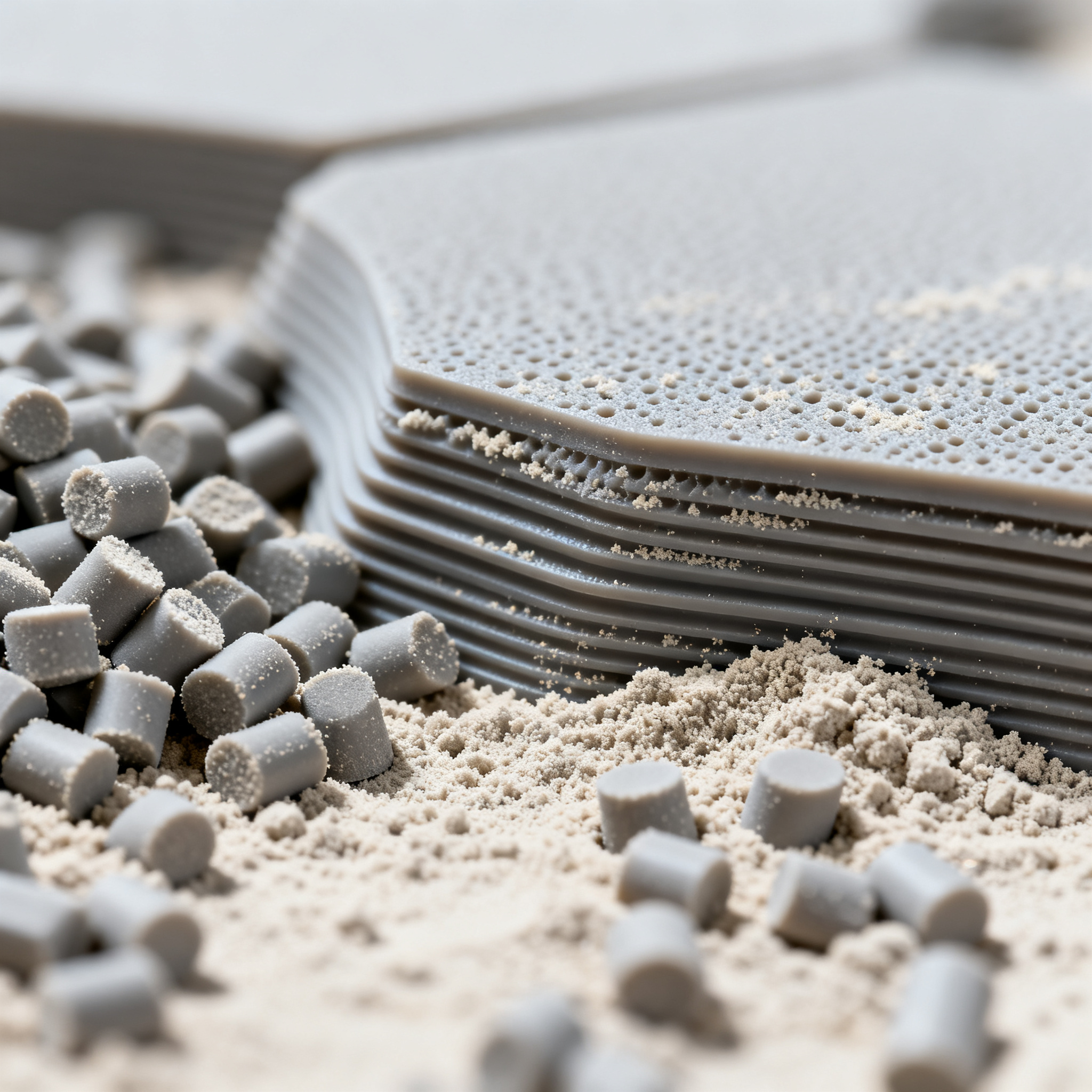
Circular economy in additive manufacturing: bio-based materials and industrial recycling programs
Nel settore dell’additive manufacturing, l’economia circolare non è più un’opzione ma una necessità: ecco come trasformare i concetti in azioni concrete.
The additive manufacturing industry is undergoing a profound transformation. Materials derived from renewable feedstocks, industrial recycling programs, and strategic partnerships are redefining how companies design and produce 3D-printed components.
Le soluzioni più avanzate non si limitano a ridurre l’impatto ambientale. Offrono anche vantaggi operativi concreti: filiere più resilienti, costi di materia prima più prevedibili e conformità anticipata alle normative europee su tassonomia e imballaggi.
- Bio-based PA11 is derived from castor oil grown through certified sustainable agricultural programs
- Virtucycle allows recycling of PA11, PA12, PEBA, and PVDF while maintaining performance equivalent to virgin material
- Partnerships like Plastic Bank neutralize the plastic impact of industrial-scale 3D printing operations
Bio-based materials: from castor to industry
Bio-based PA11 is redefining the potential of industrial AM, combining high technical performance with a sustainable agricultural supply chain.
Rilsan PA11 is a concrete example of an advanced material derived from renewable sources. Polyamide 11 is produced from castor oil, a raw material that does not compete with food crops.
The difference compared to other “bio” materials lies in supply chain control. The Pragati program, promoted by Arkema, directly supports local farmers in sustainable castor cultivation. It is not just about certifications: the program includes training, technical support, and access to agricultural practices that improve the quality of life in rural communities.
From a technical standpoint, PA11 maintains the required performance in demanding industrial applications. Mechanical strength, dimensional stability, and chemical durability make it suitable for sectors such as automotive, aerospace, and medical devices. Sustainability does not represent a compromise on performance.
Bio-based PA11 is compatible with the main industrial 3D printing technologies, including HP's Multi Jet Fusion. The traceability of the supply chain is documented and certified.
Closing the loop with Virtucycle
Industrial recycling of AM materials is no longer a dream: the Virtucycle program demonstrates how to close the life cycle of high-performance polymers.
Virtucycle is a partnership program offered by Arkema to customers who use high-performance polymers. The model is simple: Arkema collects industrial waste of PA11, PA12, PEBA, and PVDF, processes them through Agiplast (a recycling center acquired by Arkema), and provides certified recycled grades with a guaranteed minimum content.
Accepted materials include injection and extrusion waste, unused powders, parts, and granules. The quality of recycled materials is certified by SCS Global Services. Over 26 references have been certified for recycled content after production and supplier audits.
The operational advantage is twofold. Companies that produce waste can valorize it instead of disposing of it. Those that purchase recycled grades obtain materials with an improved LCA profile without compromising technical performance. Arkema acts as an intermediary between the two parts of the chain.
| Material | Accepted type | Certification |
|---|---|---|
| PA11 / PA12 | Industrial waste, powders, granules | SCS Global Services |
| PEBA elastomers | Pre-consumer and post-consumer | SCS Global Services |
| PVDF fluoropolymers | Processed parts, waste | SCS Global Services |
Neutralize the impact with Plastic Bank
Le partnership strategiche possono scalare la sostenibilità anche in contesti produttivi complessi, trasformando ogni chilogrammo di filamento venduto in un’azione concreta contro l’inquinamento marino.
Additive-X has adopted a different but complementary approach. Through the partnership with Plastic Bank, for every kilogram of filament sold, an equivalent amount of plastic is prevented from reaching the oceans.
Plastic Bank operates in vulnerable coastal communities, where it collects plastic destined for the oceans and transforms it into credits for goods and services. The model creates social and economic value beyond the environmental impact. Companies that join demonstrate that sustainability can be scalable even in high-volume sectors.
The operational message is clear: 3D printing can be an environmentally responsible choice if accompanied by structured strategies. It is not enough to have “bio” or “recycled” material on the technical data sheet. Verifiable programs, transparent partnerships, and measurable commitments are needed.
Additive-X has also integrated carbon offsetting programs with Carbon Footprint, investing in methane recovery projects in Brazil and reforestation in the United Kingdom. In 2022, it offset 64 tons of carbon emissions, demonstrating that even small-sized companies can structure climate neutrality plans.
Conclusion
The circular economy in AM is not only ethical, but also operational: the right materials and the right processes make the difference. Bio-based PA11, the Virtucycle program and partnerships like Plastic Bank demonstrate that industrial sustainability is possible without compromising on performance.
Companies that integrate these approaches today build competitive advantages for tomorrow. More resilient supply chains, early regulatory compliance, and access to certified materials are tangible benefits. Sustainability becomes an element of technical differentiation, not just communication.
Evaluate today the integration of a bio-based material into your production process: the sustainable ROI is closer than you think.
article written with the help of artificial intelligence systems
Q&A
What is bio-based PA11 derived from and what advantages does it offer in industrial additive manufacturing?
Bio-based PA11 is derived from castor oil, cultivated through the sustainable agricultural program Pragati promoted by Arkema. It offers high technical performance, such as mechanical strength, dimensional stability and chemical durability, and is compatible with technologies such as HP Multi Jet Fusion. Sustainability is ensured by a traceable and certified supply chain, without compromising industrial performance.
How does the Virtucycle program work and which materials can it recycle?
Virtucycle is an Arkema partnership program that collects industrial waste of PA11, PA12, PEBA and PVDF, processes them through Agiplast and provides certified recycled grades. Accepted materials include injection and extrusion scraps, unused powders, parts and granules. Quality is certified by SCS Global Services, guaranteeing performance equivalent to virgin material and an improved LCA profile.
What is the goal of the partnership between Additive-X and Plastic Bank?
The partnership between Additive-X and Plastic Bank prevents, for every kilogram of filament sold, an equivalent amount of plastic from reaching the oceans. Plastic Bank operates in vulnerable coastal communities by collecting plastic and converting it into credits for goods and services. This model creates social, economic and environmental value, demonstrating that sustainability is scalable even in high-volume sectors.
What operational benefits does the adoption of circular economy materials and processes offer in additive manufacturing?
The adoption of circular economy materials and processes offers more resilient supply chains, more predictable raw material costs and early compliance with European regulations on taxonomy and packaging. Companies can valorize industrial waste instead of disposing of it and access certified materials with an improved LCA profile. These benefits transform sustainability into a concrete and measurable competitive advantage.
What is Additive-X's approach to carbon emission offsetting?
Additive-X has integrated carbon offsetting programs with Carbon Footprint, investing in methane recovery projects in Brazil and reforestation in the United Kingdom. In 2022 it offset 64 tonnes of carbon emissions. This demonstrates that even companies of limited size can structure concrete and verifiable climate neutrality plans.
Why is the circular economy considered a necessity and no longer an option in additive manufacturing?
The circular economy is a necessity because bio-based materials, industrial recycling programs and strategic partnerships are redefining the production models of additive manufacturing. These approaches make it possible to build more resilient supply chains, anticipate regulatory compliance and gain access to certified materials. Furthermore, they offer tangible competitive advantages, transforming sustainability from mere communication into technical differentiation.