
Backflip AI arrives in Europe: Mark3D brings artificial intelligence to reverse engineering
Mark3D introduces Backflip AI to the European market, a platform that uses artificial intelligence to convert 3D scans, meshes, and photographs into editable parametric CAD models. The goal is to automate one of the slowest processes in the digital chain: the manual reconstruction of geometry from mesh to CAD.
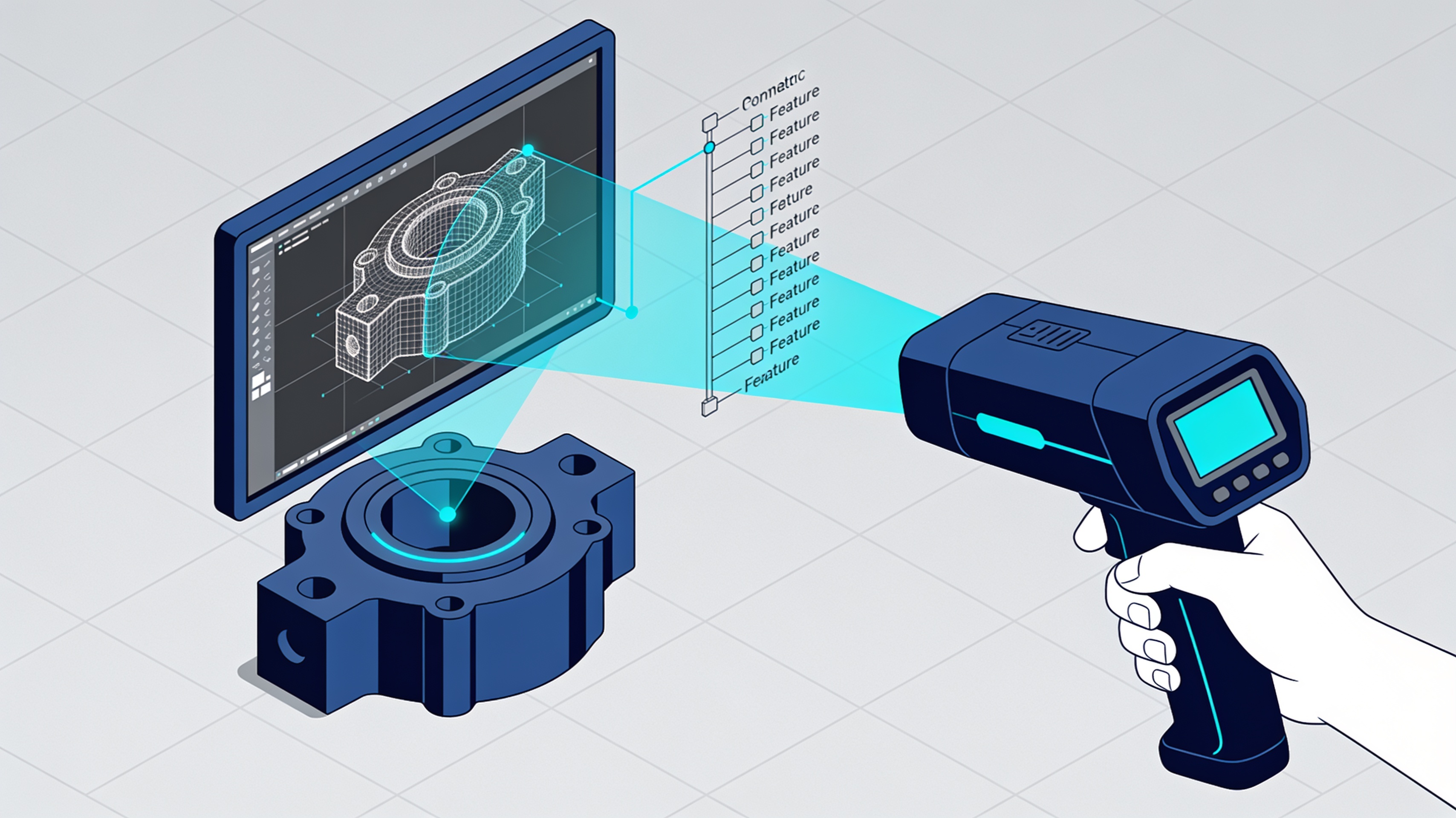
The innovation is not limited to a simple file conversion. Backflip seeks to reconstruct the original design logic, generating a feature tree composed of sketches, constraints, extrusions, revolutions, patterns, fillets, and chamfers.
- Backflip AI transforms 3D scans and meshes into parametric CAD models using artificial intelligence
- Mark3D completes the scan-to-print chain by reducing reverse engineering times
- The platform reconstructs the feature tree, not just the geometric surface
- Compatible with Autodesk Fusion and OnShape
Mark3D's strategy: from scanning to printing
Mark3D expands its portfolio beyond Markforged printers, building a complete digital chain from reverse engineering to additive manufacturing.
The European distributor, known mainly as a Markforged partner for composite and metal systems, has progressively integrated 3D scanners, inspection software, and reverse engineering. The agreement with Backflip completes an operational chain: scan → CAD reconstruction → modification → 3D printing.
Mark3D already distributes Artec scanners and uses ZEISS solutions for reverse engineering. The addition of Backflip AI aims to reduce the most critical bottleneck: manual reconstruction of geometry.
The problem of traditional reverse engineering
A 3D scan produces millions of triangles, but it does not contain the design intelligence needed to modify the model. This is the gap that Backflip seeks to bridge.
An optical or laser scanner typically returns a point cloud or a triangular mesh. This data accurately represents the physical surface, but it does not contain information such as cylinders, planes, axes, or dimensional relationships.
A mesh describes a “skin” made of triangles. A parametric CAD model, on the other hand, describes a sequence of geometric operations. The difference is substantial: millions of triangles approximating a hole versus a cylindrical hole with a diameter of 12 mm, concentric to an axis and positioned 25 mm from a reference.
In the first case, modifying the geometry is inconvenient. In the second, it is enough to change a dimension.
The engineer imports the scan, identifies planes and sections, creates sketches, recognizes cylinders, measures radii, reconstructs the features, and progressively verifies the deviation between CAD and scan. A task that can take hours or days, especially on complex parts.
How Backflip AI works
The platform does not merely convert formats: it reconstructs the logic with which a designer would have created the part, using artificial intelligence models trained on CAD geometries.
Backflip accepts 3D scans, meshes, photographs, and technical drawings as input. It supports standard formats such as STL, OBJ, GLB, and STEP. The output is a parametric CAD model compatible with Autodesk Fusion and OnShape.
The distinctive element is the reconstruction of the feature tree. Instead of producing NURBS surfaces or non-editable solids, Backflip generates constrained sketches, extrusions, revolutions, and Boolean operations. The result is a file that can be dimensioned, modified, and reindustrialized.
| Element | Traditional mesh | Backflip parametric CAD |
|---|---|---|
| Representation | Triangles | Geometric features |
| Modifiability | Limited | Complete |
| Dimensioning | Indirect | Direct |
| Output formats | STL, OBJ | STEP, Fusion, OnShape |
Funding and development
Backflip AI has raised investments from leading venture capital firms, signaling market interest in AI solutions applied to CAD.
The platform received funding led by NEA, with participation from Andreessen Horowitz. These investments confirm the growing attention toward the automation of computer-aided design processes.
Implications for additive manufacturing
The integration of AI into reverse engineering can significantly accelerate file preparation for 3D printing, especially in spare parts production and the redesign of legacy components.
The scan-to-print chain is particularly relevant for applications such as the production of obsolete spare parts, the retrofit of industrial machinery, and the digitization of physical archives. Reducing CAD reconstruction times from days to hours can make economically sustainable projects that today require too much manual work.
Mark3D positions Backflip AI as a natural complement to its Markforged 3D printing systems and Artec scanners. The platform's European availability expands the options for manufacturing companies seeking to digitize existing components without original CAD documentation.
article written with the help of artificial intelligence systems
Q&A
What does Backflip AI do in reverse engineering?
Backflip AI converts 3D scans, meshes, and photographs into editable parametric CAD models. It doesn't just convert files, but reconstructs the original design logic by generating a feature tree with sketches, constraints, extrusions, revolutions, patterns, fillets, and chamfers.
Who distributes Backflip AI in Europe?
Backflip AI is introduced to the European market by Mark3D, a distributor known primarily as a Markforged partner for composite and metal systems. Mark3D has progressively integrated 3D scanners, inspection software, and reverse engineering into its portfolio.
What is the difference between a mesh and a parametric CAD model?
A mesh describes a surface made up of millions of triangles, while a parametric CAD model describes a sequence of geometric operations such as cylinders, planes, axes, and dimensional relationships. Modifying a mesh is cumbersome, whereas on a parametric model you just need to change a dimension.
Which software is Backflip AI compatible with?
Backflip AI is compatible with Autodesk Fusion and OnShape. This allows the parametric CAD models generated by the AI to be integrated into existing design and modification workflows.
How does Backflip AI fit into Mark3D's scan-to-print chain?
The agreement with Backflip completes Mark3D's operational chain: scan → CAD reconstruction → modification → 3D printing. The goal is to reduce the most critical bottleneck in the process, namely the manual reconstruction of geometry from mesh to CAD.


