AM in production? Only if you know what to stop
Additive manufacturing has been shown to work in industrial production only when applied to specific cases with high functional requirements. Success does not depend on the novelty of the technology, but on the ability to realize geometries and functions that are difficult to achieve with conventional methods.
From idea to repeatable part
The transition from prototype to production requires a systematic approach to the definition of process parameters and the reduction of critical variables.
The central issue is not whether AM can produce the required geometry, but whether it can do so with sufficient consistency. Performance gains are often offset by greater demands for process control, material traceability, and post-processing.
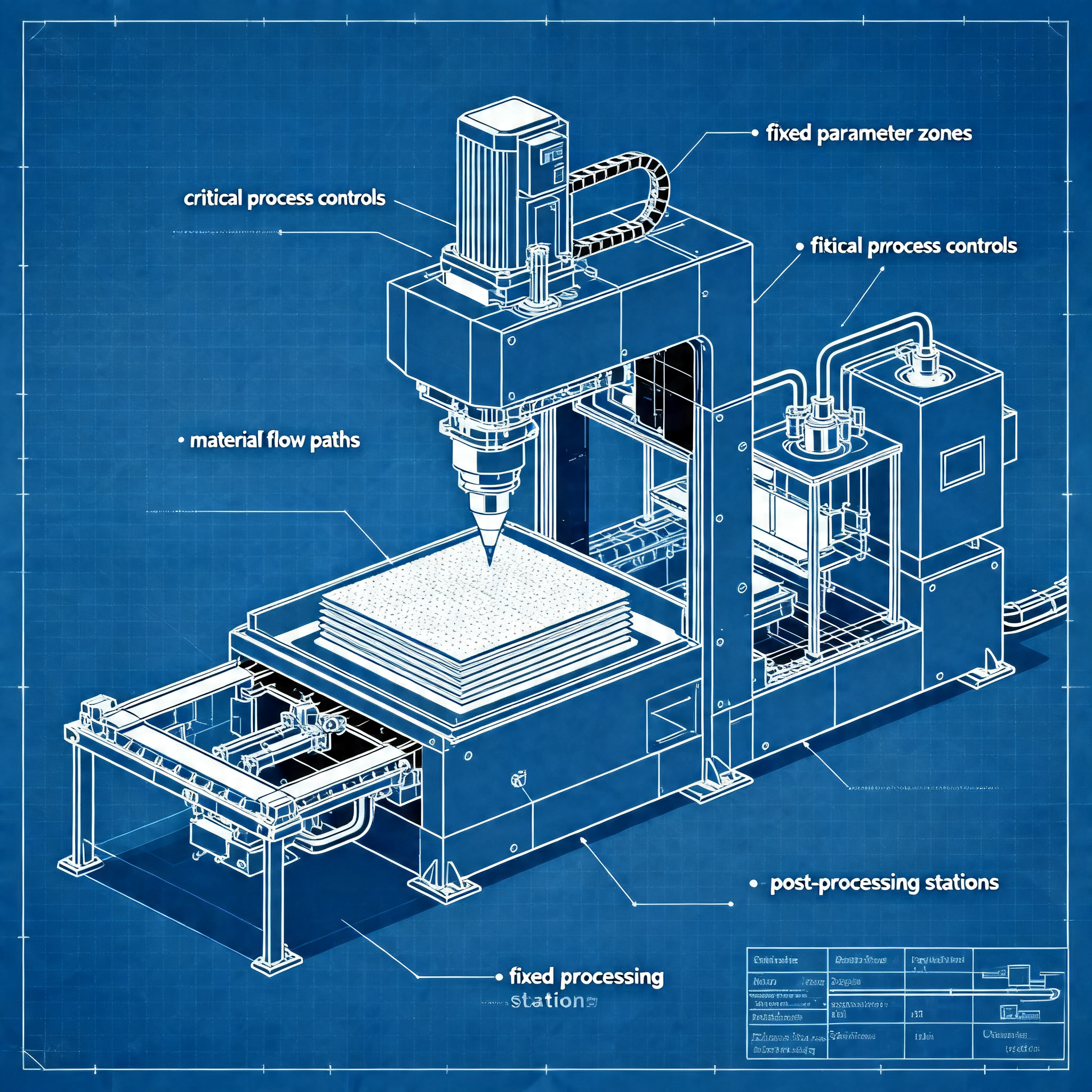
The industrial response has been to narrow the scope and stabilize the variables. AM is introduced for clearly defined part families, often with frozen designs, fixed parameter sets, and tightly controlled material supply. Production volumes remain limited, but predictability improves.
- Material properties and supply traceability
- Environmental conditions and machine state
- Fixed process parameters and conservative configurations
- Post-processing capacity as a limiting factor
AM processes are sensitive to variations in material properties, machine conditions, and parameter selection. Small changes can have disproportionate effects on part quality. Achieving statistically stable production depends on disciplined control of inputs rather than just the machine's capacity.
Sectors that make a difference
In areas such as aerospace and medical, AM becomes advantageous only when integrated into established production flows and with high-quality standards.
Production relevance has emerged in applications where performance considerations outweighed cost efficiency and throughput. In aerospace, weight reduction, component consolidation, and internal features offer measurable performance advantages.
In medical and dental applications, patient-specific geometry and controlled porosity address functional and clinical requirements that conventional processes cannot easily meet. In tooling, conformal cooling enables more uniform thermal control and shorter cycle times.
| Sector | Key advantage | Main constraint |
|---|---|---|
| Aerospace | Weight reduction and part consolidation | Qualification and certification |
| Medical | Patient-specific geometry | Traceability and clinical standards |
| Tooling | Conformal cooling | Repeatability and scale costs |
BMW has reached 1.6 million parts between prototypes and series production, shifting AM beyond prototyping toward a fully integrated production ecosystem. This success is based on automation and an open materials approach, potentially replacing traditional tooling with 3D printing throughout the vehicle's entire lifecycle.
Materials and post-processing: where wins or losses occur
The choice of material and the control of post-processing determine the final quality and repeatability of the mass-produced component.
Support removal, heat treatment, mechanical processing, surface finishing, and non-destructive evaluation are often necessary to meet functional and regulatory requirements. These stages introduce costs, lead times, and variability that must be managed as part of the overall process.
In many cases, the post-processing capability becomes the limiting factor rather than the print throughput. Changes to materials, machine hardware, software, or process parameters may require requalification, especially in regulated or safety-critical applications.
AM production systems tend to favor fixed configurations and conservative update cycles. This supports reliability but constrains continuous improvement and reduces the practical flexibility often associated with AM in initial discussions.
Economic evaluation remains complex. The value of AM is often distributed across reduced tooling, design consolidation, lead time reduction, improved inventory management, and enhanced lifecycle performance. These benefits are real but difficult to capture in cost models optimized for unit price comparison.
Volumetric limits and practical constraints
Even with advanced technologies, the physical limits of machines and scale costs strongly influence production feasibility.
Adoption in production has been driven by application-specific performance requirements rather than general improvements in machine capability. Where performance benefits were marginal or could be achieved by optimizing conventional processes, adoption tended to stall.
Organizational capability is an additional and often underestimated constraint. Effective implementation spans design engineering, materials expertise, quality assurance, production planning, and IT infrastructure. Aligning responsibilities and expertise across these functions is challenging, especially in organizations structured around conventional production processes.
Where AM has been successful, it has functioned as a specialized productive path within a broader production system rather than as a general alternative. This pattern reinforces a broader observation: adoption has been driven by specific performance requirements of the application, not by technological capability in itself.
AM is not a universal tool, but a strategic lever for specific sectors. When applied judiciously to cases where performance benefits are structural and not marginal, it can truly scale. Success requires consolidated designs, fixed parameters, controlled materials, and disciplined post-processing.
Evaluate your case: where can AM truly enter the production chain without compromising reliability and costs? The answer lies in identifying applications with high functional requirements that justify the additional complexity, not in adopting the technology as a general alternative to traditional manufacturing.
article written with the help of artificial intelligence systems
Q&A
In which sectors is additive manufacturing truly useful for industrial production?
AM is advantageous in sectors such as aerospace, medical, and tooling, where functional requirements outweigh cost efficiency. In aerospace, it allows weight reduction and component consolidation, while in the medical field it enables customized geometries.
What are the key critical factors to bring AM from prototyping to series production?
The transition requires rigorous control of critical variables such as material properties, environmental conditions, process parameters, and post-processing. It is essential to stabilize these inputs to ensure repeatability and consistent quality.
Why isn't additive manufacturing yet widely adopted across all industrial sectors?
Adoption is limited because performance benefits must justify the complexity and additional costs. In cases where traditional processes suffice, AM is not implemented, making it more strategic than universal.
How do materials and post-processing affect the final quality of components produced with AM?
Materials and post-processing directly determine quality and repeatability. Operations such as support removal, heat treatments, and surface finishes are often necessary and represent a key limiting factor in the production process.
What is the role of traceability and material control in industrial AM?
Traceability is crucial especially in regulated sectors like aerospace and medical. Changes in materials or processes often require requalification, making rigorous and documented control of every stage indispensable.