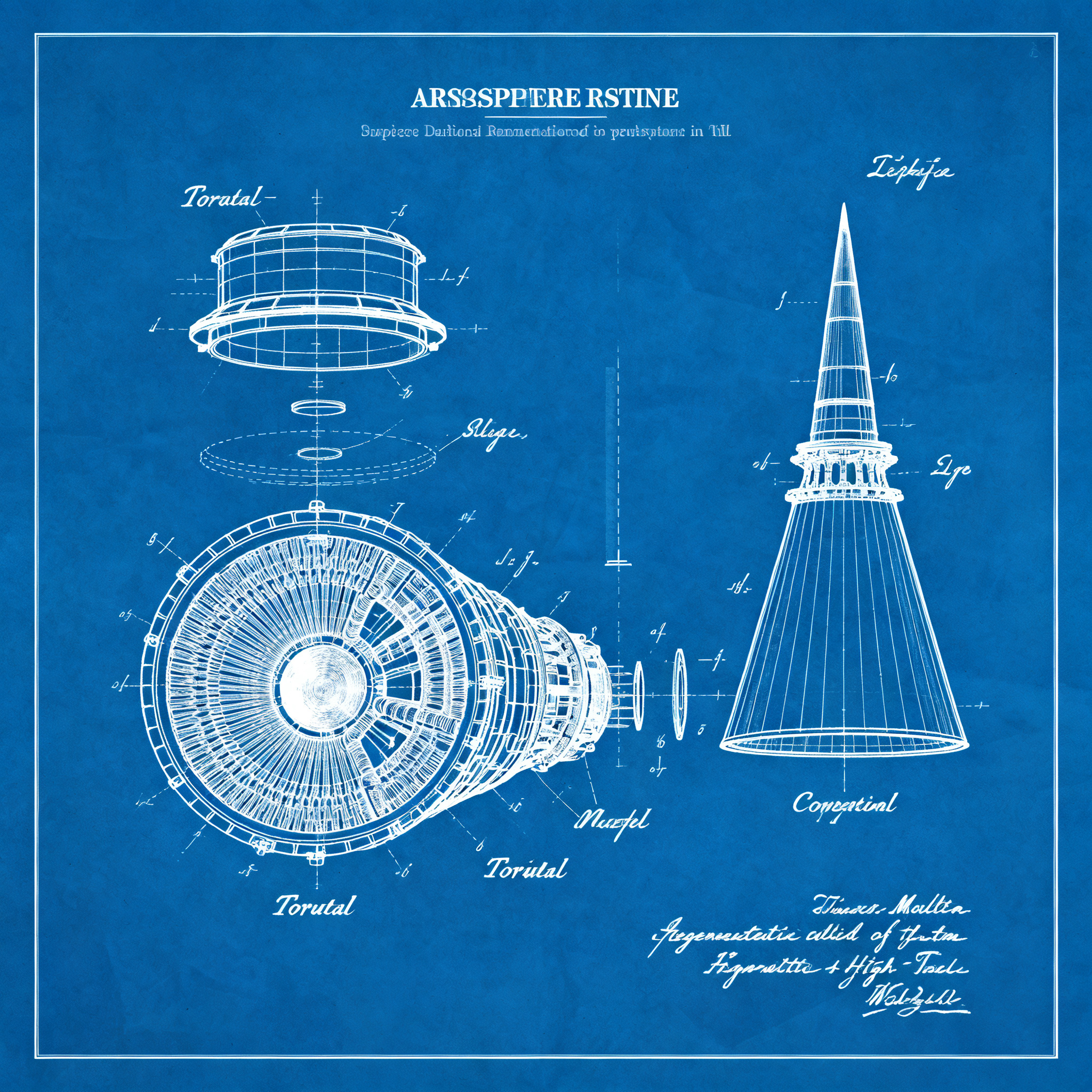
Aerospike vs classic Nozzle: who wins at 3000°C?
Two rocket engines designed with the same computational model but radically different shapes show how geometry affects real-world performance. LEAP 71 tested both designs under extreme operational conditions, revealing the advantages and criticalities of each architecture.
Comparison geometry: traditional nozzle vs aerospike
The shape determines the efficiency of the expanded flow and the thermal behavior of the component during ignition and steady-state operation.
LEAP 71 developed two completely different 20 kN engines using the same Noyron model. The first uses a conventional bell nozzle, the second is an aerospike with a toroidal combustion chamber and a central spike.
The aerospike promises superior efficiency from sea level to vacuum, maintaining optimal performance across all atmospheric regimes without thrust losses. The “inside-out” design eliminates the need to adapt the nozzle geometry to different operating altitudes.
- Both engines generate 2 tons of thrust (4,500 lbf) by burning cryogenic methane and liquid oxygen
- The aerospike offers constant efficiency from ground to vacuum, the classic nozzle is optimized for a specific regime
- Identical development time: from specification to first ignition in less than three weeks
The conventional nozzle reached steady-state conditions at nominal chamber pressure, validating the underlying physical models by operating beyond 93% combustion efficiency. Pressure and temperature data fell within the expected ranges.
Heat-proof materials: the choice of CuCrZr
The CuCrZr copper alloy allows resistance to temperatures above 3000°C while maintaining structural integrity during extreme thermal cycles.
Both engines were 3D printed by Aconity3D using a high-temperature copper alloy. The CuCrZr combines thermal resistance and high conductivity, a crucial combination for managing heat flows in regenerative cooling systems.
Additive production has made it possible to create geometries impossible with traditional methods. Complex cooling channels run through the walls of the combustion chamber. In the case of the aerospike, cryogenic methane cools the external chamber while liquid oxygen cools the central spike.
The CuCrZr offers superior thermal conductivity compared to nickel superalloys, allowing heat to be extracted more quickly from critical zones. Hot mechanical strength remains sufficient for chamber pressures up to 50 bar.
Hot-fire test: operational results and discrepancies
Data collected during the tests confirms the theoretical models but reveals criticalities in thermal transients, especially for the aerospike during startup.
The bell-shaped engine passed the tests without issues, reaching steady-state operation and maintaining nominal pressure. Combustion efficiency beyond 93% fully validated the Noyron model.
The aerospike showed different behavior: it reached full chamber pressure at 50 bar but operated only for a single ignition. Problems during start transients prevented multiple cycles.
| Parameter | Bell nozzle | Aerospike |
|---|---|---|
| Chamber pressure | Nominal (stable) | 50 bar (reached) |
| Test cycles | Multiple | Single |
| Combustion efficiency | >93% | To be validated |
| Start transients | Stable | Critical |
LEAP 71 tested an advanced ignition system during the same campaign. This system will be integrated to improve start and shutdown transients, which are particularly critical for the aerospike.
Actual pressure and temperature measurements fell within expected ranges, confirming the validity of the physical models implemented in Noyron. Operational feedback will provide data to refine thermal transients.
Implications for future engine design
The differences that emerged suggest distinct development paths: the classic nozzle for immediate reliability, the aerospike for multi-regime efficiency.
The conventional nozzle confirms itself as a mature solution for applications requiring immediate reliability. The consolidated geometry minimizes risks during transients and is ideal for missions with a predictable flight profile and stable operating regime.
The aerospike requires further development but offers unique advantages. Its constant efficiency from sea level to vacuum makes it attractive for fully reusable launch systems. Both stages of the rocket would benefit from optimized performance at all altitudes.
The deep throttling capability of the aerospike is crucial for controlled re-entry. Reusable launchers need to modulate thrust over wide ranges, a characteristic that justifies efforts to resolve startup criticalities.
LEAP 71 is developing progressively larger engines. The XRA-2E5, a 200 kN aerospike one meter tall, has been printed in Inconel 718 as a monolithic part, demonstrating the scalability of the computational and additive process.
Conclusion
The choice between a classic nozzle and an aerospike is not just stylistic: it has concrete implications for efficiency, reliability, and thermal complexity. Tests have shown that both architectures are feasible with additive production and advanced computational models. The bell nozzle offers immediate operational maturity, while the aerospike promises superior performance benefits once startup criticalities are resolved.
Explore the test data and compare your simulation models with the results obtained in a real environment. Experimental validation remains the only way to verify the accuracy of the physical models implemented in computational design systems.
article written with the help of artificial intelligence systems
Q&A
What is the main performance difference between the aerospike and the bell nozzle tested by LEAP 71?
The aerospike ensures constant efficiency from sea level to vacuum thanks to the 'inside-out' design, which eliminates the need to adapt the geometry to different operating altitudes. The bell nozzle, on the other hand, is optimized for a specific regime, but demonstrated greater operational maturity by reaching stable steady-state conditions with over 93% combustion efficiency.
What materials were used to build the engines and what properties make them suitable for extreme temperatures?
The 20 kN engines were 3D printed in CuCrZr copper alloy, which withstands temperatures above 3000°C while maintaining structural integrity and offers high thermal conductivity for regenerative cooling systems. For the larger XRA-2E5 prototype of 200 kN, Inconel 718 was used instead, demonstrating the scalability of the manufacturing process.
What results emerged from the real ignition tests (hot-fire test) for each engine?
The conventional nozzle passed multiple ignitions, reaching nominal pressure stably and validating the underlying physical models. The aerospike reached full chamber pressure at 50 bar, but could only operate for a single cycle due to critical issues in thermal transients during startup.
Why is the aerospike considered promising for fully reusable launchers despite current shortcomings?
Beyond multi-regime efficiency, the aerospike offers deep throttling capability, essential for modulating thrust over wide ranges during controlled reentry. This characteristic makes it attractive for reusable systems where both stages must optimize performance at all altitudes and manage complex flight phases.
How did additive manufacturing influence the development and performance of the two engines?
3D printing made it possible to create complex internal geometries, such as regenerative cooling channels, impossible with traditional methods. This allowed LEAP 71 to develop both 20 kN designs with identical times of less than three weeks, from specification to first ignition.