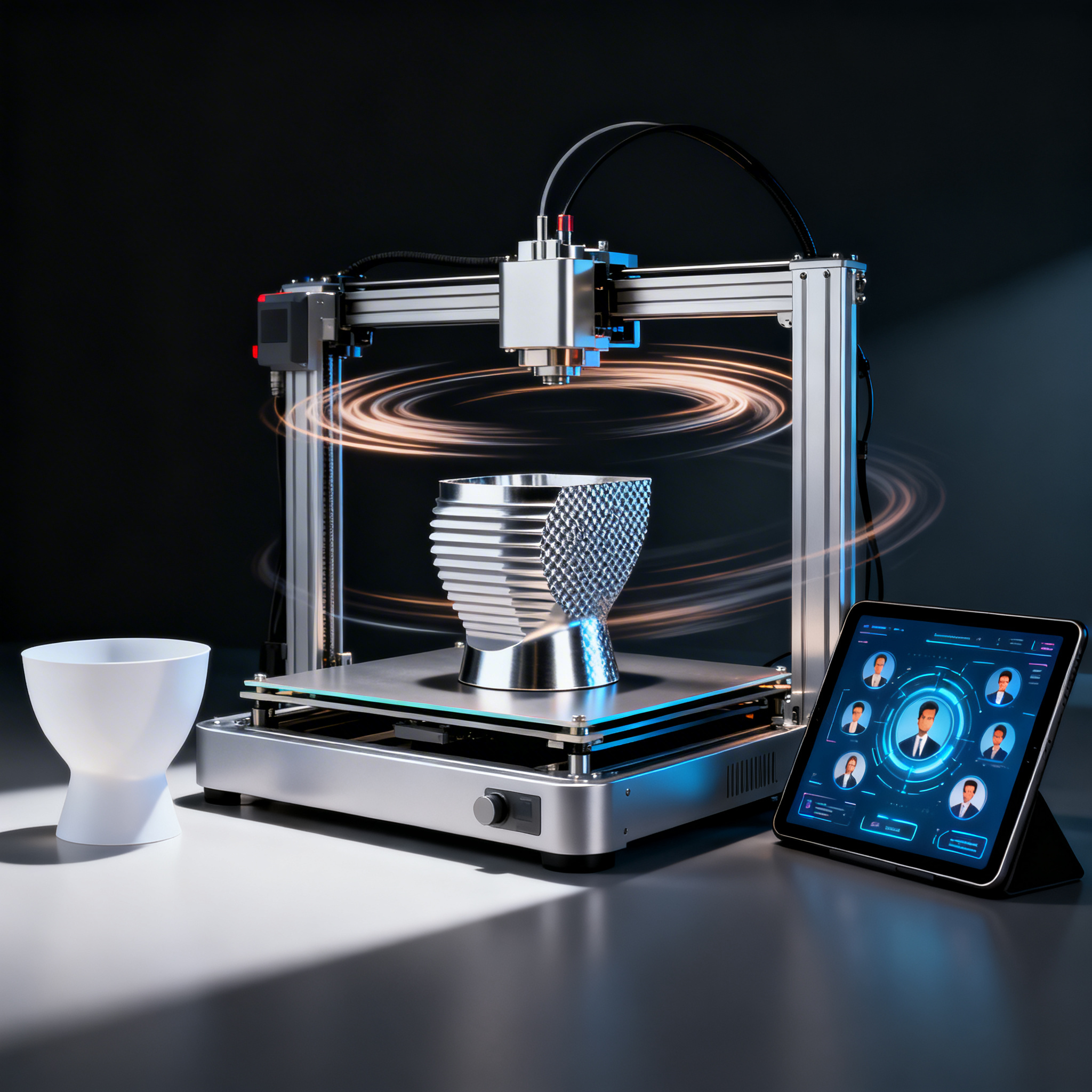
How 3D Printing Transforms Product Innovation: Speed, Materials, and Digital Collaboration
3D printing is not just an emerging technology: it is a tool that is redefining the early stages of industrial innovation. From rapid prototyping to experimentation with advanced materials, this technology is accelerating product development cycles and breaking down traditional barriers between design and manufacturing.
Rapid Prototyping: From Weeks to Days
*3D printing allows ideas to be tested in record time, accelerating the product development cycle and drastically reducing prototyping costs.*
In the research and development sector, time is a critical resource. 3D printing has revolutionized the prototyping process by enabling the transformation of a CAD file into a physical object in just a few hours. Simple parts can be printed in a matter of hours, while more complex or large-scale components require only one or two days. This represents a paradigm shift compared to traditional methods, which could take weeks to produce a single prototype.
The speed of iteration is particularly advantageous during the design development phase. Engineers can now test an idea, identify its flaws, and improve it in a continuous cycle measured in days rather than weeks. It is possible to print specific sections or modules, make changes to the design, and reprint only the necessary part, creating a new experimental freedom for R&D teams without the time and cost constraints typical of traditional prototyping.
This speed also allows for the creation of quick mock-ups for conceptual meetings or functional prototypes to test real-world scenarios. Companies can even organize small-scale design competitions, accelerating the innovation process through the rapid exploration of multiple design solutions.
Innovative Materials for Realistic Simulations
*Thanks to advanced polymers and composites, it is possible to replicate the mechanical properties of the final product already in the early stages of development, enabling more accurate tests and more informed design decisions.*
The wide range of materials available for 3D printing represents one of its most significant advantages for product innovation. Developers can now use materials that closely resemble those of the final production process, or experiment with new high-performance solutions that offer unique characteristics.
Advanced thermoplastic materials, reinforced composites, and even metal pastes allow the creation of prototypes that are not just simple visual representations, but functional components with realistic mechanical properties. This enables strength, flexibility, and durability testing already in the early stages of development, reducing the risk of discovering critical issues only during production.
Multi-material printing has further expanded possibilities, allowing the integration of rigid, flexible, and specialized regions in a single build. This reduces the need for fastening elements, adhesives, and manual assembly, cutting labor costs and simplifying the production process. In the medical sector, for example, this capability allows the creation of anatomical models with multiple colors, textures, and opacities, making prototypes more realistic and understandable.
The ability to rapidly test different materials also allows for the exploration of innovative solutions that might not have been considered with traditional methods, opening new paths for product innovation.
Remote Collaboration and Instant Reproducibility
*Digital models can be shared and printed anywhere in the world, ensuring consistency and speed in design communication across geographically distributed teams.*
The digital nature of 3D printing has transformed how teams collaborate in product development. A print file can be sent from one site to another to be printed in different locations, enabling rapid and cost-effective experimentation and iteration processes. This capability eliminates geographical barriers and accelerates communication between remote teams.
Creating a digital library of parts that can be printed on demand offers significant advantages in inventory management. Companies can save massively on storage costs by eliminating the need to maintain physical warehouses of prototypes or test components. Files can be easily shared worldwide for modifications and remote printing, enabling distributed production.
This instant reproducibility ensures consistency between different iterations and across different teams. An engineer in Europe can design a component, share it with a colleague in Asia who prints and tests it locally, and receive real-time feedback. This integrated digital workflow dramatically accelerates the development cycle and improves the quality of design decisions.
The ability to print complex geometries or parts with moving components, impossible to realize with conventional methods, opens further possibilities for innovation. Engineers are no longer constrained by the limits of traditional production and can explore designs that were previously simply unfeasible.
Conclusion
3D printing is not just a means of production, but a catalyst for continuous innovation thanks to its ability to integrate into modern digital workflows. The combination of rapid prototyping speed, a variety of advanced materials, and borderless digital collaboration is transforming the way companies develop new products.
This technology reduces the risks associated with innovation, lowers barriers to entry for experimentation, and enables faster, more iterative development cycles. Companies that integrate 3D printing into their R&D processes can respond more quickly to market changes, test more ideas in less time, and bring better products to market faster.
**Discover how to integrate 3D printing into your product development process to accelerate innovation and improve design quality.** Whether it's bringing 3D printing in-house or using external printing services, the key is to start leveraging this transformative technology to remain competitive in the era of digital manufacturing.
article written with the help of artificial intelligence systems
Q&A
How does 3D printing accelerate prototyping compared to traditional methods?
3D printing transforms a CAD file into a physical object in hours or days, while traditional methods require weeks, enabling rapid iteration cycles and reducing prototyping costs.
What advanced materials are available for 3D printing and what are they used for?
Advanced thermoplastic polymers, reinforced composites, and metal pastes allow the creation of functional prototypes with realistic mechanical properties, enabling strength and durability testing already in the early stages of development.
How does 3D printing facilitate collaboration among geographically distributed teams?
Print files can be shared digitally and printed in any location, allowing remote teams to iterate quickly, test, and provide real-time feedback, eliminating geographical barriers.
What advantages does multi-material printing offer in prototyping?
Multi-material printing integrates rigid, flexible, and specialized regions into a single build, reducing the need for fasteners, adhesives, and manual assembly, cutting costs and simplifying production.
How can companies integrate 3D printing into their R&D processes?
Companies can bring 3D printing in-house or use external services to leverage prototyping speed, material variety, and digital collaboration, accelerating innovation and improving design quality.