
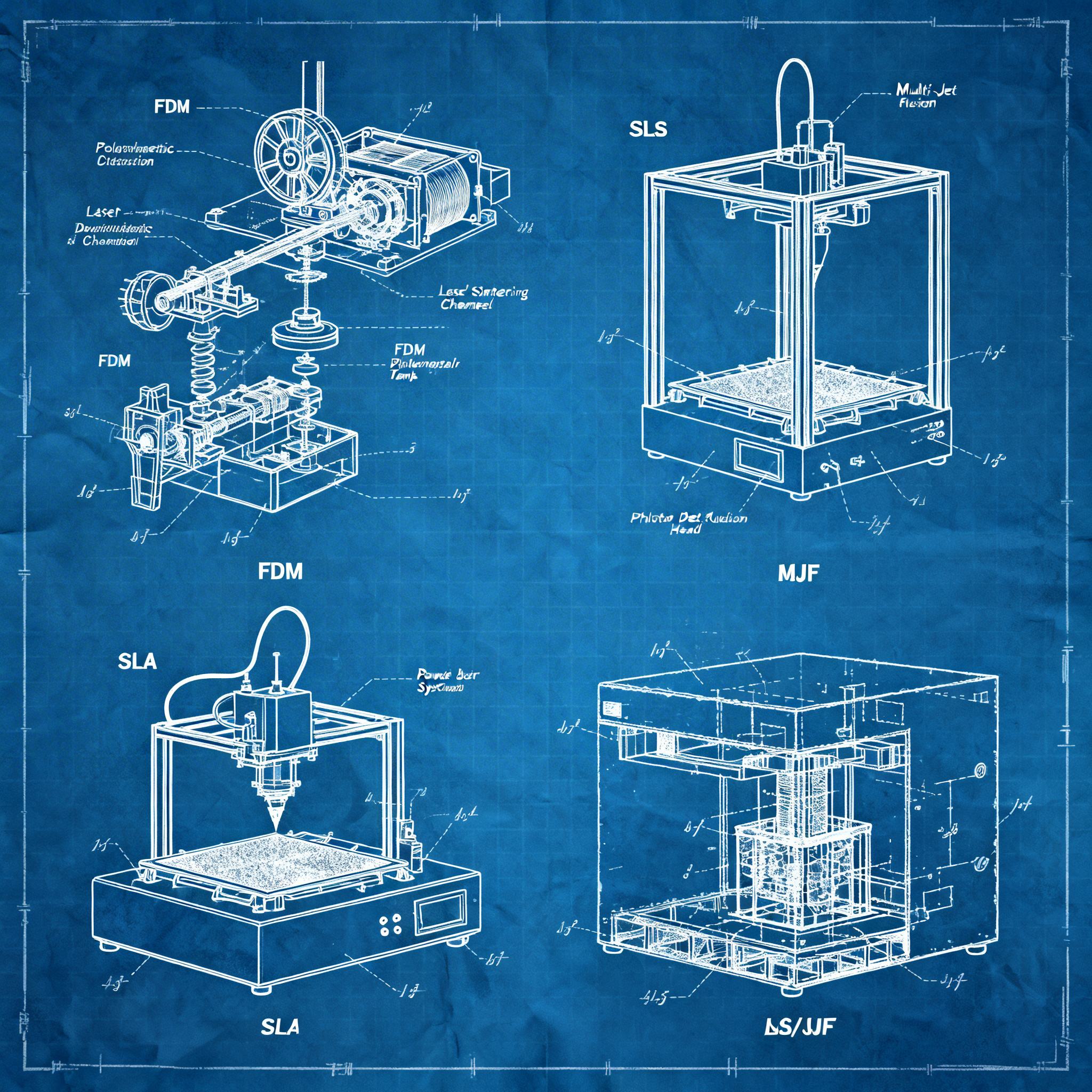
Comparison of 3D Printing Technologies for Polymers: FDM, SLA, SLS, and MJF Compared
Not all 3D printing technologies are equal when it comes to working with advanced polymers: here is what their capabilities really are and where they stop.
In the industrial landscape of polymer 3D printing, four technologies dominate the market with profoundly different performance and limitations. The choice among FDM (Fused Deposition Modeling), SLA (Stereolithography), SLS (Selective Laser Sintering), and MJF (Multi Jet Fusion) cannot be based on generic rankings of speed or cost, but requires a precise understanding of the mechanical, thermal, and dimensional properties obtainable with each process. New polymer formulations are also redefining the operational boundaries of these technologies, opening applications in highly technically demanding sectors such as aerospace, automotive, and medical.
FDM: Precision and Thermoplastic Materials
FDM remains an established choice for prototypes and functional parts thanks to the versatility of the polymers that can be used, but it has limitations in terms of resolution and surface finish.
FDM technology has undergone significant evolution, with advanced desktop printers challenging older industrial machines. The new generation of compact systems delivers high speeds, better surfaces, and greater reliability, so much so that many companies are replacing obsolete industrial platforms with more modern desktop machines. The real qualitative leap concerns the material portfolio: in addition to classic PLA, today polycarbonate “blended” for applications above 110°C, PAEK-family polymers such as Victrex LMPAEK and PEKK printable on compact machines, and PAEK-CF composites with elastic moduli above 3,000 MPa, competitive with traditional aerospace thermoplastics, are accessible.
In large-format (LFAM/BAAM), pellet FDM opens multi-material scenarios for tooling, molds, and structures, where the ability to locally vary stiffness and strength becomes strategic. However, managing the transition between different materials requires accurate control of flow rate, temperature, and back pressure to avoid contamination and obtain mechanically sound joints.
SLA: Surface Detail and Dimensional Precision
Stereolithography offers excellent geometric definition and aesthetic quality, ideal for detailed models and parts with complex surfaces.
SLA stands out for its ability to produce components with superior surface finish and high dimensional precision, characteristics crucial for dental, medical, and aesthetic prototyping applications. Platforms such as Axtra3D’s Lumia X1 combine laser and projection (Hybrid PhotoSynthesis) to maintain speed and detail, with repeatability below 30 μm and declared productivity up to 10× compared with conventional SLA workflows.
The integration of washing, drying, and post-curing steps in the same machine reduces batch-to-batch variability, a critical element for service bureaus aiming to stabilize resin as a repeatable process for final parts. The material ecosystem matters as much as the machine: validated print profiles for Henkel LOCTITE 3D, Arkema N3xtDimension, and Forward AM Ultracur3D resins make it possible to move from single prototyping to small-batch production with consistent results.
In multi-material, innovative approaches such as thin-film material switching via chemical (solvent) means allow alternating resins with different photopolymerization kinetics, achieving strong mechanical cohesion at boundaries and minimal interfacial defects, opening applications in aerospace for components with internal voids and in biomedical for scaffolds with controlled porosity.
SLS: Mechanical Strength and Geometric Complexity
The SLS process enables the production of high-strength and complex components, leveraging polymers such as Nylon without the need for support.
Selective laser sintering excels in geometric freedom and microstructural quality of the material, eliminating the need for support structures thanks to the self-supporting powder bed. This feature makes it possible to create complex geometries, deep undercuts, and integrated assemblies that are impossible with other technologies.
Operational constraints mainly concern powder management, post-build heat treatment and, for critical-load applications, hot isostatic pressing (HIP). Per-part productivity depends heavily on the number of lasers, layer thickness, and packing density in the chamber: a low-density build drastically increases the energy consumed per component.
The mechanical properties achievable with Nylon PA12 and PA11 are high, with good impact resistance and dimensional stability, while new formulations with mineral or fibrous fillers expand the range of applications toward structural components in automotive and customized medical devices.
MJF: Speed and Uniform Quality
Multi Jet Fusion combines production speed and uniformity of mechanical properties, making it competitive for small-to-medium production runs in industrial settings.
HP's MJF technology positions itself as a response to the evolution of 3D printing from a prototyping tool to a true production technology. Its growing adoption in sectors such as data centers, aerospace, defense, and medical testifies to the maturity achieved: components for cooling systems, ducts, supports, and custom housings are produced with reduced lead times and repeatable quality.
MJF's competitive advantage lies in the combination of build speed, uniformity of mechanical properties in all directions, and superior surface finish compared to traditional SLS. The ability to consolidate multiple parts into a single component, integrating different functions and reducing assemblies, translates into concrete design benefits for lightweighting and topology optimization.
The concept of a “digital warehouse” made possible by MJF increases supply chain resilience: instead of physically stocking spare parts, companies archive validated files and produce on demand, reducing risks related to disruptions, transport costs, and procurement times.
Real Benchmarking: Mechanical and Thermal Properties
An objective comparison based on technical data shows how each technology performs in specific application scenarios, highlighting advantages and structural limitations.
Mechanical performance varies significantly: FDM with PAEK-CF reaches elastic moduli above 3,000 MPa, competitive with SLS in Nylon PA12 (approximately 1,700-1,850 MPa) but with more pronounced anisotropy. SLA with engineering resins reaches 2,500-3,000 MPa but with lower impact resistance than SLS and MJF. Continuous operating temperature ranges from 60-80°C for standard SLA, 80-100°C for SLS/MJF in PA12, up to over 110°C for FDM with polycarbonate and over 200°C for PAEK.
Dimensional accuracy favors SLA (±0.05-0.1 mm over 100 mm), followed by MJF (±0.3 mm), SLS (±0.3-0.5 mm), and FDM (±0.5-1 mm), with variability linked to shrinkage, warping, and post-processing. Surface finish sees SLA in the lead (Ra 1-5 μm), followed by MJF (Ra 5-10 μm), SLS (Ra 10-15 μm), and FDM (Ra 15-50 μm), with direct impact on aesthetic and functional applications where friction or sealing are critical.
Frontiers of Materials: Innovation in Polymers
New advanced polymers are redefining the operating margins of existing technologies, opening new possibilities in sectors such as aerospace and automotive.
Advanced polymer formulations are shifting application boundaries: SLA resins with crystallinity control via grayscale masks make it possible to program local mechanical properties, useful for medical simulators and components with variable damping. In multi-material, DLP systems with thin film and integrated washing produce sealed cavities without trapped resin, opening scenarios in aerospace for lightweight gradient components and in biomedical for drug delivery.
For FDM, access to PAEK on desktop machines and foaming filaments (LW-PLA-HT) for ultralight components expands the range from hobbyist to advanced engineering. In large format, the ability to manage controlled transitions between different materials makes functional multi-material practical for tooling and molds.
SLS and MJF benefit from new powders with functional fillers (conductive, flame-retardant, biocompatible) and faster qualification processes, accelerating adoption in certified production for aerospace and medical.
Conclusion
The choice of the best technology depends on the specific application and required properties; no solution is universally superior. FDM offers material versatility and low costs but with finishing limitations; SLA excels in detail and aesthetics but requires accurate post-processing; SLS ensures geometric freedom and mechanical strength with complex powder management; MJF combines speed and uniformity for industrial serial production.
Carefully evaluate your project requirements and consult the material datasheets to maximize the effectiveness of the selected technology. The frontier of advanced polymers is making the boundaries between prototyping and production increasingly blurred, but only a rigorous analysis of mechanical and thermal properties, precision, and total costs allows choosing the optimal process for each application.
article written with the help of artificial intelligence systems
Q&A
What are the main differences between FDM and SLA in terms of surface finish and precision?
SLA offers superior surface finish (Ra 1–5 μm) and very high dimensional accuracy (±0.05–0.1 mm on 100 mm), ideal for aesthetic and dental applications. FDM, on the other hand, has a rougher finish (Ra 15–50 μm) and lower precision (±0.5–1 mm), but compensates with a wide choice of advanced thermoplastic materials.
In what ways does SLS technology excel compared to other polymer 3D printing technologies?
SLS stands out for its ability to produce complex parts without supports thanks to its self-supporting powder bed. It also offers excellent mechanical properties, with materials such as PA12 and PA11, and good impact resistance, making it ideal for structural applications in automotive and medical fields.
What advantages does MJF technology offer in an industrial context?
MJF combines high production speed, uniform mechanical properties, and better surface finish compared to traditional SLS. It is particularly advantageous for low-to-medium batch production, enabling the consolidation of multiple functions into a single component and supporting the concept of digital inventory.
How do FDM and SLA technologies perform in terms of material thermal resistance?
FDM can achieve continuous operating temperatures above 110°C with polycarbonates and over 200°C with PAEK-family polymers. Standard SLA is generally limited to 60–80°C, although some advanced technical resins can reach elastic moduli of 2,500–3,000 MPa, albeit with lower thermal resistance.
What material innovations are redefining the capabilities of 3D printing technologies?
New formulations such as printable PAEK for desktop FDM, crystallinity-controlled SLA resins, and multi-material systems are expanding application boundaries. These materials enable 3D printing use in advanced sectors like aerospace, automotive, and biomedical, improving strength, lightness, and functionality.


