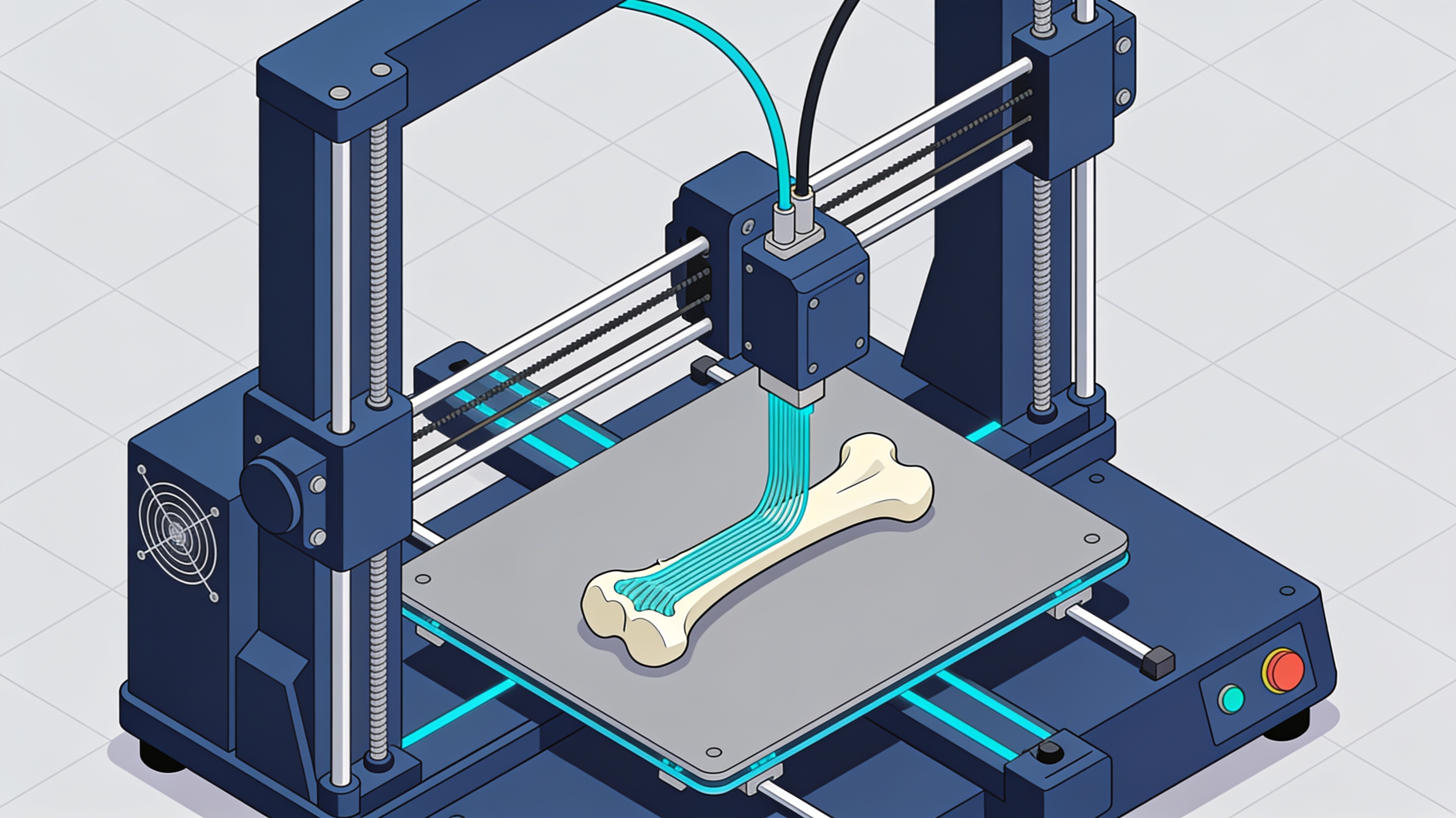
Desktop 3D printers recreate the Megalosaurus: 166 million years in seven weeks
Fourteen desktop 3D printers worked for seven weeks to bring back to life the first dinosaur ever named by science. The result is a spectacular exhibition at Blenheim Palace in England, where five nine-meter-long Megalosaurus skeletons dominate the historic gardens.
The installation “Dinosaurs Are Forever” represents an emblematic case of how additive manufacturing is also transforming the world of art and scientific dissemination.
The project: when art and paleontology meet 3D printing
British artist Jay Jay Burridge created five monumental Megalosaurus sculptures combining scientific reconstruction, artistic vision, and additive manufacturing.
Burridge, through his studio Future Fossils, did not want to create simple museum replicas. He collaborated with Dr. Matt Dempsey, a musculoskeletal biologist and vertebrate paleontologist who completed his doctorate at the University of Liverpool and the Natural History Museum in London.
Together they developed a new interpretation of the Megalosaurus based on the original fossils and evidence from closely related dinosaurs. The finished sculptures mix science, art, and engineering, with skeletons that appear part dinosaur and part machine.
- 14 Bambu Lab printers produced the ABS-GF bones in 7 weeks
- 5 Megalosaurus skeletons 9 meters long exhibited at Blenheim Palace
- Collaboration between artist, paleontologist, and additive manufacturing company
- First scientifically named dinosaur (1824) recreated with modern technology
Production: additive manufacturing on an artistic scale
Gerard Shields of Printpool, a British additive manufacturing company, coordinated production using exclusively desktop printers.
To create the 3D-printed bones, Future Fossils collaborated with Printpool. Shields used 14 Bambu Lab printers operating continuously for over seven weeks.
The chosen material was ABS-GF, an ABS filament reinforced with fiberglass. This choice ensures structural strength and durability for outdoor installations.
After printing, the components were sent to the Future Fossils laboratory for final finishing and assembly. Each sculpture is built around a lightweight mobile structure, with individual bones either 3D-printed or hand-carved.
The Megalosaurus: the dinosaur that made history
The project recreates the first scientifically named dinosaur, bringing it back to Oxfordshire where its original fossils were discovered.
Megalosaurus holds a fundamental place in paleontology. The fossils found in Oxfordshire were studied by geologist William Buckland, who formally named the animal in 1824.
It became the first dinosaur to receive a scientific name, although at the time no one called it a dinosaur. The term “Dinosauria” would only be introduced in 1842.
Now, over 200 years later, Megalosaurus has returned to Oxfordshire in a completely new form. “It is perfectly logical that the dinosaurs of the future are 3D printed,” said Burridge. “We are taking creatures from 166 million years ago and rebuilding them with today’s technology”.
ABS-GF combines the thermoplastic properties of ABS with the mechanical strength of fiberglass, making it ideal for large structural components exposed to weathering.
Implications for additive manufacturing
The project demonstrates the maturity of desktop printers for large-scale artistic and scientific productions.
The use of 14 desktop printers for a project of this scale highlights how FDM technology has become reliable for complex serial productions. Seven weeks of continuous printing require stable machines and high-performance materials.
The choice of desktop printers over more expensive industrial solutions suggests a favorable cost-benefit ratio for artistic and museum applications. Horizontal scalability (more machines in parallel) confirms itself as an effective strategy for medium-large volumes.
The Megalosaurus case represents a concrete example of how additive manufacturing is leaving laboratories and factories to enter museums, galleries, and public spaces, democratizing the production of monumental works.
article written with the help of artificial intelligence systems
Q&A
How many 3D printers were used for the Megalosaurus project?
Fourteen Bambu Lab desktop printers were employed to produce the dinosaur bones. The machines operated continuously for over seven weeks to complete production.
What material was chosen to print the Megalosaurus skeletons?
The material used is ABS-GF, an ABS filament reinforced with glass fiber. This choice ensures the necessary structural strength and durability for an outdoor installation.
Where are the 3D-printed Megalosaurus sculptures displayed?
The five nine-meter-long skeletons are exhibited in the historic gardens of Blenheim Palace in England. The installation is part of the exhibition titled 'Dinosaurs Are Forever'.
Who collaborated on the scientific creation of the Megalosaurus sculptures?
Artist Jay Jay Burridge collaborated with Dr. Matt Dempsey, a vertebrate paleontologist and musculoskeletal biologist. Together they developed an interpretation based on original fossils and scientific evidence.
What is the historical significance of the Megalosaurus in this project?
The Megalosaurus is the first dinosaur ever scientifically named in history, dating back to 1824. The project brings it back to Oxfordshire, the same area where its original fossils were discovered.