3D-printed Nitinol metamaterials for transcatheter vascular implants
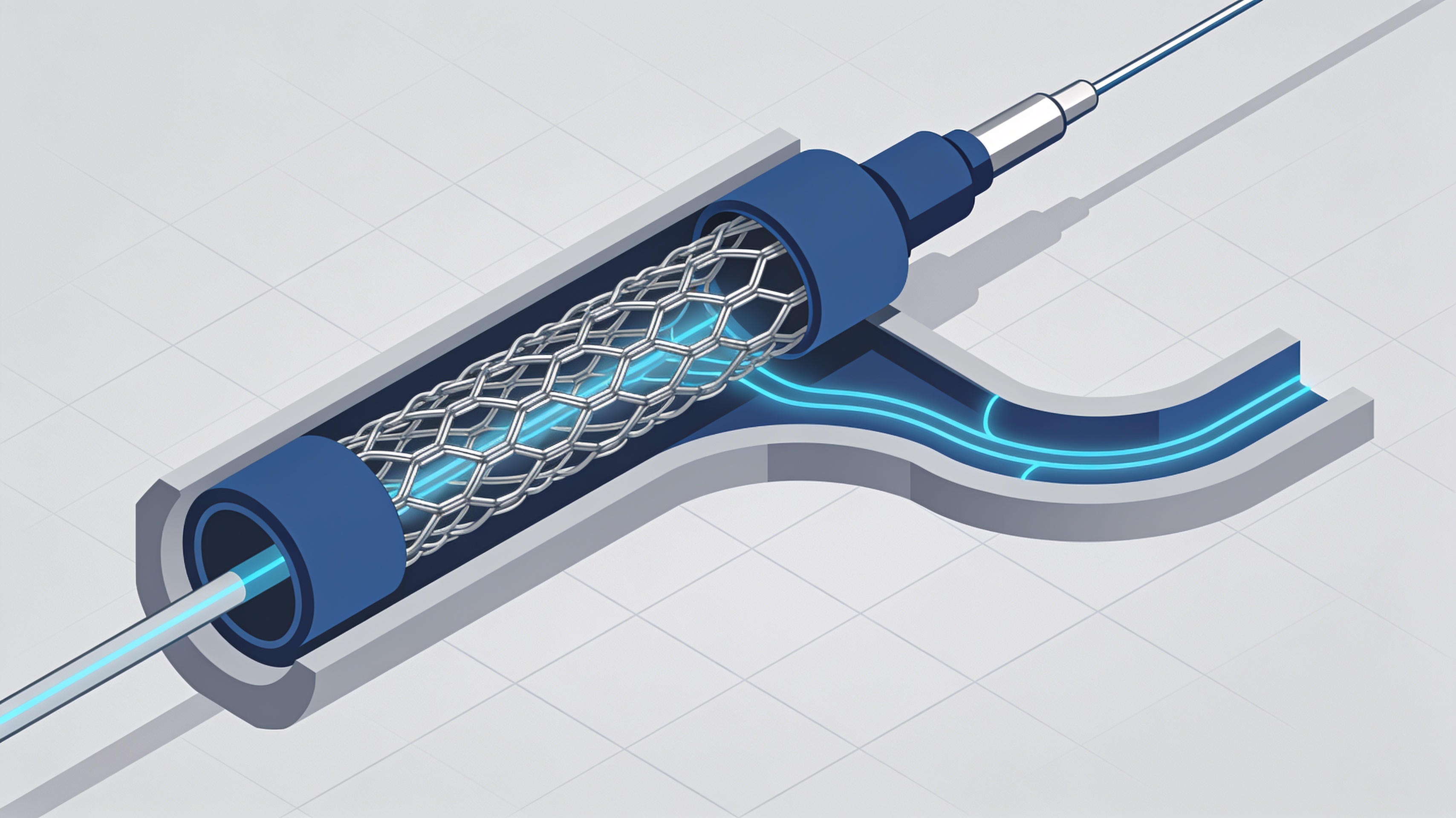
An international group of researchers has developed customizable Nitinol vascular structures using metal 3D printing and intertwined geometries. The technology allows the devices to compress for passage through a catheter and to reopen once positioned.
The research, led by IMDEA Materials Institute and Universidad Politécnica de Madrid, was published on October 13, 2026 in the journal npj Metamaterials. The project also involved the Massachusetts Institute of Technology and the University of Galway.
- 3D-printed Nitinol vascular structures with intertwined geometries
- Compression capability for transcatheter insertion and recovery of the original shape
- International project led by IMDEA Materials Institute
- Prototypes not yet approved for implantation in humans
The challenge of transcatheter implants
Vascular devices must pass through blood vessels in a compressed form and recover their functional geometry without damaging tissues.
Stents and transcatheter implantable structures face extreme mechanical requirements. They must pass through blood vessels in a compact configuration. Once positioned, they must recover the necessary shape without exerting excessive forces on the vessel walls.
The relationship between compression capacity, elastic recovery, and expansion force is crucial for these applications. 3D printing offers anatomical customization, but traditional metal structures have significant limitations.
Limitations of conventional metal lattices
3D-printed lattice structures have elements rigidly connected at the nodes, resulting in deformation problems.
Many metal structures produced by additive processes consist of lattices with rigidly connected elements. When they are compressed, the elements must bend. At large deformations, this behavior rapidly increases stiffness and concentrates stresses at specific points.
This mechanism limits the compression capacity required for transcatheter insertion. Stress concentrations can also compromise the device's reliability.
Interwoven geometries: an alternative approach
The developed architecture resembles textile structures, allowing movement and reorientation of the filaments instead of only bending.
In traditional lattices, the elements bend. In interwoven structures, the filaments slide and reorient relative to one another, introducing a more flexible deformation mechanism.
The architecture developed by the research group allows filaments with appropriate geometries to move and mutually reorient. Part of the shape variation derives from relative sliding and from changes in the weave angles.
The solution combines the flexibility of traditional interwoven structures with the ability to build complex geometries in a single process. In conventional production processes, the assembly and handling of filaments impose limits on the shapes that can be obtained.
The role of Nitinol
The nickel-titanium alloy offers superelasticity and shape memory, properties essential for transcatheter devices.
Nitinol is a nickel-titanium alloy characterized by superelasticity and shape memory. These properties are essential for devices that must undergo large deformations during insertion and recover their original geometry.
The combination of Nitinol and 3D-printed interwoven geometries represents an innovative approach. Additive manufacturing offers an alternative path to build geometries that already incorporate the required architecture.
State of research and prospects
The prototypes have measured mechanical performance but are not devices approved for clinical use.
The mechanical performance of the prototypes has been measured, but this is not a device approved for implantation in humans. The research is at an experimental stage and requires further validation.
Anatomical customization via 3D printing could open new possibilities for vascular implants. However, the technology must pass through clinical and regulatory validation phases before reaching medical application.
The project demonstrates how additive manufacturing can enable innovative mechanical architectures. The integration of smart materials such as Nitinol with complex geometries represents a promising direction for advanced medical devices.
article written with the help of artificial intelligence systems
Q&A
Who developed the 3D-printed Nitinol vascular structures?
The research was led by IMDEA Materials Institute and Universidad Politécnica de Madrid, with the involvement of Massachusetts Institute of Technology and University of Galway. The study was published on October 13, 2026 in the journal npj Metamaterials.
How do braided structures work compared to traditional metal lattices?
In traditional lattices the elements bend and, under large deformations, stiffness increases by concentrating stresses. In braided structures the filaments slide and reorient relative to each other, introducing a more flexible deformation mechanism.
Why is compression capacity important for transcatheter implants?
Vascular devices must travel through blood vessels in compressed form and then recover their functional geometry once positioned. The relationship between compression, elastic recovery, and expansion force is crucial to avoid damaging vessel walls.
What limitations do conventional 3D-printed metal lattices have?
Many additive metal structures have elements rigidly connected at the nodes. When compressed, the elements must bend and this behavior limits the compression capacity required for transcatheter insertion, with possible stress concentrations.
Are the prototypes already approved for human implantation?
No, the prototypes are not yet approved for human implantation. These are customizable vascular structures developed at the research level, with compression capacity for transcatheter insertion and recovery of their original shape.