
Custom footwear and clothing: how 3D printing is revolutionizing production
We are commenting on two recently published patent applications, not technologies already established on the market. These are innovations that could enter production in the next 2-5 years, changing the way shoes and wearable components are designed and manufactured.
Patents cited
- TOPOLOGY OPTIMIZED 3D PRINTED STRUCTURES FOR FOOTWEAR — February 11, 2026
- MULTI-LAYER EXTRUDED UPPERS FOR ARTICLES OF FOOTWEAR AND OTHER FOOT-RECEIVING DEVICES — January 14, 2026
3D printing is no longer just experimental: two new patented technologies are about to enter footwear factories, promising lighter, higher-performing, custom-made products. Soles with topology-optimized structures can weigh up to 30% less without sacrificing strength, while multilayer uppers extruded directly in 3D make it possible to combine comfort, support, and breathability in a single printed piece. These innovations are already plausible thanks to technologies established in other sectors and adopted by advanced sports companies.
What problem does it solve
Traditional footwear suffers from trade-offs between lightness, durability, and comfort. These technologies aim to overcome them with computer-designed and precisely manufactured structures.
When designing a shoe with conventional methods, every improvement in one direction tends to worsen another characteristic. A lighter sole risks being less durable; a more breathable upper may offer less structural support. These limitations stem from the constraints of materials and traditional production processes: injection molding, cutting and sewing of fabrics, assembly of separate components.
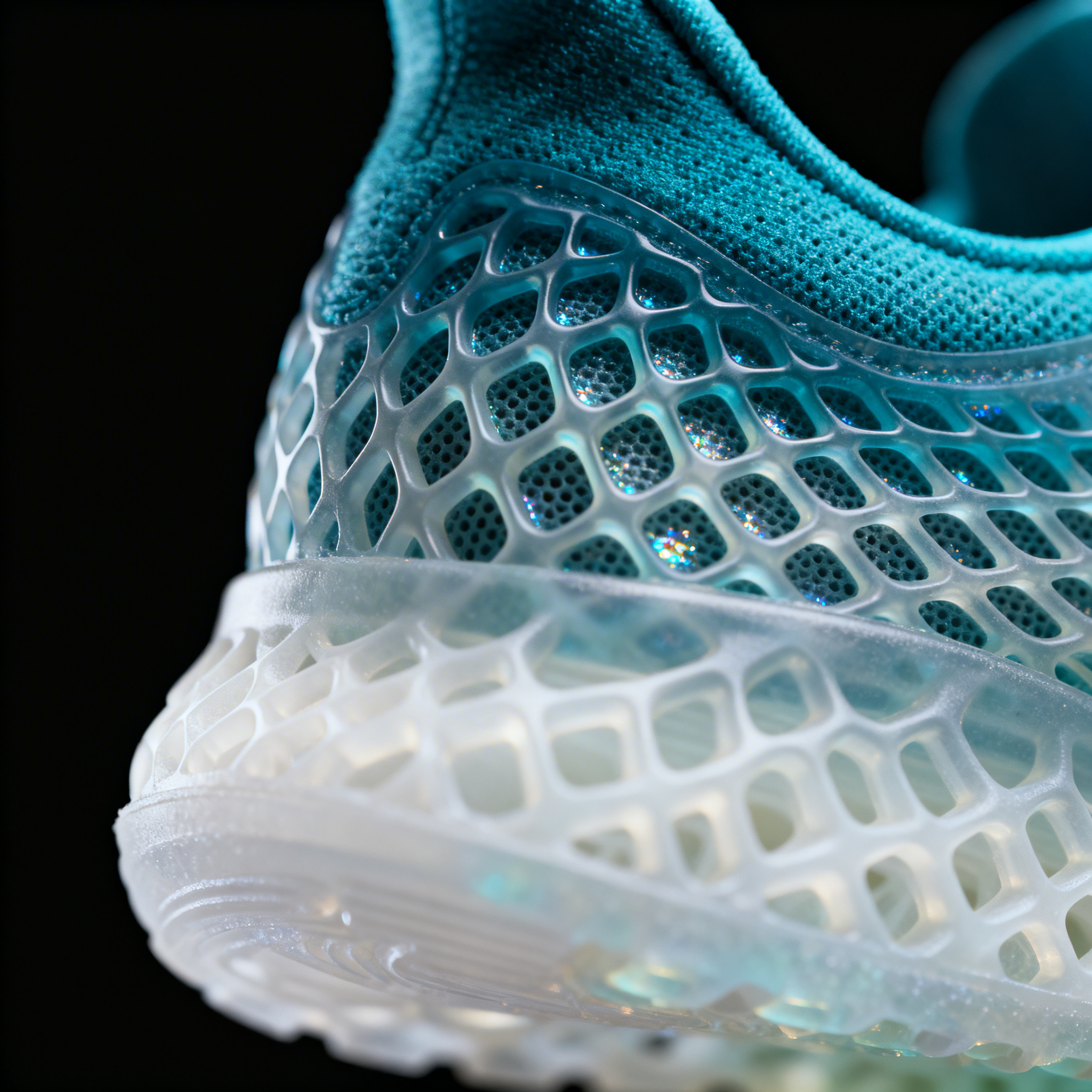
The patent on topology-optimized structures starts from the observation that traditional soles contain a lot of material that is “useless” from a structural standpoint: areas that do not contribute to mechanical strength but add weight and cost. Topology optimization is a computational technique that calculates where material is truly necessary and where it can be removed, creating internal lattice structures that maximize strength and cushioning while minimizing mass.
In parallel, traditional uppers require the assembly of multiple pieces of fabric, synthetic leather, or mesh, sewn or glued together. Every seam is a potential point of failure, every added layer increases weight and production complexity. The patent on extruded multilayer uppers proposes building the entire upper in a single additive process, depositing filaments of different materials along calculated paths, so as to obtain differentiated mechanical properties (stiffness in the heel, elasticity in the forefoot, lateral breathability) without seams or joints.
The idea in 60 seconds
Two recent patents introduce soles with optimized internal structure and 3D-printed multilayer uppers, for lighter, stronger, and customized footwear.
The first patent describes a method for 3D printing footwear components—in particular soles—by populating the internal volume with a lattice of interconnected unit cells, whose arrangement is determined by topology optimization algorithms. In practice: the software calculates where reinforcements are needed and where material can be reduced, generates a honeycomb or three-dimensional lattice structure, and the printer deposits material only where necessary.
The second patent concerns the production of uppers by multilayer extrusion: the printer deposits simultaneously or sequentially multiple filaments (with different properties: rigid, elastic, breathable) along paths designed to form the heel, midfoot, toe, and side zones. Each layer fuses with the one below at the contact points, creating a single piece without the need for stitching.
Both technologies are based on additive processes (FDM 3D printing or similar), but the real leap is in the integration between advanced computational design and automated production: it is not just about “printing a shoe,” but about generating geometries impossible to obtain with traditional molds and customizing them based on biomechanical data or individual preferences.
What really changes (tangible improvements)
The soles can weigh up to 30% less, while the uppers offer differentiated mechanical properties without seams, improving comfort and durability.
Weight reduction without compromising strength
The patent on topologically optimized structures indicates that the soles can reach a weight of up to 30% less compared to traditional equivalents. This is not just weight reduction: the internal lattice structure maintains (or improves) cushioning and mechanical strength, because the material is distributed exactly where it is needed. For a runner, 30 grams less per shoe means less fatigue over long distances; for a manufacturer, less material means reduced costs and lower environmental impact.
Customizable cushioning and elastic response
The same lattice structure can be designed with variable density: denser under the heel to absorb impact, more open in the forefoot to promote propulsion. This level of control is difficult to achieve with injection-molded EVA or polyurethane foams, which have uniform properties. The patent does not specify quantitative cushioning values, but the logic is clear: variable geometry = customized mechanical response.
Elimination of seams in uppers
The patent on multilayer uppers describes a continuous process in which the filaments fuse together during deposition. This eliminates seams, which are traditionally weak points (they can tear, cause irritation, accumulate moisture). A seamless upper is more durable and comfortable, and can be produced faster because it does not require manual assembly operations.
Mechanical properties differentiated zone by zone
Depositando filamenti con caratteristiche diverse (ad esempio TPU rigido per il contrafforte del tallone, TPU morbido per la linguetta, mesh traspirante per i lati), il processo descritto nel second patent permette di ottenere un componente con supporto, elasticità e ventilazione calibrati in ogni zona, senza aggiungere strati o componenti separati. Anche qui i documenti brevettuali non forniscono dati quantitativi di traspirabilità o rigidità, ma il principio è solido e già applicato in altri settori (packaging multistrato, tessili tecnici).
Esempio in azienda / sul mercato
Produttori sportivi stanno già testando queste tecnologie per linee premium, adattando la geometria delle suole ai dati biomeccanici degli utenti.
Un caso d’uso plausibile, coerente con il brevetto sulle strutture ottimizzate, è quello di un produttore di calzature sportive che introduce una linea premium di scarpe da corsa personalizzate. Il cliente effettua una scansione 3D del piede (con smartphone o scanner dedicato), fornisce dati sul proprio stile di corsa (appoggio tallone/avampiede, pronazione), e il sistema genera una suola con reticolo interno ottimizzato per quel profilo biomeccanico. La scarpa viene stampata su richiesta e spedita in pochi giorni.
Questo modello è già in fase sperimentale presso aziende come Zellerfeld, che ha costruito una piattaforma completa per la produzione on-demand di calzature stampate in 3D, e presso brand sportivi consolidati che stanno testando midsole stampate con tecnologie simili (fonti indicano che Carbon e altri fornitori di sistemi additivi collaborano con marchi come Adidas e New Balance). L’adozione di ottimizzazione topologica per suole è un’estensione naturale di queste iniziative.
Per gli upper multistrato, un esempio concreto potrebbe essere una fabbrica che produce calzature per sport specifici (calcio, trekking, basket), stampando upper con rinforzi e zone elastiche calibrate per ogni disciplina, senza dover gestire decine di varianti di tessuto e operazioni di cucitura. Il patent descrive proprio questa possibilità: variare densità e rigidità lungo il percorso di estrusione, ottenendo un prodotto finito pronto per l’assemblaggio con la suola.
Trade-offs and limitations
The introduction requires advanced software and specific skills; moreover, the complexity of the materials can slow down integration into existing processes.
Need for topological simulation software
Topology optimization is not a trivial process: it requires finite element method (FEM) simulation software and iterative algorithms that calculate the optimal distribution of material based on load, weight, and geometry constraints. These tools exist (they are used in aerospace and automotive), but adapting them to footwear and integrating them into the production flow requires specific skills and investments in software licenses. It patent does not specify which software is needed, but it is clear that a traditional footwear manufacturer will have to train staff or hire engineers with experience in generative CAD.
Post-processing and support removal
Complex lattice structures may require supports during printing, which must then be removed. Depending on the geometry and material, this can be laborious and introduce surface defects. It patent does not go into detail about post-processing, so it is not clear how critical this aspect is: it could be manageable with careful design (minimizing supports) or require manual operations that slow down production.
Thermal management in multi-layer extrusion
Depositing filaments with different properties (for example, TPUs with different hardnesses) requires precise control of the extrusion temperature and deposition speed, to prevent the materials from not fusing correctly or degrading. It patent on multilayer uppers describes the process but does not provide detailed operating parameters. This means that industrial adoption will require a setup and validation phase, with possible critical issues related to repeatability and the quality of the finished product.
Integration with automated finishing systems
3D-printed uppers may require cutting operations, edge finishing, or the application of additional reinforcements. The patent does not specify whether and how these operations are automated. If they require manual intervention, the speed advantage of 3D printing is partially nullified. Industry sources indicate that integration with automated cutting and finishing systems is still under development, so it is an area to monitor.
Reality check: what is needed to reach production
It is necessary to invest in specialized machinery and staff training, with a return on investment of between 3 and 5 years.
Investment in hardware and software
To adopt the technologies described in the two patents, a footwear manufacturer must:
- Purchase 3D printers optimized for elastomers (TPU, TPE), with the ability to handle complex geometries and, in the case of multilayer uppers, multiple extruders or rapid filament-changing systems. Indicative cost: from 10,000 to 100,000 euros per machine, depending on the production scale.
- Software licenses for topological optimization and advanced slicing: tools such as Altair OptiStruct, Autodesk Fusion 360 Generative Design, or open-source equivalents. Annual cost: from a few thousand to tens of thousands of euros, plus staff training.
- 3D scanning and data management infrastructure: to customize footwear, precise foot measurements must be acquired and individual data flows managed. This requires scanners (from a few hundred to thousands of euros) and custom order management software.
Staff training
The skills required differ from the traditional ones in the footwear sector: technicians are needed who can operate 3D printers, manage generative CAD software, and interpret biomechanical data. This entails internal training programs or targeted hires, with non-negligible costs and timelines.
Validation and certification
Footwear must pass strength, durability, and safety tests (slip resistance, material toxicity). Optimized structures and multilayer uppers are new, so test protocols must be adapted and results validated. This requires time (months or years) and resources for laboratory tests and field tests.
Return on investment
The brevetto sulle strutture ottimizzate suggests an adoption horizon of between 2 and 5 years, consistent with the time needed to industrialize the process. The economic return depends on scale: for low-volume premium lines, customization and marketing can justify higher prices; for mass production, material savings (30% less) and reduced waste can offset the initial investment in 3-5 years, provided sufficient volumes are reached.
Industry sources indicate that companies such as Zellerfeld are already operating on a commercial scale, but with specific business models (centralized production, direct online sales). For traditional manufacturers, integration into existing processes is more complex and requires a gradual approach: start with pilot lines, validate quality and costs, then scale.
Conclusion
These innovations represent a real step toward smart manufacturing of footwear and garments, while requiring significant commitment for industrial adoption. The two patents analyzed—soles with topologically optimized structures e extruded multilayer uppers—they are not futuristic concepts, but plausible technical solutions that rely on technologies already established in other sectors (aerospace, automotive, packaging) and on rapidly evolving 3D printing platforms.
The tangible benefits—weight reduction of up to 30%, elimination of seams, biomechanical customization, reduction of waste—are real and measurable, but adoption requires investments in hardware, software, training, and validation. It is not about replacing traditional production lines overnight, but about progressively integrating new capabilities that make it possible to offer differentiated, higher-performing, and sustainable products.
Delve deeper into the patents and assess how they could integrate into your production processes. If you operate in the footwear sector or in related fields (orthoses, wearable devices), consider launching pilot projects with technology partners specializing in 3D printing and computational optimization. The adoption horizon is 2-5 years: those who start now will have a competitive advantage when these technologies become market standards.
article written with the help of artificial intelligence systems
Q&A
What is the main advantage of 3D-printed soles with topological optimization?
The soles can weigh up to 30% less while maintaining or improving strength and cushioning, thanks to an internal lattice structure that places material only where it is needed.
How does the multilayer upper patent eliminate the problems of traditional stitching?
It builds the entire upper in a single 3D-extrusion process, fusing different filaments without seams; this removes weak points and irritations and speeds up production.
Why can the internal lattice geometry be customized?
Because topological optimization calculates cell placement based on the user’s biomechanical data, allowing variable density to cushion or support specific areas of the foot.
When could footwear with these technologies reach the market?
The innovations, currently under patent, could enter production within 2–5 years, as they rely on additive processes already proven in other industries.
What is a concrete example of a sports application mentioned in the article?
A manufacturer can offer premium running shoes: after a 3D scan of the foot and gait analysis, the optimized-lattice sole is printed on demand and shipped within a few days.


