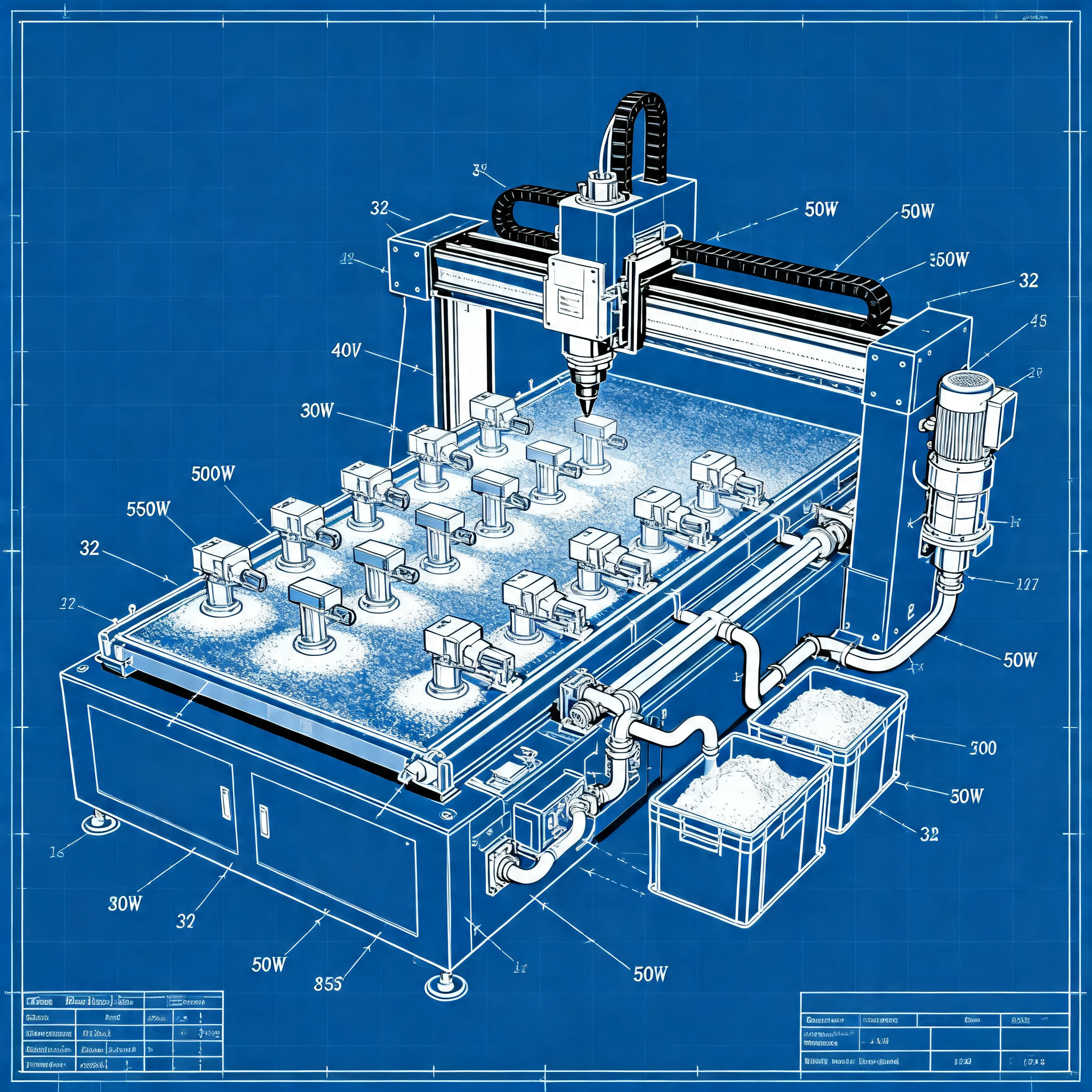
32 laser, 500W each: where does it break?
Multi-laser systems are redefining the boundaries of metal additive production: here's what they can really do today.
The race for productivity in metal 3D printing has led manufacturers to multiply the number of lasers on LPBF platforms. Systems with 32 lasers of 500W each represent today's commercial state of the art, but behind the numbers lie precise technical limits that determine what is truly feasible in production.
- Processable volume up to 3862 liters with 32 lasers of 500W on meter-scale platforms
- Closed and contactless system for powder handling with redundant modular containers
- Integration with MES and automated systems for complete process traceability
- Thermal management and laser beam overlap remain the critical operational constraints
Power and parallelism: is the real limit thermal?
Heat management determines the actual productivity of multi-laser systems, regardless of the installed nominal power.
When 32 lasers of 500W operate in parallel on a volume of 3862 liters, the total installed power reaches 16kW. The problem is not generating this energy, but dissipating the resulting heat without compromising metallurgical quality.
The overlap zones between the scanning areas of the different lasers require advanced algorithms to avoid variations in mechanical properties. Each beam must be calibrated to maintain uniformity across the entire work plane, with continuous control of energy and the scanning path.
Process gas flow management becomes critical on meter-scale volumes. Systems like AirSword maintain a uniform flow to remove fumes and protect optics during long-duration builds, preserving optical surfaces and extending operational times without extraordinary maintenance.
Record volumetry: when 3862 liters are not enough
The processable volume poses logistical and structural challenges to ensure operational continuity without interruptions.
The FS1521M-U platform with 32 lasers of 500W reaches a build volume of 3862 liters, maintaining the meter-scale architecture. This means handling up to four tons of metal powder per single job, with positioning accuracy along the Z axis necessary for complex structures.
| Parameter | 32 laser system | 8 laser system |
|---|---|---|
| Build volume | 3862 liters | ~91 liters (450×450×450mm) |
| Total power | 16,000 W | 4,000 W |
| Build powder | Up to 4 tons | ~200 kg |
The volumes of powder handled during a single job are very high. For this reason, the systems adopt redundant modular containers that allow continuous feeding and collection of overflow without interrupting the process, increasing operational safety and reducing waste.
Scalability towards even larger formats exists: Eplus3D has presented a configurable system with 256 lasers, but the increase in operational complexity, investment costs, and maintenance requirements make a thorough analysis of return on investment crucial.
Closed and contactless: advantages and design constraints
The contactless design offers material safety and flexibility, but imposes geometries compatible with the laser work field.
The closed and contactless dust management system integrates feeding, recovery, and sieving operations into a continuous flow. Everything takes place under inert gas, with the aim of increasing operational safety and simplifying powder batch traceability.
The contactless architecture with fixed scanners requires components to remain within the optical work field. Geometries exceeding this area cannot be processed without introducing movable optics, increasing complexity and costs.
The “Open Platform” philosophy allows working with both proprietary materials and third-party developed alloys, provided they are qualified on the platform. This openness facilitates the development of specific parameters for titanium, nickel superalloys, and copper alloys, based on application needs.
Experience with copper alloys has led to the development of “red” laser solutions capable of achieving densities close to 99.97% on metric-scale components. Efficient absorption of the wavelength is crucial for highly reflective materials.
Industrial scalability without interruption
Integration with MES and automated systems allows scaling production without losing traceability or quality.
Machines are designed as productive cells integrable into industrial lines. Workflows can be connected to handling systems, process monitoring, and MES for serial production management, with complete traceability of each powder batch and process parameter.
Integrated production flow
- Automatic feeding: Modular containers provide powder without process interruption.
- Continuous monitoring: Sensors track temperature, oxygen, and status of each laser in real time.
- Collection and sieving: Closed system recovers and prepares powder for the next cycle.
- MES recording: Every parameter is stored for certification and quality analysis.
Systems like the Infinity 450 iFusion450-8 with eight 500W lasers claim cost per part reductions of up to 70% and annual capacity increases of up to 6-7× compared to conventional configurations. These numbers depend on specific use cases: material, layer thickness, volume fill percentage, and nesting strategy.
In-line integration allows for addressing sectors sensitive to the cost/quality/time ratio, such as aerospace, defense, automotive, and energy, where repeatability and process risk management are as important as nominal speed.
Conclusion
Multi-laser systems with 32 sources of 500W represent the cutting edge of metal additive manufacturing, but require precise design choices to fully exploit their potential. Thermal management, laser beam overlaps, and the handling of tons of powder remain critical operational constraints.
The record volumetry of 3862 liters opens up possibilities for large components such as sections of aeronautical engines and structures for energy systems. However, the contact-less architecture with fixed scanners imposes that geometries remain within the optical working field, limiting design freedom.
Carefully evaluate thermal and geometric constraints before integrating a multi-laser system into your production process. The return on investment analysis must consider not only nominal productivity, but also operational complexity, maintenance costs, and compatibility with target materials.
article written with the help of artificial intelligence systems
Q&A
What is the maximum achievable processable volume with a 32-laser 500W system?
The maximum processable volume is 3862 liters on metric-scale platforms. This allows for the production of large components such as aerospace engine sections or energy structures.
What are the main operational constraints in multi-laser systems for metal 3D printing?
The main constraints are thermal management, laser beam overlap, and handling large amounts of powder. Heat dissipation is critical to avoid alterations in metallurgical properties.
How are powder flows managed in advanced 32-laser systems?
Modular redundant containers are used, allowing continuous feeding and overflow collection without interrupting the process. Everything occurs in a closed environment under inert gas for safety and traceability.
What advantages do multi-laser systems integrated with MES and automation offer?
They enable full process traceability, productive scalability, and up to 70% reduction in part costs. Additionally, they ensure operational continuity and integration into automated industrial production lines.
What design limitations does the 'contact-less' architecture with fixed scanners impose?
Geometries must remain within the optical working field; otherwise, movable optics must be introduced. This increases complexity and costs, limiting design freedom while maintaining safety and operational flexibility.