WINBO patents a heated system for pellet feeding in 3D printing
Guangzhou Wenbo Intelligent Technology obtains a Chinese utility model for an integrated container that heats, handles and doses plastic granules intended for additive manufacturing. The solution aims to standardize the material flow in pellet systems.
On 17 July 2026, Guangzhou Wenbo Intelligent Technology Co., Ltd., known under the WINBO brand, was granted Chinese utility model CN224510438U. The document describes a “consumable material heating mechanism” intended for 3D printers operating with bulk material.
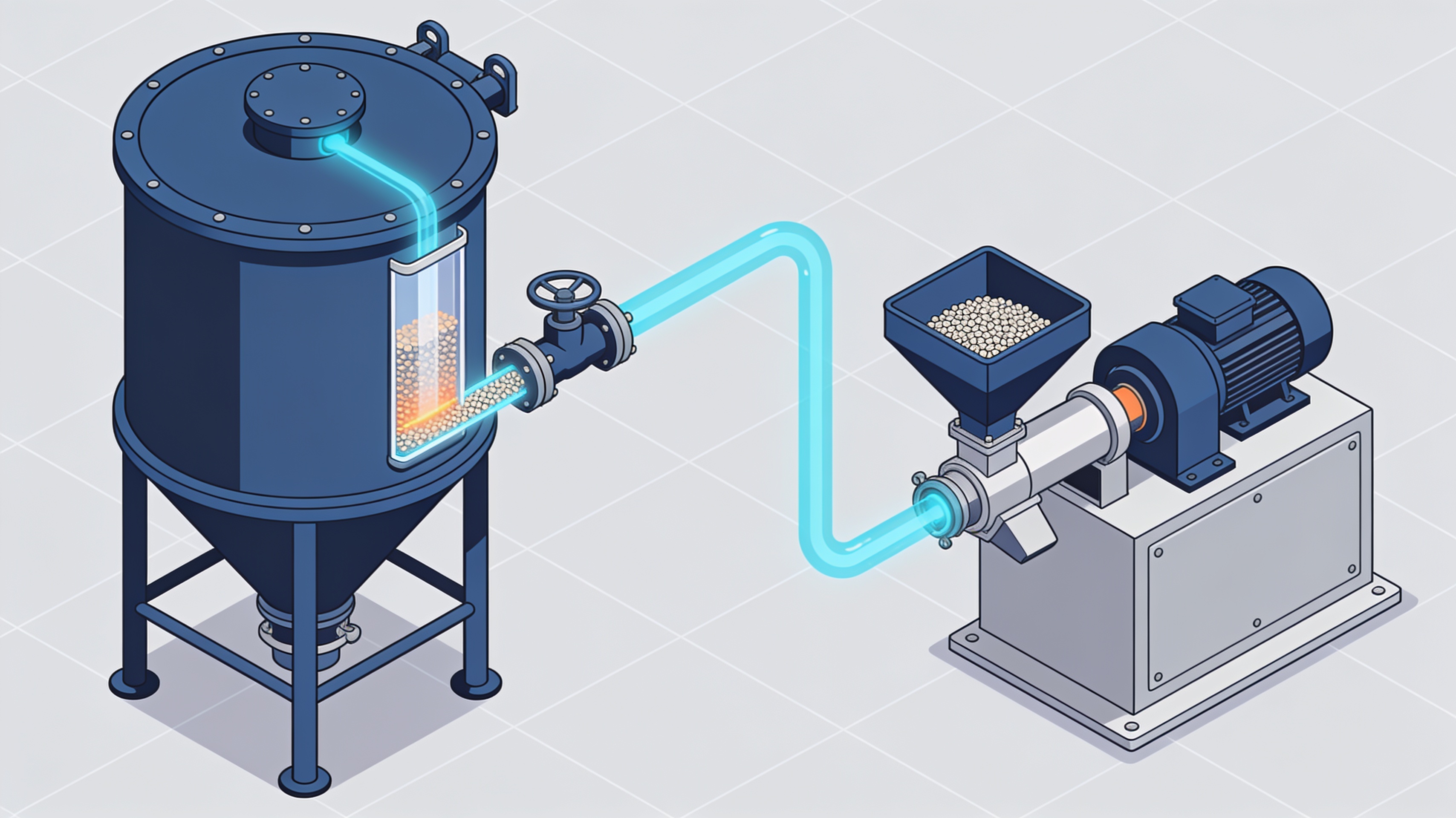
The configuration shown in the drawings indicates a system designed to work with pellets, granules or powders, not with continuous filament. The design concentrates three functions normally handled by separate components: preheating, handling and controlled feeding to the extruder.
- Utility model CN224510438U granted on 17 July 2026
- Integrated system for heating and dosing plastic pellets
- Cylindrical container with lower conical geometry
- Isolation valves on inlet and outlet
- Transparent window for visual level control
Why an integrated system for pellets is needed
Pellet 3D printing systems require a constant material flow to avoid extrusion defects. Variations in dosing produce irregular beads and interruptions.
In pellet 3D printers and large-format systems, oscillations in material flow cause concrete problems. Under-extrusion, pressure build-ups, and print interruptions result from discontinuous feeding.
The WINBO system addresses this problem by integrating preheating with controlled handling. The goal is to prepare the granules before they reach the extruder, ensuring a more uniform flow rate.
Container structure
The main component is a cylindrical vessel with a tapered bottom and removable threaded lid. The conical geometry facilitates the convergence of material towards the outlet.
The container has a tapered lower part that should reduce stagnation zones for the granules. This geometry helps the material converge towards the outlet duct more evenly.
At the top, a removable threaded lid allows access to the heating unit. This solution should facilitate inspection and cleaning of the system.
The material enters through a duct located near the top, while the outlet is at the bottom. Both connections are equipped with valves that allow the container to be isolated during maintenance, material replacement, or machine shutdown.
Visual level check
A transparent glass window allows checking the amount of material in the container. Pellet depletion can interrupt production or introduce air into the circuit.
The presence of a transparent window is a simple but functional element. In pellet systems, material depletion can cause air to enter the feed circuit, resulting in print interruption.
Visual inspection does not replace automatic measurement. In an industrial version of the system, level sensors could integrate this function.
In the Chinese industrial property system, a utility model protects a technical solution applied to the shape or structure of a product. It does not certify that the device is already marketed nor guarantee the declared performance.
Applications in pellet systems
Pellet 3D printing allows reducing material costs compared to filament and working with technical polymers in industrial formats. Uniform dosing remains a technical challenge.
Additive manufacturing systems that use pellets instead of filament offer economic and operational advantages. Plastic granules cost less than extruded filament and are available in a wider range of formulations.
However, flow management is a critical issue. Variations in dosing directly translate into visible defects on the printed part, compromising dimensional accuracy and surface finish.
Limitations of available documentation
The utility model describes the constructive configuration but does not provide experimental data. Performance, consumption, and compatibility with specific polymers will need to be verified.
At present, no data have been published regarding endurance tests, dosing accuracy, energy consumption, or container capacity. The solution must be considered a formalized technical proposal.
The industrial effectiveness will need to be verified through prototypes, tests with different materials, and prolonged operating cycles. Only field tests can confirm the claimed advantages over traditional feeding systems.
| Component | Function | Declared advantage |
|---|---|---|
| Conical geometry | Material conveying | Reduction of stagnation zones |
| Inlet/outlet valves | Container insulation | Simplified maintenance |
| Transparent window | Visual level control | Exhaustion prevention |
| Threaded cap | Heater group access | Inspection and cleaning |
WINBO's patent documentation represents a contribution to the management of bulk materials in 3D printing. Practical validation of the system will determine whether the integration of heating and dosing into a single component offers concrete advantages over solutions currently available on the market.
article written with the help of artificial intelligence systems
Q&A
What is the Chinese utility model number assigned to WINBO?
The Chinese utility model assigned to Guangzhou Wenbo Intelligent Technology is CN224510438U. This document describes the heating mechanism for 3D printer consumable material.
When was the patent officially assigned to WINBO?
The utility model was assigned on July 17, 2026. This date marks the official recognition of the integrated solution for plastic pellet management.
Which three main functions does the new WINBO system integrate?
The system integrates preheating, handling, and controlled feeding to the extruder into a single component. This configuration replaces traditionally separate components.
What type of geometry does the patented container feature?
The container has a cylindrical shape with a tapered or conical lower part. This geometry facilitates smooth material convergence toward the outlet duct, reducing stagnation.
What problems does the integrated feeding system solve for pellet printing?
The solution addresses fluctuations in material flow that cause under-extrusion, pressure buildup, and print interruptions. By ensuring a constant flow, more uniform beads are achieved.