
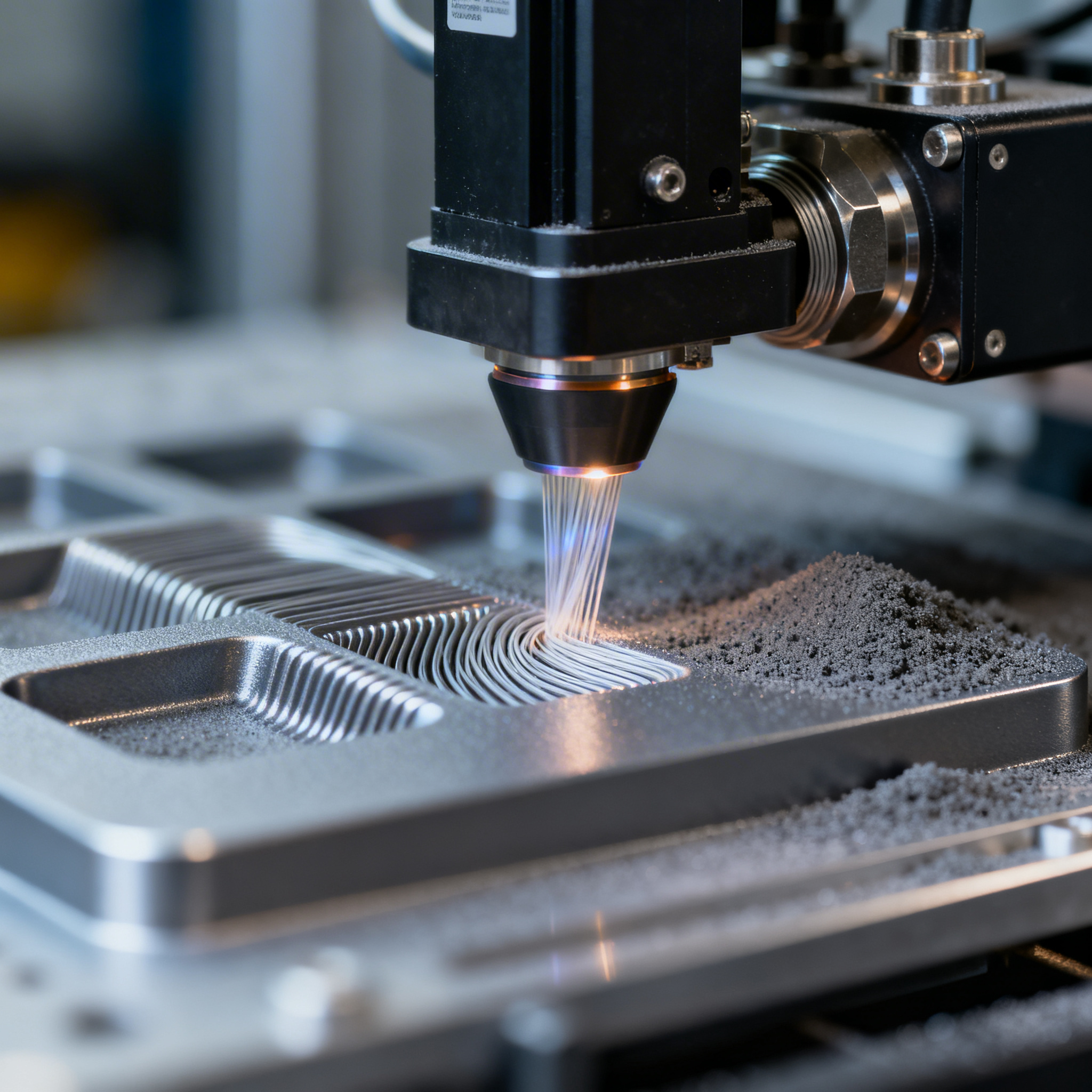
Ultrafast and High Precision in Industrial Additive Processes: How It Really Works
Advanced additive processes are redefining the boundaries of industrial production thanks to technologies that combine unprecedented speed and precision.
Industrial additive manufacturing has moved beyond the prototyping phase to establish itself as a concrete production solution. At the heart of this evolution are technologies capable of combining production speed, dimensional precision, and surface quality, supported by automated post-processing systems that eliminate traditional bottlenecks. The key to success lies in the integration of advanced hardware, high-performance materials, and intelligent automation throughout the entire process chain.
Technologies Behind Ultrafast Additive Manufacturing
The fastest 3D printing technologies currently used in industry are based on operating principles that make it possible to drastically reduce production times while maintaining high quality standards, with particular reference to multi-laser systems and optimized process architectures.
High-speed additive manufacturing systems stand out for architectures that maximize throughput without compromising quality. Multi-laser configurations represent one of the most effective solutions: multiple sources operate simultaneously on the same work area, increasing production capacity and reducing cost per component. This architecture is essential for the transition to serial production.
In the metal segment, platforms such as Precision Additive's PA-300 integrate the proprietary Scanning Super Laser Melt (SSLM) technology, which enables build speeds up to ten times higher than conventional systems. The artificial intelligence-based architecture continuously monitors the process and automatically corrects deviations in real time, ensuring repeatable results from one build to the next.
For polymers, systems such as HP Multi Jet Fusion and volumetric technologies represent the cutting edge of speed. Tomographic volumetric printing (TVAM) solidifies entire 3D geometries through calculated light projections while the resin is optically rotated, completing entire volumes in seconds or minutes instead of hours. This approach eliminates the traditional layer-by-layer paradigm, offering significant advantages for complex geometries.
The integration of in-situ monitoring based on structured metrology, such as Phase3D's Fringe Inspection system, transforms quality control from a post-process activity into real-time inspection. By measuring the three-dimensional profile of each layer during the build, these systems provide calibrated and quantitative data on powder layer uniformity, melt surface topology, and effective thickness, enabling immediate quality decisions.
Compatible and High-Performance Materials
The expansion of industrial applications depends on the availability of high-performance materials compatible with ultrafast processes, including engineering polymers, elastomers, and advanced metal alloys.
In the polymer segment, materials compatible with high-speed processes include PA6, PA11, PA12, ABS, polycarbonate (PC), polypropylene (PP), TPU, TPE, and composite materials reinforced with glass fiber, carbon, or mineral fillers. This range makes it possible to cover applications ranging from structural components to gaskets and parts with chemical resistance requirements.
Advanced thermoplastic materials for systems such as Multi Jet Fusion offer mechanical properties comparable to those achievable with injection molding, with the advantage of geometric freedom. PA12, in particular, represents the industry standard for mechanical strength, dimensional stability, and compatibility with post-processing.
In the metal sector, ultrafast platforms have expanded the range of processable alloys. In addition to stainless steels such as 17-4PH and 316L, advanced systems such as PA-300 can process magnesium, tungsten, and copper alloys, materials traditionally difficult to work with using conventional technologies due to their specific thermal and optical properties.
Composite materials represent an area of significant growth. Polymers reinforced with short carbon or glass fibers offer exceptional strength-to-weight ratios, making them ideal for aerospace and automotive applications where mass reduction is critical. The compatibility of these materials with automated post-processing systems is essential to ensure adequate surface and mechanical properties.
Post-Processing Automation: Vapor Smoothing and Beyond
Automated chemical finishing systems are revolutionizing the surface quality and mechanical strength of printed components, eliminating manual operations and ensuring industrial repeatability.
Chemical vapor smoothing is one of the most effective technologies for improving the performance of printed thermoplastic components. Systems such as AMT PostPro SF100 and SF50 use controlled chemical vapors to smooth and seal surfaces, simultaneously improving mechanical strength, surface finish, and air or water tightness.
The process operates in fully automated chambers where components are exposed to calibrated chemical vapors that selectively dissolve surface layers, eliminating the roughness typical of additive processes. The technology is compatible with SLS, MJF, FDM/FFF, and other processes, and can treat all major thermoplastic materials including PA6, PA11, PA12, ABS, PC, PP, TPU, and reinforced composites.
The advantages of automated vapor smoothing include reducing surface roughness by up to 90%, increasing fatigue resistance by eliminating surface stress concentrators, and creating surfaces impermeable to liquids and gases. These improvements open up new applications in sectors such as automotive, medical, and fluidics, where surface properties are critical.
In addition to vapor smoothing, integrated systems such as AMT PostPro DP Max combine depowdering and sandblasting in a single automated solution, handling loads up to 30 kg and supporting various abrasive media. This integration reduces handling times and increases the overall efficiency of the production flow.
The ability to fully automate post-processing eliminates one of the main bottlenecks of industrial additive manufacturing. According to sources, post-processing can account for more than half of the total cost of a qualified metal component; automation drastically reduces this economic impact.
Integration into Existing Production Flows
The introduction of ultrafast additive technologies into automated production lines requires structured approaches that ensure operational continuity, traceability, and scalability.
The effective integration of advanced additive processes into existing production flows depends on three key factors: digital continuity, physical automation, and data management. Digital continuity makes it possible to use the same CAD file from prototyping to serial production, eliminating the need for retooling and reducing transition times.
Modern cloud-native CAD platforms support collaborative workflows with branching and merging, similar to software development, enabling geographically distributed teams to iterate quickly. Integration through robust APIs maintains associative links between design, simulation, build preparation, and post-processing, automatically updating the entire chain when the geometry changes.
In the aerospace and defense sector, ultrafast additive manufacturing is becoming the fastest-growing production process. Applications range from payload components and test equipment to propulsion-related designs that withstand extreme thermal and mechanical loads. The ability to consolidate assemblies into fewer components reduces joints and fasteners, improving durability and simplifying logistics and inventory.
A concrete example of integration concerns the production of components for assembly lines: spare parts for line changeovers can be printed on demand to reduce costly machine downtime. In energy and industrial equipment, corrosion-resistant components are produced to operate under extreme conditions.
Centralized digital control of design files, combined with distributed production at qualified suppliers, reduces dependence on physical tooling and improves response times when priorities change. This approach is particularly relevant in regulated environments where traceability, certification, and quality assurance are essential.
Conclusion
Ultrafast additive processes today represent a concrete response to the needs of modern industrial production, combining speed, precision, and scalability. The integration of advanced printing technologies, high-performance materials, and automated post-processing systems is eliminating the traditional limits of additive manufacturing, transforming it from a prototyping tool into a complete production solution. The ability to ensure repeatable quality, reduce setup times, and adapt quickly to demand fluctuations makes these technologies strategic for high-complexity sectors such as aerospace, defense, energy, and medical.
Explore the technologies presented and evaluate the implementation of integrated solutions for your production sector. The adoption of ultrafast additive processes requires a systemic approach that considers the entire value chain, from design to post-processing, ensuring that each phase is optimized to maximize productivity and quality.
article written with the help of artificial intelligence systems
Q&A
What are the main technologies used in high-speed industrial additive processes?
The main technologies include multi-laser systems, such as those found in Precision Additive's PA-300 with SSLM technology, and volumetric techniques like TVAM. These solutions increase production throughput while maintaining high precision and surface quality.
How do materials affect the performance of ultrafast processes?
High-performance materials, such as technical polymers, elastomers, and advanced metal alloys, determine the final quality of the component. For example, PA12 is a standard for mechanical strength and dimensional stability, while special alloys like magnesium and copper expand possible applications.
How does post-processing automation improve additive manufacturing?
Post-processing automation, such as vapor smoothing and integrated depowdering systems, drastically reduces time and operational costs. It also improves surface finish, mechanical strength, and ensures industrial repeatability, eliminating manual operations.
What advantages does integrating ultrafast additive processes into existing production lines offer?
Integration enables digital continuity, scalability, and complete process traceability. Moreover, it allows on-demand production of critical components, reducing machine downtime and improving logistics and production efficiency.
Which industries are most adopting ultrafast additive manufacturing?
The main sectors are aerospace, defense, automotive, and energy. In particular, they are used for components subjected to extreme loads, complex parts consolidated into single elements, and rapid, customized replacement systems.


