3D printing technologies for custom orthopedic implants: from design to biocompatibility
Additive manufacturing is radically transforming the production of customized implantable devices in the medical sector. The ability to design custom components based on patient anatomical images allows for solutions that are more precise than standard implants, improving stability and biological integration. In orthopedic and spinal surgery, where even minor anatomical differences can affect clinical outcomes, 3D printing is contributing to the development of highly specific implants that reduce operative times and improve functional results.
Advanced materials for 3D printing of orthopedic implants
The landscape of materials for 3D-printed orthopedic implants is expanding beyond traditional metal alloys. While titanium remains the most used material for its mechanical strength and biocompatibility, interest is growing in “metal-free” solutions made of non-metallic materials, capable of offering biological compatibility and comparable structural performance.
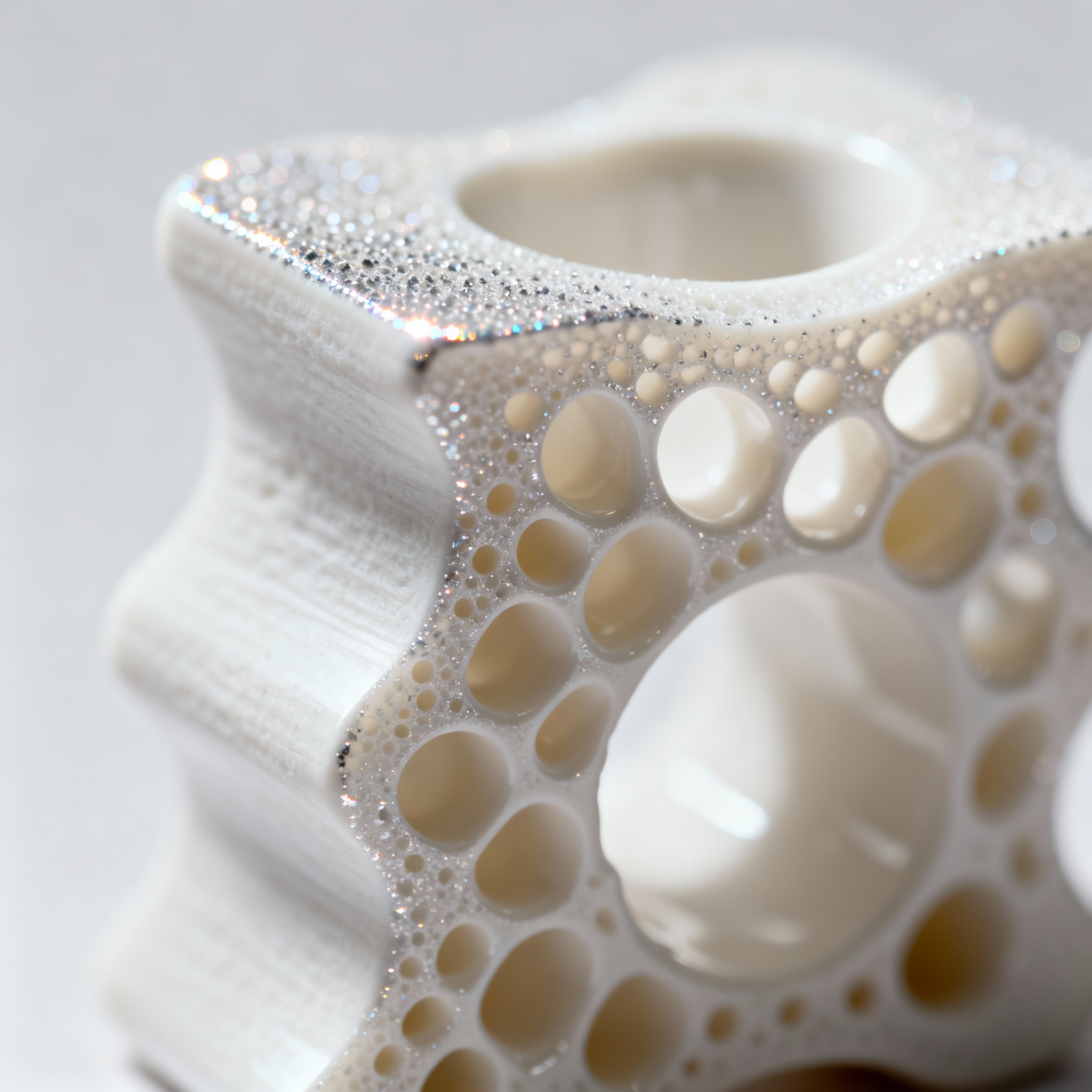
The company Nivalon has developed a customized spinal implant free of metallic components, based on advanced ceramics and high-performance composites. This approach offers significant advantages: high compressive strength, excellent chemical stability, better radiological compatibility, and reduced interference with diagnostic systems such as MRI and CT scans. Traditional metallic implants can in fact generate artifacts in imaging, release particles over time, and present excessive rigidity compared to natural bone.
A key element is the 3D printing technology developed by XJet, known for the NanoParticle Jetting process, which allows the additive production of ceramic components via the deposition of suspended nanoparticles. This technology guarantees high-quality surfaces, complex geometries impossible with traditional methods, high density of the final material, and precision suitable for medical applications.
Ceramic materials such as zirconia or alumina are already used in dental and joint prostheses thanks to high hardness, excellent wear resistance, biological stability, and absence of corrosion. Their use for spinal implants requires highly controlled production processes, which additive manufacturing makes more flexible and adaptable.
3D scanning and modeling processes for personalized anatomy
The personalization of orthopedic implants begins with the acquisition of high-resolution digital images. In Vietnam, a medical team completed a complex elbow reconstruction surgery employing 3D printing technologies, in collaboration with the VinUniversity 3D printing center. The process started with the computerized tomography of the patient's limb.
The obtained data were processed to create a virtual three-dimensional model of the deformed elbow. Through advanced modeling software, the physicians simulated the osteotomy, i.e., the cutting of the bone necessary to realign the joint. The “digital twin” allowed for the identification of the exact points of intervention and the prediction of the aesthetic-functional result before proceeding with the incision.
In Belgium, the hospital group AZORG chose to structurally integrate 3D printing by establishing PrintPlace in the Moorselbaan campus (Aalst). The new headquarters hosts 3D visualization tools, 3D scanners, and approximately thirty 3D printers, with the objective of reducing external handoffs and cycle times for solutions generated by concrete clinical needs. The approach valorizes the “upstream” phase (co-design, engineering, testing, iterations) making it more fluid thanks to the proximity between clinicians and technical teams.
A practical feedback is the use of printed models to facilitate communication with the patient: in some cases, interested parties receive a 3D replica of the affected part, for informational purposes and to support the care pathway.
Biomechanical validation and fatigue testing of implants
Biomechanical validation of 3D printed orthopedic implants is crucial to ensure safety and clinical effectiveness. In the United States, the FDA has published technical guidelines for devices made with additive manufacturing and a specific discussion paper on point-of-care 3D printing. In Europe, the reference framework remains Regulation (EU) 2017/745 (MDR) for medical devices, while standards such as ISO 13485 are frequently cited for quality management systems.
When a hospital produces objects internally related to the clinical pathway, traceability, material management, process control, post-processing and acceptance criteria become central. The in situ production of pre-operative models and custom tools reduces dependence on foreign imports and lowers costs for patients.
A custom implant can offer better load distribution, greater immediate post-intervention stability, reduced risk of misalignment and the possibility of integrating controlled porosity to promote osseointegration. Porous or reticular structures, in particular, can promote bone growth inside the implant, improving long-term spinal fusion.
Integration of porous surfaces and bioactive coatings
One of the main advantages of 3D printing in orthopedics is the possibility of designing implants that exactly reproduce the patient's morphology and integrate functional surfaces. A custom implant with porous structures can promote bone growth inside it, improving long-term biological integration.
XJet's NanoParticle Jetting technology allows the production of ceramic components with complex geometries unachievable with traditional methods, maintaining high-quality surfaces and high density of the final material. This capability represents a significant step forward compared to metal-only solutions.
In the elbow reconstruction intervention in Vietnam, the use of certified biocompatible materials guaranteed the safety of contact with internal tissues. Thanks to the surgical guides produced in-house by VinUniversity, anesthesia time was reduced by 30%, minimizing the risk of infections and accelerating post-operative recovery.
Numerous clinical cases and industrial projects have demonstrated how 3D printing can transform spinal surgery through vertebral implants tailored for tumors or deformities, optimized porous intervertebral cages, devices with better radiological compatibility and rapid production for complex cases.
Sterilization protocols and industrial quality control
Sterilization and quality control protocols are fundamental when 3D printing enters the hospital environment. The use of technical ceramics in medicine requires highly controlled production processes, which additive manufacturing can make more flexible while maintaining rigorous standards.
Advanced ceramic materials such as zirconia and alumina offer high hardness, excellent wear resistance, biological stability, and absence of corrosion, but require specific post-processing and sterilization protocols to ensure clinical safety.
The establishment of the 3D technology center at VinUniversity represents a paradigm shift for healthcare: in-situ production of pre-operative models and customized tools reduces dependence on foreign imports and lowers costs for patients. Beyond orthopedics, the center is exploring applications in maxillofacial and cardiovascular surgery.
AZORG and PrintPlace describe the integration of 3D printing as a structural choice: placing expertise and tools where needs arise (departments and services) to reduce friction and increase the capacity to create ad-hoc solutions. In a multi-site healthcare context, the outcome also depends on governance, clinical priorities, and the management of quality and responsibility throughout the entire lifecycle of printed products.
Future prospects and standardization of production processes</h
article written with the help of artificial intelligence systems
Q&A
- How does 3D printing improve the precision and outcome of orthopedic surgeries?
- Starting from the patient's anatomical images, custom implants are designed that perfectly adapt to the individual morphology, reducing operative times and improving stability and biological integration compared to standard implants.
- What advantages do ceramic materials offer compared to metal alloys in 3D-printed spinal implants?
- Ceramics (zirconia, alumina) do not produce MRI/CT artifacts, do not release metal ions, have stiffness similar to bone, and have excellent biocompatibility; moreover, they allow controlled porosity to favor osseointegration without corrosion issues.
- How is the anatomical customization of an implant performed?
- High-resolution CT images are acquired, a virtual 3D model (“digital twin”) is reconstructed, and the intervention is simulated; the file is then sent to the 3D printer to produce the implant or surgical guides precisely calibrated to the patient.
- What are the main regulations and tests required to validate a 3D-printed orthopedic implant?
- In Europe, the MDR 2017/745 Regulation and ISO 13485 apply; fatigue tests, load distribution, osseointegration, material traceability, and documented sterilization protocols are required to obtain clinical approval.
- How does hospital integration of 3D printing reduce costs and treatment times?
- Centers like PrintPlace or VinUniversity produce models, guides, and implants in-house, eliminating external suppliers, shortening the supply chain, and lowering costs for the patient, in addition to reducing anesthesia time by 30%.