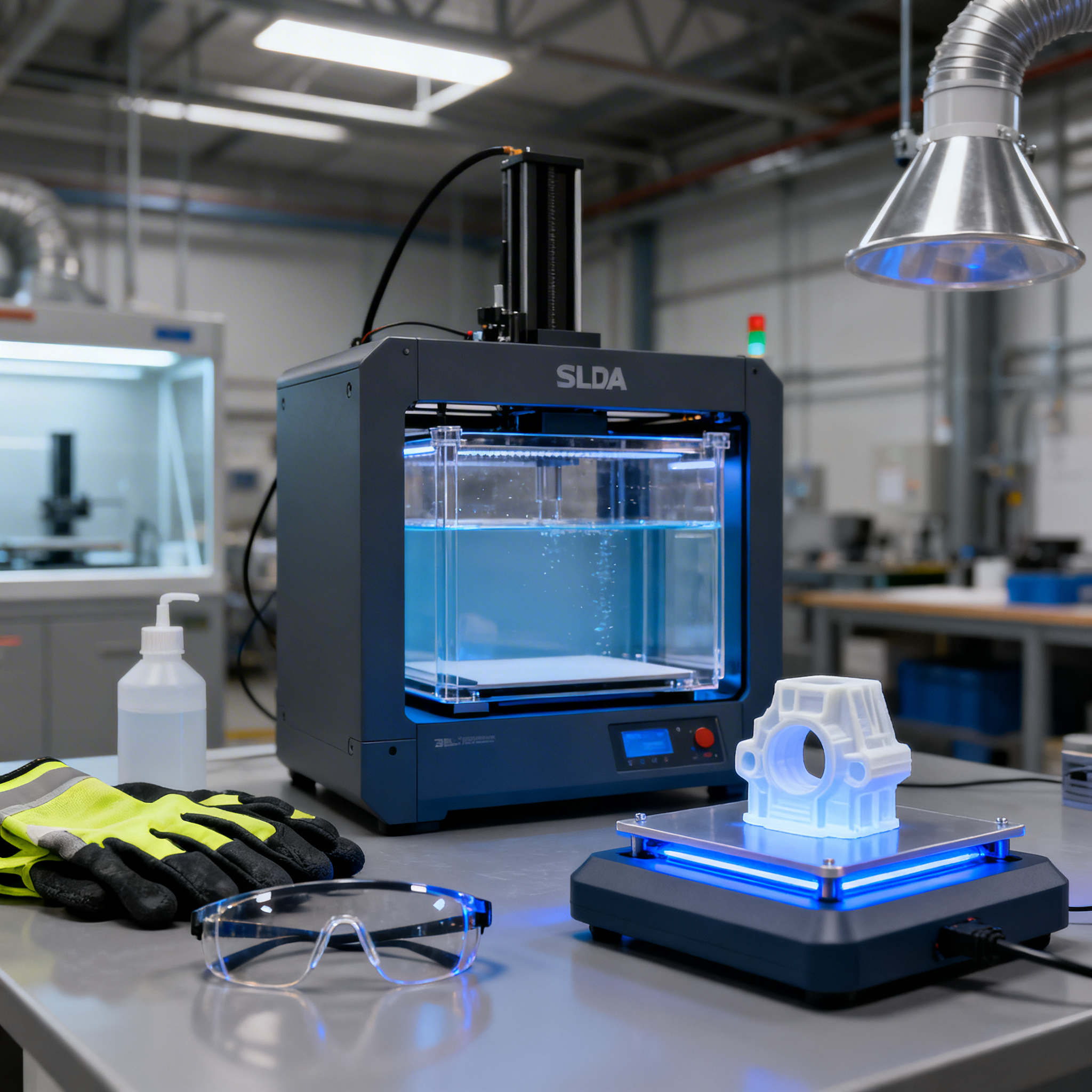
Safety of Photopolymer Resins in SLA Printers: Process Standardization and Informed Choices
Stereolithography resins are not all the same: here is how to manage safety and compliance in the production process.
The growing adoption of SLA 3D printing in the industrial sector has brought to the forefront the need to systematically manage the chemical risks associated with photopolymer resins. The choice between proprietary and third-party materials, the correct implementation of safety protocols, and waste management are no longer secondary aspects, but critical elements to ensure operational continuity, regulatory compliance, and operator health protection.
Chemical Composition of SLA Resins: Risk Analysis
Photopolymer resins contain reactive monomers and photoinitiators that present significant health risks when handled in liquid form, regardless of brand or price range.
The most widespread commercial formulations contain liquid photopolymers that solidify when exposed to 405-nanometer light. According to analyses conducted on over 70 resines from 17 different manufacturers, the majority of general-purpose resins contain between 30% and 60% methoxyethyl acrylamide (ACMO), a compound classified by the US EPA with a Significant New Use Regulation (SNUR) due to risks from skin contact and inhalation of vapors.
The exact chemical composition often remains confidential for proprietary reasons, as in the case of Formlabs resins, but safety data sheets (SDS) must still report hazardous components and their GHS classifications. The critical problem is that many manufacturers do not clearly indicate all components in the SDS, leaving users without complete information on the real risks.
A particularly insidious aspect is the mechanism of the Immunological sensitization: repeated exposure can develop an allergic response that initially does not produce evident symptoms. The operator may work for months or years without apparent consequences, then suddenly develop severe reactions even to minimal exposures. This condition is irreversible and can permanently prevent any future contact with unpolymerized resins.
Minimum Safety Operating Standards
Safe handling of resins requires an integrated system of personal protective equipment, adequate ventilation, and standardized operating procedures, not optional accessories.
The minimum requirements for a safe work environment include:
- Nitrile gloves of adequate thickness, to be replaced frequently and never reused
- Respirator with organic vapor filters (Class A or higher), not surgical masks
- Protective goggles or face shield during resin pouring and piece removal
- Dedicated protective clothing, washable separately
Ventilation:
Room ventilation is fundamental and must be designed considering not only the room where the printer operates but also the air flows towards the rest of the environment. In industrial contexts, integration with localized suction systems and adequate filters is necessary. In domestic environments or shared offices, it is essential to prevent vapors and aerosols from reaching un-equipped areas.
Workflow organization:
A clear separation must be maintained between liquid resin handling zones and ordinary work areas. Never eat, drink, or smoke in printing and post-processing areas. Constant cleaning of the environment prevents accidents such as accidental spills.
Material choice: Proprietary vs Open Material
The use of third-party resins through open material mode has significant implications for warranty, insurance liability, and staff competence requirements.
Formlabs printers, for example, operate primarily with proprietary photopolymer resins developed specifically for these machines. However, through Open Material Mode, it is possible to use third-party materials compatible with 405 nm wavelengths on Form 4 and Form 4L models, with reduced warranty coverage.
Critical aspects of the choice:
The use of non-proprietary materials requires advanced skills to modify printing parameters and resolve any issues. This mode is intended exclusively for expert users who understand how to print with materials not certified by the manufacturer.
The reduction in warranty coverage for certain equipment failures represents an operational risk that must be carefully evaluated. In an industrial context, this translates into potential implications for insurance coverage and liability in the event of accidents related to the use of non-certified materials.
The concept of a “validated system” is central: material, printer, process parameters, and post-processing must be considered as a coherent set. The laboratory results declared by third-party resin manufacturers may not be transferable to real-world usage conditions without specific validation.
Staff training takes on a different weight: with proprietary resins, protocols are standardized and documented by the manufacturer; with third-party materials, the company must develop and internally validate safe operating procedures.
Disposal and Waste Management Procedures
Any material contaminated with liquid resin must be treated as special waste and managed according to specific environmental regulations, never as ordinary waste.
Disposal is one of the most underestimated and critical aspects of SLA printing. No fraction containing unpolymerized resin can be treated as ordinary waste.
Contaminated materials:
Cloths, supports, used gloves, and other contaminated materials must be exposed to UV light until fully polymerized, then disposed of according to local regulations for special or similar waste.
Washing solvents:
Isopropanol (IPA) used for washing parts presents specific risks: it is highly flammable, volatile, toxic by inhalation, and can form explosive peroxides if stored improperly for long periods. IPA contaminated with resin must be managed as chemical waste, with the support of dedicated services.
Safer alternatives such as DPM (dipropylene glycol methyl ether) are emerging on the market, offering superior safety profiles with low flammability and reduced volatility.
Water-washable resins:
Contrary to common perception, water-washable resins are not inherently safer. They contain the same reactive monomers and toxic photoinitiators as traditional resines; the only difference is the washing solvent. Wastewater contaminated with photopolymer resin cannot be poured into domestic drains without treatment, under penalty of serious environmental damage.
Safe storage:
Resin and solvent containers must be stored in fireproof cabinets, away from heat sources and direct light, in environments with controlled temperature.
Conclusion
The adoption of rigorous criteria in the selection and use of SLA resins is essential to prevent occupational risks and ensure production continuity. Safety management cannot be improvised or delegated solely to the individual responsibility of operators: it requires a systemic approach that integrates material assessment, environment design, staff training, and documented procedures.
Transparency from manufacturers in communicating risks through complete safety data sheets and the availability of detailed technical documentation are discriminating factors in choosing suppliers. The 23-point checklist developed by AmeraLabs represents a concrete tool for comparably evaluating different products, regardless of brand.
Implement a structured safety plan: verify the chemical compatibility of materials through SDS analysis, train staff on the specific risks of sensitization and chronic exposures, constantly update company procedures based on regulatory and technological developments. Safety in SLA printing is not a cost, but an investment in the operational sustainability of the production activity.
article written with the help of artificial intelligence systems
Q&A
- What are the main chemical risks associated with photopolymer resins used in SLA printers?
- Photopolymer resins contain reactive monomers and photoinitiators that can cause irritation, skin sensitization, and respiratory problems. A particularly dangerous compound is methoxyethyl acrylamide (ACMO), present in many formulations and classified as a substance at risk for contact and inhalation.
- How does the choice between proprietary and third-party resins affect safety and compliance?
- Proprietary resins offer greater security thanks to standardized procedures and certified guarantees. Third-party ones require advanced expertise, may reduce insurance coverage, and increase risks related to unvalidated or poorly managed processes.
- What personal protective measures are essential during the handling of SLA resins?
- It is necessary to wear thick nitrile gloves, protective glasses or face shields, respirators with organic vapor filters, and dedicated clothing. These PPE must be changed regularly and not reused to avoid residual contamination.
- How should waste contaminated with photopolymer resin be managed?
- Contaminated materials, such as gloves and cloths, must be exposed to UV light until complete polymerization, then disposed of as special chemical waste. The isopropanol used for washing must also be treated as hazardous waste.
- Why is ventilation important in the work environment with SLA printers?
- Ventilation prevents the accumulation of toxic vapors and aerosols during post-processing. In industrial settings, the installation of localized extraction systems and dedicated filters is recommended to prevent prolonged exposure.